



“Let the Sunshine In” is a popular song from the 1960s musical *Hair*. Today, the title feels fitting, as more drivers are choosing cars with panoramic glass roofs over standard metal ones.
Glass roofs attract drivers who want brighter interiors, a more open cabin feel, or a sleek, modern look. They also make it easier for engineers to add advanced solar technology to vehicles.
Car makers and suppliers are actively developing solar-powered vehicle tech to boost driving range, improve energy efficiency, and reduce reliance on charging stations. Solar panels can also run extra features like entertainment systems, lights, and air flow, helping the car perform better while using less energy overall.
The sun offers free, strong energy that has interested car engineers for years. But putting solar panels on a car, bus, or truck is harder than installing them on a house roof. Vehicles face constant shaking and can get hit by rocks and road debris.
“Panels for vehicles must be lighter or shaped to fit curved surfaces,” says Martin Heinrich, Ph.D., who leads encapsulation and integration work at the Fraunhofer Institute for Solar Energy Systems. “Safety and crash rules also matter. But vehicle solar panels usually run at lower voltages than home systems.”
“Solar cells today are cheaper and more efficient thanks to advances in solar tech,” adds Heinrich, who has worked on solar-powered commercial vehicles. “New methods now make it easy to add solar to cars.”
“This includes curved panels with silicon cells, light panels for tough conditions, new ways to put panels on car hoods, and better power controls,” he notes. “We’ve also made progress in measuring curved panels and predicting energy output.”
Need fast answers on assembly and manufacturing?
Try Ask ASM, our smart AI search tool.
Ask ASM
“Both the car and solar industries are changing fast, with big tech and efficiency gains,” says Robert Fisher, senior manager at SBD Automotive Germany GmbH. “Solar panel costs have dropped so much that many car makers can now think about adding them to vehicles.”
A roof-mounted solar panel that extends charges this EV while driving and when parked. Photo courtesy Nissan Motor Co.
Better Technology
Fisher, a former Honda engineer, says recent advances include lighter solar materials, flexible panels, higher energy conversion, and longer life. Car makers and suppliers are also designing ways to blend solar panels into roofs, hoods, and body panels without hurting airflow or style.
“Solar panels on cars face tougher conditions than those on buildings,” says Sebastian Erhart, director of product strategy and innovation at Webasto Group, a 125-year-old company that makes battery, heating, and roof systems for electric vehicles. “A moving car deals with constant shaking, stress, and wind. This means solar panels must be tougher, better sealed, and more securely attached.”
Solar-powered cars are still a small market with special challenges, like the high cost of adding solar panels and the limited space for them, which limits how much power they can make. Weather changes, like less sun in some areas, can also affect how well they work and how popular they become.
Also, design issues, strength needs, and the need to keep the car light and aerodynamic can make building them harder.
Erhart says several things have slowed the use of solar cells in cars. “Car surfaces are small, so the energy made is less than what home solar systems produce,” he explains.
“Adding solar panels to complex roof designs brings extra design, engineering, and cost problems,” says Erhart. “Also, car makers have focused more on batteries, better motors, and digital features, so solar has been lower on the list.”
Even with many benefits, solar power hasn’t caught on in mass-market cars yet. A few older brands, like Hyundai and Toyota, have tried optional solar panels on models such as the IONIQ 5, Sonata, and Prius Prime.
Before going out of business, Fisker Automotive offered a SolarSky roof on some cars. But customers weren’t impressed with how well they worked.
Still, new developments could lead to better solar cars in the future. Hyundai, Mercedes-Benz, and Nissan have recently shown concept cars with built-in solar panels.
Earlier this year, Hyundai showed a van in Europe called the Staria Electric Camper. It has a 520-watt solar panel on the roof. The company says five hours of sun each day can make up to 2.6 kilowatt-hours of power. That energy can be saved and used for onboard systems or to add a little extra range on long trips away from charging stations.
At last October’s Japan Mobility Show, Nissan Motor Co. launched a version of its top-selling
The Sakura Kei is a compact electric vehicle that can be fitted with an optional solar panel. The roof-mounted Ao-Solar Extender charges the car both while it’s on the move and when it’s parked. Its name comes from the Japanese term “aozora,” meaning blue sky.
When parked, an extra panel slides out from its housing, boosting the solar panel’s surface area and raising its power output to around 500 watts. This extended panel also provides shade, blocking sunlight from coming through the windshield, which helps keep the cabin cooler and cuts down on air conditioning use.
The design keeps aerodynamic drag low and blends smoothly with the Sakura’s overall look. Nissan estimates that over the course of a year, the system can produce enough solar energy to cover up to 1,864 miles of driving.

This concept car features a thin layer of solar cells built directly into its body panels. Photo courtesy Mercedes-Benz Group AG
Solar Paint
At the 2025 IAA show in Munich, Mercedes-Benz Group AG drew attention with its Vision Iconic concept car. One of its standout features is a layer of solar cells embedded into the vehicle’s exterior.
“We are exploring innovative solar modules that could be applied to the body of electric vehicles almost like an ultra-thin paste,” says Markus Schäfer, chief technology officer at Mercedes-Benz. “The light-sensitive surface can be adapted to different materials.”
“If the entire surface of the Vision Iconic were coated, it could capture additional range from sunlight, depending on the region and local conditions,” Schäfer adds. “For instance, covering 11 square meters—roughly the surface area of a mid-size SUV—could generate enough energy for up to 12,000 kilometers per year under ideal circumstances.”
According to Schäfer, the coating is free of rare-earth materials and silicon, and it can be recycled without difficulty. The solar cells achieve a high efficiency rate of 20 percent and continue producing energy even when the car is turned off.
“Solar paint could become a highly effective solution for extending range and reducing the need for charging stops in the future,” notes Schäfer. “It is made entirely from non-toxic, widely available raw materials. It is easy to recycle and significantly less expensive to manufacture than traditional solar modules. At just 5 micrometers thick, the coating is extremely thin yet very durable.”
“Our research team is working to make it usable on every exterior surface of the vehicle, no matter the shape or angle,” says Schäfer. “The goal is to coat all exterior surfaces to get the maximum possible energy output.”
“It appears that in this case, solar modules are applied as a thin film onto the body panels, and then paint is sprayed over them,” says Fisher of SBD Automotive. “The key innovation in the paint is that it allows solar radiation to pass through while still reflecting specific colors, so customers can still choose their preferred paint finish.”
“While solar panels do offer some benefits, the technology isn’t yet ready for widespread use,” Fisher cautions. “It remains more of a niche feature for now.”
Fisher sees greater potential for the technology on large commercial vehicles, such as heavy-duty trucks, which have plenty of unused roof area.

Large commercial vehicles have extensive unused roof space that is well-suited for solar panel installation. Photo courtesy Fraunhofer Institute for Solar Energy Systems
“Systems like air conditioning and refrigeration units need to run continuously,” Fisher points out. “The roof of a 53-foot semi-trailer can accommodate roughly eight full-size solar panels, generating around 4 kilowatts of power.”
Fisher argues that the broad adoption of photovoltaic (PV) technology will depend more on geography than on the technology itself. “To get the best results, you need to position your vehicle at the right angle and direction—facing south—to maximize sun exposure,” he explains. “During winter, that can be difficult across much of Asia, Europe, and North America.”
“So there will always be regions where this technology is less practical,” Fisher says. “Solar-powered driving may work well in Arizona, California, or Florida, but it’s less appealing for people in the Midwest.”
While solar-powered vehicles have gained limited traction in many northern hemisphere countries, the technology holds strong appeal in Africa and South America.

Solar panels allow this compact delivery van to travel over 31 miles per day without plugging in. Photo courtesy Bako Motors
Leveraging Chinese technology, Itaoua—a start-up based in Burkina Faso, a small landlocked nation in West Africa—is building electric vehicles fitted with solar panels to extend range and reduce reliance on charging stations.
Another start-up, Bako Motors, is currently producing a two-seat microcar called the Bee with a solar roof. It also offers a commercial variant known as the B-Van. The company runs manufacturing facilities in Saudi Arabia and Tunisia.
The company states that the solar panels can meet more than half of the vehicle’s daily energy needs. It claims the B-Van can generate enough power for about 31 miles of driving each day.
Three-Wheeled Sunmobile
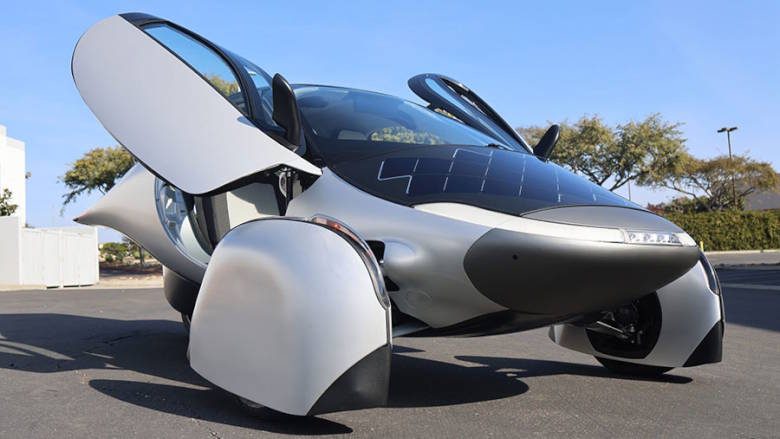
The solar-powered vehicle generating the most buzz in the United States is the long-awaited Aptera. In March, the first $40,000 microcar came off the assembly line at the company’s factory in southern California—an important step as it moves toward regulatory approval and the first customer deliveries.
The three-wheeled vehicle, which has been in development for over 15 years, relies on multiple solar panels to cut down on the need for grid charging. The panels wrap around the body, hood, and roof of the distinctive vehicle, which offers a range of up to 400 miles from a charge that takes less than an hour.
Aptera’s aerodynamic carbon-fiber composite body is covered with 3 square meters of solar cells. At least 90 percent of the energy captured by the panels goes directly toward driving the lightweight two-seater, which can go from 0 to 60 mph in 6 seconds and reach a top speed of 101 mph.
Aptera assembles its custom solar panels at its own facility. It plans to supply them to Telo Trucks, a start-up preparing to scale up production of a compact electric pickup called the MT1.
The vehicle’s efficiency is driven by power electronics that convert solar energy into cylindrical battery cells from LG Energy Solution. CTNS Co. manufactures the modules, which Aptera then integrates into battery packs.
“We’ve just finished the first vehicle from our low-volume validation assembly line,” says Chris McCammon, head of marketing at Aptera Motors Corp. “We’re aiming to begin customer deliveries by the end of this year, with production scaling up in 2027. As noted in our SEC filings, this timeline depends on securing the necessary funding.”
Aptera’s 77,000-square-foot plant in Carlsbad, California, is designed to manufacture as many as 20,000 vehicles annually, with a new car completed every 12 minutes.
“We use a streamlined, microfactory assembly method,” says McCammon. “This means we don’t need welding robots, heavy machinery, or a paint shop—our cars are wrapped rather than painted. The setup is compact and adaptable. [In the future, we intend to] duplicate this model in other sites with about 100,000 square feet to expand global vehicle deliveries.”
“Our current validation assembly line has 14 workstations,” McCammon notes. “Here, we assemble batteries, solar panels, and vehicle bodies. The chassis and body lines merge at station five, then proceed through station 14 to form a complete vehicle. All other parts arrive as pre-assembled subsystems from our supply chain.”
“For initial low-volume production, we won’t use automated guided vehicles (AGVs),” McCammon adds. “But [we plan to adopt] AGVs for high-volume production later.”

Aptera aims to mass-produce solar-powered microcars at a southern California facility. Photo courtesy Aptera Motors Corp
Some Suppliers Embrace Solar Power
Several leading automotive suppliers are optimistic about solar-powered vehicles. Their engineers are actively developing advanced technology.
AGC Automotive Europe has created a panoramic glass roof with a glass-glass design featuring high-efficiency back-contact solar cells and a sleek, all-black look. Solar cells are embedded between two thin glass layers.
“This integrated photovoltaic panoramic sunroof allows plug-free charging while driving or parked in sunlight, increasing vehicle range year-round,” explains Loïc Tous, R&D project manager at AGC Automotive. “It adds real value by enhancing daily comfort and convenience while reducing reliance on charging stations and lowering CO2 emissions.”

Back-contact solar cells combined with a low-emissivity coating on the inner glass improve thermal comfort in EVs and maintain a uniform black appearance. Illustration courtesy AGC Automotive Europe
“[It] provides more headroom and significant weight savings over roofs with traditional roller-blind systems,” says Tous.
Since most traditional rooftop solar panels use silicon-based cells, they’re heavy and rigid. To meet demand for lighter, more flexible subassemblies, Aisin Corp. engineers are developing perovskite solar cells.
Perovskite refers to a crystal structure. Materials with this structure exhibit various electrical and magnetic properties. Its simple composition allows synthesis from multiple substances.
These next-generation solar cells feature a power-generating layer of organic perovskite material just 0.001 millimeters thick. Beyond being thin and lightweight, they’re flexible and bendable.
Perovskite cell efficiency now matches silicon-based cells. They generate power even in low-light conditions like indoors or cloudy days. Their simple manufacturing process—painting or printing onto substrates—enables cost-effective mass production of automotive solar panels.

Perovskite solar cells (right) are lightweight, flexible, and inexpensive to produce at scale. Illustration courtesy Aisin Corp.
Earlier this year, Metyx Composites won a JEC Composites Innovation Award for its new automotive PV modules.
According to Ugur Ustunel, CEO of Metyx, traditional glass PV modules are heavy, fragile, and hard to integrate onto curved vehicle surfaces. “Vehicle-integrated photovoltaics need materials that are lightweight, impact-resistant, and adaptable to complex shapes,” he explains.
Metyx engineers addressed this by replacing glass with lightweight, impact-resistant composites, creating PV modules that function as structural vehicle components rather than add-ons.
They developed a completely glass-free module using fiber-reinforced composites: a highly transparent glass fiber-reinforced polymer front sheet and lightweight carbon fiber-reinforced polymer sandwich back sheet. Unlike traditional multi-step lamination, Metyx’s modules use a single-step vacuum infusion process.
“Lightweight composites combine structural performance, optical functionality, and design flexibility, making them perfect for turning vehicle surfaces into energy-generating components without adding weight or compromising safety,” says Ustunel.
“This technology overcomes a major solar vehicle hurdle: glass modules’ incompatibility with vehicle design,” Ustunel explains. “Composite PV modules enable energy generation on roofs, hoods, and side panels, supporting off-grid operation, extending range, and powering auxiliary systems.”
“This opens new mobility architectures where energy generation, structure, and design merge into one integrated system,” Ustunel adds.
At the 2026 Consumer Electronics Show in Las Vegas, Solarstic earned an award for its injection-molded vehicle solar module. The South Korean startup has collaborated with Hyundai on PV-integrated hoods and roofs.
Solarstic’s low-pressure injection-molding process safely encapsulates delicate solar cells. This eliminates glass weight and design limitations, allowing seamless integration on curved or complex exteriors while preserving original character lines with embedded solar functionality.
When installed on vehicles, Solarstic’s module generates power while driving and parked. This supplemental charging extends range, reduces charging station visits, and lowers overall costs.
The module supports various solar cell types and can be tailored to specific vehicle models and design needs, giving automakers a flexible, scalable approach to next-generation solar-integrated mobility.

Low-pressure injection molding safely encapsulates fragile solar cells, enabling seamless integration on curved or complex vehicle exteriors. Photo courtesy Solarstic
Webasto is another supplier advancing solar technology for electric vehicles. It recently introduced EcoPeak, a roof concept showcasing how lightweight construction and solar energy combine in one system.
“We use up to 80% sustainable and recycled materials,” says Erhart. “[It] also achieves up to 40% weight savings versus conventional roof systems. The concept maximizes solar area by covering both the roof and rear window, providing up to 350 kilowatt-hours of solar energy annually—equivalent to roughly 1,553 miles of range depending on vehicle type and climate.”
“Including the rear window in the solar-capturing area gives EcoPeak a larger active surface than typical solar roofs,” Erhart notes. “The system substitutes glass and aluminum with bio-mass balanced polycarbonate and lightweight polymers, significantly reducing weight while improving energy efficiency and driving dynamics.”
“The concept features an advanced integrated roller-blind system made from recycled polyethylene terephthalate bottles, enhancing comfort and shading while supporting circular material flows,” Erhart explains. “Its rapid CO₂ payback—about two years in favorable conditions—sets it apart from earlier automotive solar systems.”
For more on electric vehicle manufacturing, see these articles:
