



As robots and humans increasingly work together on the factory floor, industrial automation is growing more sophisticated. This added complexity restricts the use of collaborative robots in labor-heavy operations, such as automotive trim and final assembly.
Whenever a new vehicle model is introduced, production lines often need to be extensively reworked. Time is of the essence, and every setback comes with a hefty price tag. Digital twin technology offers engineers a powerful way to address this challenge.
“In many respects, launching a new vehicle has turned into a race against the clock,” says Ali Ahmad Malik, Ph.D., an assistant professor of industrial and systems engineering at Oakland University who has been researching this area. “Underneath the complexity is a manufacturing system that must be set up, reconfigured, retested and revalidated—often under enormous pressure.”
“Engineers put in long hours integrating new robots, sensors and control systems while production deadlines draw near,” explains Malik. “A single flaw in control logic or an off-target robot trajectory can shut down an entire line, costing the company thousands of dollars per minute.”
“Ramping up and reconfiguring systems can result in weeks of downtime, unforeseen errors during commissioning and expensive on-site troubleshooting,” Malik notes. “For instance, adding a new robotic welding cell might demand hundreds of hours of hands-on code verification and safety checks.”
“These difficulties have only grown with the move toward cutting-edge vehicle designs—lightweight materials, self-driving technologies, compact yet powerful engines and software-defined vehicles,” says Malik. “At the same time, emerging manufacturing approaches like lights-out production, human-robot collaboration, industrial IoT and smart factories are forcing manufacturers to rethink conventional processes at every stage.”
Oakland University recently introduced a Master of Science in Smart Manufacturing program that incorporates Industry 4.0 technologies aimed at building intelligent, adaptive and efficient production systems. The program allows engineers to concentrate on several specialization tracks, including artificial intelligence, augmented/virtual reality, collaborative robotics and digital twins.
Looking for quick answers on assembly and manufacturing topics?
Try Ask ASM, our new smart AI search tool.
Ask ASM
“A digital twin is a virtual replica of a physical assembly system that serves as a ‘front runner’ for validation and control across its design, build and operation,” says Malik. “As a digital model capturing both the components and behavior of a real system, digital twins are made possible by advances in virtualization, sensor technology and computing power.”
Malik’s recent research, supported by a grant from Festo Corp., investigated how digital twin technology can shorten development timelines, reduce complexity and streamline reconfiguration efforts. He studied the impact of digital twins on human-robot assembly systems at a manufacturing plant in Denmark.
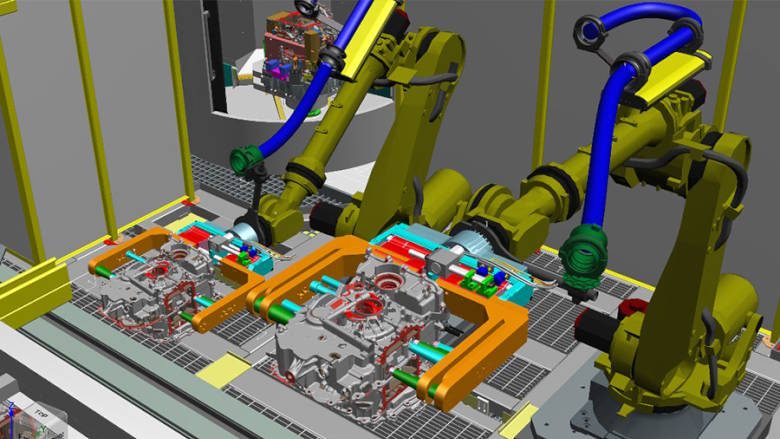
Malik built a digital twin model linking two connected environments—one physical and one digital. The digital environment was a three-dimensional virtual model of the human and robot, while the physical environment represented the actual production setup made up of humans, robots and other equipment.
During the design phase, a digital twin was used to choose the assembly system resources that matched production needs and their relationship with the rest of the system. Dynamic simulation demonstrated that the digital twin can progressively evolve from manual data synchronization to automated, real-time data, thereby increasing its value at the system level.
“A digital twin can guide the optimized performance of a physical system by building its precise, time-based virtual model and running simulations,” says Malik. “Whenever a production parameter in the physical system is altered, new variables are simulated to forecast future behavior and identify necessary optimizations.”
“This behavior can be visualized and evaluated without any risk of financial loss or injury to personnel that would otherwise exist in the real production environment,” Malik emphasizes.
“The behavior can be visualized and assessed without the risk of any financial loss or human injury that may otherwise be present in the real production.”
– Ali Ahmad Malik, Ph.D.
“Progress in virtualization, sensor technologies and computing power has advanced the concept of digital twins,” explains Malik. “A digital twin is a high-fidelity, reliable and fit-for-purpose computational model of a complex manufacturing system.”
“Simulations featuring highly accurate, richly detailed and versatile environments of large-scale real-time systems, when paired with smart sensor feedback and machine learning techniques, can be considered digital twins,” says Malik. “They can be applied to design, verify, optimize and validate a manufacturing system’s operational dynamics during the early design phase, commissioning, reconfiguration and end-of-life stages.”
One key use of digital twin technology is virtual commissioning. It is carried out using software-in-the-loop and hardware-in-the-loop methods, which substitute all or some of the hardware with simulated or emulated components to build a virtual manufacturing system that closely mirrors the real one.
Virtual commissioning can speed up changeovers and simplify system reconfigurations. The same models can also be refined to develop control programs, robot code, safety system verification and CNC machine instructions.
“Building a digital twin is not a simple task, due to a range of associated challenges,” Malik observes. “There is no single, universally accepted definition. Moreover, the nature and depth of detail of a digital twin depend on the specific use case it is designed to serve.”
“A practical strategy for digital twin development involves applying standards to ensure consistent digital representation, data exchange and interoperability,” says Malik. “Examples include ISO 23247 for virtual representations, IEC PAS 63088 for data modeling, ISO 10303-242 for 3D engineering data exchange and USCAR-53 for unified industrial communication in automotive manufacturing.”
ISO 23247 outlines the general architecture for digital twins in manufacturing. IEC 63278-1 (asset administration shell) provides structured digital representations of assets. ISO 10303-242 extends the STEP (Standard for the Exchange of Product model data) standard to enhance semantic interoperability in industrial automation. SAE/USCAR-53 further supports standardized machine-level communication through data models and protocols such as MQTT (Message Queuing Telemetry Transport) and JSON (JavaScript Object Notation).
In one R&D project that Malik led with the United States Council for Automotive Research, a robotic assembly system for an automotive manufacturer was virtually optimized, debugged, verified and validated. This approach cut the physical commissioning process down by weeks.
The effort involved creating detailed simulations of automated conveyor lines, robotic cells with modular grippers and CNC machining centers. Multiple simulation and emulation tools from different vendors were combined to produce a high-fidelity digital twin.
It delivered not only visualization and robot motion analysis, but also interference detection, real-world robot calibration, offline robot programming, CNC emulation, control logic, drive systems, HMI interfaces and safety validations.
“A frequent concern among manufacturers is the return on investment of digital twins,” says Malik. “A structured evaluation compares development costs—covering software, hardware and expertise—with measurable gains such as shorter changeover times, fewer errors, faster commissioning and greater flexibility.”
“When deployed effectively, the resulting improvements in efficiency and quality can far outweigh the upfront investment, making a compelling business case for digital twins,” Malik adds.
