



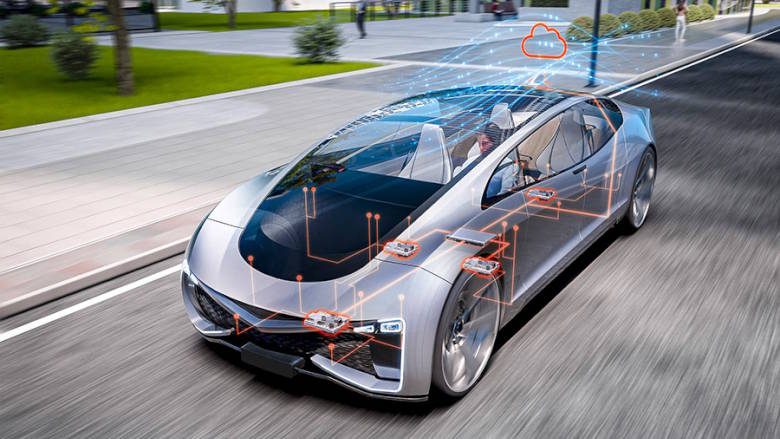
The power electronics system of an electric car governs how electrical energy travels from the battery to the motors and other components. It supplies power in a precise, controlled way, at a set voltage and with a specific AC or DC current waveform.
For instance, an onboard battery charger regulates the flow of electrical energy from the AC charging network into direct current that is compatible with the battery. This process demands efficient power factor correction and requires galvanic isolation to maintain safety.
The task is made more complex because the charger must work with residential single-phase AC charging, commercial three-phase charging, and newer DC interfaces that bypass the charger altogether. Increasingly, the onboard charger may also offer bidirectional capability to support vehicle-to-grid and vehicle-to-load functions.
Demand for power electronics is projected to expand over the next decade, fueled by rising demand for electric vehicles and data centers. A recent IDTechEx report forecasts the market will grow 10 percent per year, reaching $65 billion by 2036.
Automakers are pursuing higher efficiency, dependable reliability, and greater power density. Increasingly, this means adopting wide bandgap semiconductors, silicon carbide (SiC) and gallium nitride (GaN). These technologies have the potential to transform the power electronics industry, supporting high-voltage operation and new power architectures, such as 800-volt systems.
“The traction inverter converts high-voltage direct current from the battery into a precisely controlled three-phase alternating current that powers electric motors,” says Matthew Fall, technology analyst at IDTechEx. “Torque and speed are precisely managed, ranging from a standstill to rotational speeds of thousands of RPM.”
Software control of the traction inverter is a critical factor that determines the efficiency and thermal performance of electric vehicles, so it remains a closely guarded secret for most OEMs.
Looking for quick answers on assembly and manufacturing topics?
Try Ask ASM, our new smart AI search tool.
Ask ASM
EV Applications
The main application for SiC is the inverter, which converts DC power stored in an EV battery into AC power for traction motors.
SiC’s bandgap of 3.26 electron volts (eV) compared to 1.12eV for silicon (Si), along with three times higher thermal conductivity, allows for smaller power electronics components, which lowers on-resistance and switching losses. This enables switching frequencies above 50 kilohertz. Silicon insulated-gate bipolar transistors (IGBTs) are typically limited to below 20 kilohertz, which enhances motor control and reduces the size of passive components needed.
“However, SiC remains a more costly material than silicon, so many budget EV models have yet to adopt the technology,” notes Fall.
Inverters convert DC power stored in an EV battery into AC power for traction motors. Illustration courtesy General Motors
A DC-DC converter reduces high-voltage power from the main battery to a lower voltage to run auxiliary devices, such as air conditioning and infotainment systems. It also provides galvanic isolation between high-voltage and low-voltage components. DC-DC converters have strict reliability requirements, because they must operate continuously across all vehicle states, from when the ignition is not even on to peak power demand during rapid acceleration.
“Increasingly, the DC-DC converter and onboard battery charger are being combined into the same system, lowering component count and assembly complexity,” says Fall. “However, this introduces complexity as both [devices] must be electrically isolated for safety.
“Power electronics manufacturing varies depending on the material,” explains Fall. “Silicon has traditionally been the preferred semiconductor material for EV applications at both high and low voltages. With mature, diverse supply chains and decades of manufacturing refinement, silicon is the most affordable semiconductor material for power applications. Silicon carbide is more complex and expensive.”
Silicon carbide cannot be grown from a melt. The primary crystal growth method for SiC is physical vapor transport, where SiC powder sublimes and recrystallizes on a seed crystal under tightly controlled temperatures.
While 300-millimeter Si wafers are standard, SiC wafers are commercially available at only 200-millimeter, which reduces the number of dies available per wafer. However, Wolfspeed Inc. recently announced that it has developed a 300-millimeter SiC monocrystalline wafer.
Thermal and mechanical interfaces between the semiconductor die and substrate are typically achieved with silver sintering. Interconnection is accomplished through wire bonding, using either aluminum or copper. Whether wire or ribbon is used depends on the specific power module, which is encapsulated in epoxy resin and attached to a metal frame for improved thermal management before it’s mounted to a printed circuit board (PCB).
According to Fall, there is significant variability in the materials and processes used in module packaging. This affects device performance, thermal management, and the module’s ability to perform in demanding automotive environments.
“Components must be tested extensively,” Fall points out. “The power electronics automotive qualification process represents one of the most demanding series of reliability tests in engineering, involving extremes of temperature and mechanical stress, with operational lifetimes measured in decades.”
Qualified power modules are then assembled into complete inverters, onboard battery chargers, or DC-DC converters. That process involves module mounting, thermal interface material application, attachment of cold plates, electrical interconnection, and system-level testing.

BYD’s “8-in-1” power train combines an onboard charger and DC-DC converter, along with six other components, into a single assembly module. Illustration

By sourcing from multiple suppliers, General Motors minimizes the risk of production halts caused by semiconductor shortages affecting inverters and other critical components. Photo courtesy General Motors
GM’s Hybrid Strategy for Power Electronics
General Motors is striking a balance between keeping key operations in-house and drawing on a worldwide network of suppliers as it ramps up power electronics production for its growing electric vehicle range. The company works closely with leading Tier One suppliers for essential parts, while its overall approach blends outsourced assembly of electronics with hands-on system integration at the vehicle and subassembly stages.
For GM, power electronics cover a broad category of high-voltage systems, including onboard chargers, inverters, accessory power modules, and wiring harnesses.
“In my view, anything high-voltage that isn’t the battery falls under power electronics,” says Bethany Combs, a power electronics design system engineer at GM. “These systems are at the heart of how the vehicle runs, handling everything from energy conversion to propulsion and charging across all our EV platforms.”
Suppliers handle the most intricate steps of electronics production—especially those that demand clean room settings and extreme precision. They ship fully assembled, sealed units ready to be built into larger vehicle systems.
Once those units arrive at GM, the focus shifts to putting everything together at the system level. On truck platforms, for instance, power electronics modules are attached to cradles and supporting structures before being sent to final assembly plants, where they’re installed alongside the rest of the vehicle’s major systems.
This step-by-step approach lets the automaker separate the highly complex work of electronics manufacturing from the final vehicle build, while still keeping tight control over how everything fits together and gets validated.
There are also cases where GM carries out more direct assembly of exposed electronics. Inverter systems, for example, may be built into drive units before the final installation step. Since these parts can be partially uncovered during assembly, workers need to exercise extra caution when handling and testing them.
Even though the technology behind these systems is sophisticated, the hands-on assembly process is fairly straightforward compared to the advanced manufacturing done by suppliers upstream. While automation plays a major role, it isn’t the whole story.
Human operators still play a part in important steps like placing components and kicking off assembly sequences, all backed by a series of manufacturing controls designed to keep things consistent and traceable.
“An operator still needs to grab the parts from the pallet and set them into the drive unit or the cradle directly,” Combs explains.

Steady advancements in power electronics are expected throughout the coming decade. Illustration courtesy IDTechEX
This blend of automated processes and human involvement mirrors where EV manufacturing stands today—differences in the size, weight, and layout of components make full automation difficult. Alongside those practical limitations, rigorous controls are enforced throughout assembly, driven by the safety and reliability demands of working with high-voltage systems.
Managing the supply chain is another critical piece of the puzzle for this approach. Power electronics depend on a sprawling global supplier base, with semiconductors being a notable weak link. Following the widespread disruptions triggered by the COVID-19 pandemic, GM has sharpened its focus on strengthening supply chain resilience, especially when it comes to securing chips.
A dual-sourcing approach gives the company the flexibility to offer suppliers alternative components that match the same performance and packaging standards, reducing the likelihood of production slowdowns. GM has also set up a specialized semiconductor team dedicated to tracking supply conditions and staying ahead of potential shortages.
Tracking the origins and history of every component is another pillar of the automaker’s supply chain strategy. Suppliers keep thorough records of where parts come from and how they were made, allowing GM engineers to trace any problems back to their origin if defects are discovered. This transparency is especially valuable given how spread out the supply chain is, with components potentially sourced and produced across several different regions.
Quality control has grown more sophisticated to keep pace with this added complexity, even though many of the fundamental principles haven’t changed. Early issues with EV power electronics often centered on solder joints and PCB manufacturing—areas where well-established industry standards were already in place.
As electric vehicle production has scaled up, GM has drawn on those existing standards to develop stronger quality assurance systems. Regional supplier quality teams work side-by-side with manufacturing partners to provide on-site supervision, making sure production lines meet all required specifications and that process controls are applied uniformly across every facility.
When it comes to system-level integration, technical requirements and cost considerations both play a role in shaping the final decisions.
Although GM has created its own internal designs previously, the high demands of large-scale electronics production make outsourcing the more practical choice for many parts.
“It’s more logical to obtain modules from a Tier One supplier,” explains Combs. “This way, we can concentrate on integrating systems and enhancing overall vehicle performance, while our partners manage the intricate details of electronics manufacturing.”
At the same time, the automaker maintains control over critical subcomponents and technical specifications, guaranteeing that all systems align with goals for performance, affordability, and dependability.
Combs explains that upcoming improvements in power electronics for GM’s EV platforms will likely stem more from fine-tuning than from major manufacturing advances. She highlights cost efficiency and real-world customer needs as the main priorities, pointing out that not every technological leap—like ultra-fast charging—matches actual market demand.
“Our main priority is definitely cost—making power electronics as affordable as possible while still meeting what customers actually need,” Combs states.
This focus mirrors a larger trend in the EV industry, where initial waves of innovation are now shifting toward refinement and mass production.
As power electronics grow more standardized and integrated, GM and other carmakers face the ongoing challenge of staying flexible and resilient within increasingly intricate supply chains, all while delivering solutions that satisfy a wide range of changing customer expectations.
:

Infineon relies on automation to maintain consistent quality and output. Photo courtesy Infineon Technologies AG
Infineon’s Comprehensive System Support
Infineon Technologies AG is a top provider of automotive microcontrollers and power systems, offering components made from silicon (Si), silicon carbide (SiC), and gallium nitride (GaN). Their extensive lineup includes power modules, individual devices, and bare dies.
These parts are vital for key applications like onboard battery chargers, DC-DC converters, and inverters found in both fully electric and hybrid vehicles.
“We provide complete system support for automakers—not just power switches, but also essential supporting parts like microcontrollers, drivers, and sensors,” says Stefan Obersriebnig, business line head for ATV high voltage at Infineon. “This allows us to deliver finely tuned systems that smoothly combine sensing, control, and actuation.”
Infineon’s semiconductor production is split into frontend and backend stages. The company runs its own large-scale fabrication plants in Dresden, Germany; Kulim, Malaysia; and Villach, Austria. Backend operations—such as assembling HybridPACK Drive Generation 2 power modules—take place in Cegled, Hungary, and Warstein, Germany.
“The frontend, where chips are made, demands the strictest cleanroom environments, so it’s heavily automated to reduce contamination, boost precision, and lower costs,” Obersriebnig explains. “The backend, where devices are packaged and assembled, also follows cleanroom protocols, though with slightly relaxed standards. We use automation to ensure both quality and cost efficiency.”
“Our vertically integrated supply chain guarantees a steady chip supply, stable manufacturing, and reliability for our automotive clients, while also letting us streamline production costs,” Obersriebnig adds. “We depend on tightly managed production schedules and consistent processes—automated wherever feasible—to maintain uniform quality and high yields.”
Infineon also excels in hall-sensor-based current measurement devices, which simplify assembly for customers and save space within the vehicle.
“All these approaches together lead to real reductions in manufacturing complexity and expense, helping speed up electrification without sacrificing quality,” Obersriebnig asserts.
The company uses advanced simulation and modeling tools to refine designs before building physical prototypes.
“In addition to conventional simulation, we provide virtual reference designs and comprehensive component libraries, enabling engineers to simulate complex analog systems,” Obersriebnig notes. “These digital resources allow for faster design cycles, cut development time and risk, and foster innovation.”
As the automotive sector embraces more digital and AI-powered design methods, Obersriebnig sees these tools as crucial for achieving top-quality, optimized EV power electronics and accelerating development. That’s because demands for lower cost, better performance, and faster turnaround are pushing advances in packaging and assembly techniques.
“We expect wider use of molded packages and PCB-based solutions with embedded chips for both Si and SiC technologies,” says Obersriebnig. “Emerging materials like GaN are also poised to play a bigger role in automotive uses, unlocking next-level efficiency and power density.”
“As these technologies evolve, manufacturing will become even more automated, integrated, and digitalized to handle higher volumes, tighter tolerances, and reduced costs,” Obersriebnig predicts.

Power electronics must be fine-tuned across electrical, thermal, and mechanical aspects. Illustration courtesy Aumovio Engineering Solutions
Aumovio Prioritizes Adaptability
As EV platforms continue to evolve, suppliers are increasingly judged by their ability to manage both integration and complexity. Power electronics are no longer isolated parts—they’re interconnected systems that must be optimized across electrical, thermal, and mechanical dimensions.
The task for automotive engineers is to develop and produce systems that meet shifting performance demands while staying scalable, reliable, and cost-effective.
Aumovio Engineering Solutions became an independent company after separating from Continental AG in September 2025. Since then, it has established itself as a leading EV power electronics supplier, specializing in high-performance power conversion systems for diverse vehicle types.
Instead of just providing off-the-shelf components, Aumovio focuses on customizable, application-specific solutions built around bidirectional converters, multi-level inverters, and fully electrified drivetrains. Their broad product range covers voltages from 48 to 1,000 volts and includes traction inverters, DC-DC converters, starter generators, and high-voltage energy recovery systems—plus specialized parts like spark generators for exhaust heat management.
“This wide scope reflects our system-level philosophy: components aren’t designed in isolation but as integral parts of a larger architecture,” says Neil Cheeseman, chief engineer for electric drivetrain and propulsion at Aumovio.
“Most projects demand a system-level mindset,” Cheeseman explains. “Our tailored design process ensures that interacting parts work together seamlessly to minimize energy losses, maximize efficiency, and cut cooling needs and overall system costs.”
From a manufacturing standpoint, Cheeseman notes that the complexity of power electronics comes less from production volume and more from the number of subassemblies and the strict requirements of high-voltage operation.
For instance, a standard inverter incorporatesHere is the paraphrased version:

Tier One suppliers are developing solutions that fulfill the changing demands of EVs, while ensuring they remain scalable, dependable and cost-effective. Photo courtesy Aumovio Engineering Solutions
“When it comes to an inverter, there are more subassemblies involved,” explains Cheeseman, referencing the extra parts needed to handle power conversion and measurement. Sourcing high-voltage components also brings limitations, since essential parts like power modules and capacitors come from only a select group of specialized manufacturers.
Production volumes at Aumovio generally fall in the low thousands annually, with prototype and small-batch builds managed in-house and larger-scale production handled by other divisions of the company. This blended approach mirrors the wide range of applications they serve, which often prioritize customization over high-volume output.
Design considerations further increase the difficulty. Fast switching speeds and elevated voltage levels demand thoughtful PCB layout to handle electromagnetic interference and maintain proper creepage and clearance distances, all while working within the compact space requirements of automotive packages. These concerns must be tackled at the earliest stages of product development to prevent complications later in manufacturing and performance.
Simulation is at the core of tackling these obstacles. Aumovio depends extensively on digital engineering tools to simulate electrical and thermal performance under various operating scenarios, allowing engineers to fine-tune performance and durability before building any physical prototypes.
“By precisely simulating temperature and voltage extremes during the design phase, we can enhance performance while extending product lifetime and reliability,” explains Cheeseman. “AI adds further value by offering deeper understanding of how different components in power electronics behave.”
This allows engineers to test various configurations and control approaches far more rapidly than conventional methods allow. These simulation platforms also assist with system calibration and verification. For example, hardware-in-the-loop testing lets teams measure converter responsiveness in real time before committing to more expensive dynamometer testing, lowering development risk and accelerating schedules.
Like other companies in the supply chain, one of the biggest hurdles involves system integration, especially as the automotive sector transitions toward “X-in-1” designs that merge several functions into one housing. While this consolidation lowers costs and streamlines vehicle design, it also creates new challenges on the manufacturing floor.
“The toughest challenge in putting together today’s power electronics is system integration,” states Cheeseman. “Combining parts like an electric motor and inverter into one unit may require those pieces to move into controlled environments such as clean rooms, which raises costs and complicates the workflow.”
Meanwhile, climbing battery voltages are stretching the boundaries of current component technology. As systems near 1,000 volts, the power modules available—whether built on IGBT or silicon carbide—do not always meet the needs of upcoming designs.
Power modules above 1,200 volts are not yet accessible, which leads to engineering challenges such as handling voltage stress in tightly packed spaces. Overcoming these obstacles often demands close cooperation with suppliers, especially for components like DC link capacitors, where keeping parasitic inductance low is essential.
Cheeseman anticipates that manufacturing processes will move toward higher integration and fewer discrete components down the road. For instance, by building high-current switching elements straight into PCBs—particularly in 48-volt systems—producers will be able to streamline assembly, enhance heat dissipation, and shrink the overall system footprint.
“Power electronics manufacturing is moving in the direction of simpler assembly and greater integration,” says Cheeseman. “These developments [will] make production more efficient, while aligning with the wider industry push toward more compact, efficient and affordable electrified powertrains.”
To learn more about electric vehicle manufacturing, check out these articles:
Zonal Wiring Architecture Will Make EVs Easier to Assemble
Next-Generation Line Layouts Improve Efficiency
Gigacasting: The Next Big Idea in Automotive Manufacturing?
