



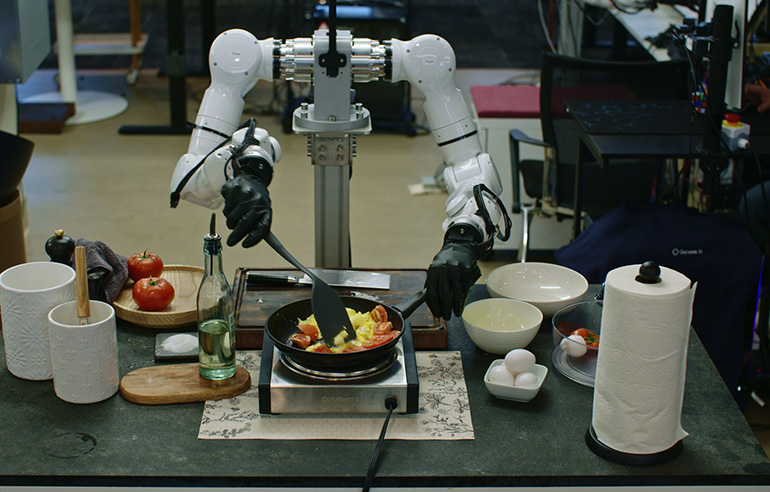
The GENE026.5 robot brain enables dexterous, two-handed cooking. Source: Genesis AI
After years of steady progress, robots are becoming far more skillful at handling objects, driven by breakthroughs in artificial intelligence. Genesis AI has now introduced GENE-26.5, a system it says grants robots “human-level physical manipulation capabilities.”
The San Carlos, California-based company also revealed a method to “unlock unlimited amounts of data” and train GENE-26.5 at large scale. This method brings together two proprietary elements: a new data engine and a human-scale robotic hand that allows skills to be transferred directly from people to robots.
“Together, these innovations remove the fundamental data bottleneck that has held back robotics foundation models, opening the door to a new wave of highly capable general-purpose robots,” Genesis AI stated.
“The brain and hand are the two most critical and intricate components in robotics, and today we are unveiling the industry’s most advanced versions of both,” said Zhou Xian, co-founder and CEO of Genesis AI. “For the first time, we’re enabling robots to perform tasks that only human hands could do before, and to do so reliably and at scale.”
The startup came out of stealth mode with $105 million in funding last year. Genesis AI describes itself as a “global full-stack robotics company building general-purpose robots with human-level intelligence and capabilities.”
GENE-26.5 built for demanding robot tasks
“GENE-26.5 is an AI foundation model, purpose-built for robotics and designed to absorb massive amounts of data across diverse environments,” Genesis AI explained. It is meant to allow robots to carry out complex, multi-step tasks with human-level dexterity. The company said GENE-26.5 represents progress toward a future where robots can be rapidly deployed and adjust to new settings and unfamiliar tasks.
To showcase GENE-26.5’s abilities, Genesis AI released a video of its system displaying fluid, human-like dexterity and precise, coordinated hand movements for a variety of complex tasks:
- Cooking a 20-step meal, including chopping tomatoes, cracking an egg with one hand, and coordinating both hands
- Making a smoothie, including handling ingredients, pouring, blending, and serving mid-air with coordinated hand control
- Carrying out high-precision lab experiments with delicate instruments, including pipetting, transferring liquids, and mid-air manipulation
- Wire harnessing, arranging and securing wires into organized bundles, which Genesis AI described as one of the most challenging tasks in electronics and electrical engineering
- Solving a Rubik’s Cube, using continuous in-air manipulation that demands coordinated, high-speed reasoning and precise wrist control
- Single-handed multi-object grasping, simultaneously handling four objects of different sizes and sorting them into designated bins
- Playing the piano at a human level, performing an ultra-fast, highly complex composition
Genesis AI said it has demonstrated that GENE-26.5 can equip robots with a broad range of complex skills and a level of physical manipulation that was previously unattainable.
“General-purpose robotics has the potential to reshape the global economy while opening an entirely new chapter for AI,” said Eric Schmidt, former CEO of Google and an investor in Genesis AI. “Genesis is driving a paradigm shift in robotics. This marks an important milestone for their team and the robotics industry as a whole.”
Robotic gripper modeled after the human hand
“The embodiment gap, or the difference between the human form and robotic form, has always severely limited robots’ performance and their ability to learn from human data,” Genesis AI noted.
The company has tackled these limitations with its proprietary hardware designed to match the human hand. The end effector replicates the human hand in both form and function, and it works alongside a data-collection glove fitted with tactile-sensing electronic skin.
“When worn by a person, the glove enables a 1:1:1 mapping between the glove itself, the person’s hand, and the robotic hand,” Genesis AI explained. “This allows people to seamlessly feed GENE-26.5 high-quality data at scale that translates into robotic skills. The result is natural, human-like movement that generalizes reliably across complex physical tasks, use cases, and environments.”
Editor’s note: At the 2026 Robotics Summit & Expo this month in Boston, there will be keynotes, sessions, and exhibits on embodied and physical AI. Register now to attend.

Affordable hardware to scale up data collection
Genesis AI also said its glove costs 100 times less than typical hardware and has shown up to five times greater data-collection efficiency than traditional teleoperation methods in internal testing. The company said this approach makes affordable, continuous, large-scale robotics training possible.
The company said it is working with partners to deploy the glove in real-world work environments. By simply wearing the glove while going about their regular tasks, everyday activities can become sources of new categories of training data to build what Genesis AI described as potentially the world’s largest human skill library.
In addition, Genesis AI‘s data engine draws on egocentric video footage from people wearing cameras to capture how they interact with the world, as well as vast quantities of human-based internet videos. The company said its approach will leverage these data sources to help its foundation model learn more efficiently and enable robots to handle more complex tasks.
“At Genesis, we believe succeeding in robotics demands excellence at every level,” said Theophile Gervet, co-founder and president of Genesis AI. “That’s why
“
We’re passionate about driving innovation across the entire technology stack, from AI all the way down to hardware. By managing every component ourselves, we can create a unified system and tackle challenges from a complete perspective. This strategy provides us a significant edge by leveraging massive volumes of data, which ultimately determines the capabilities of foundation models.”
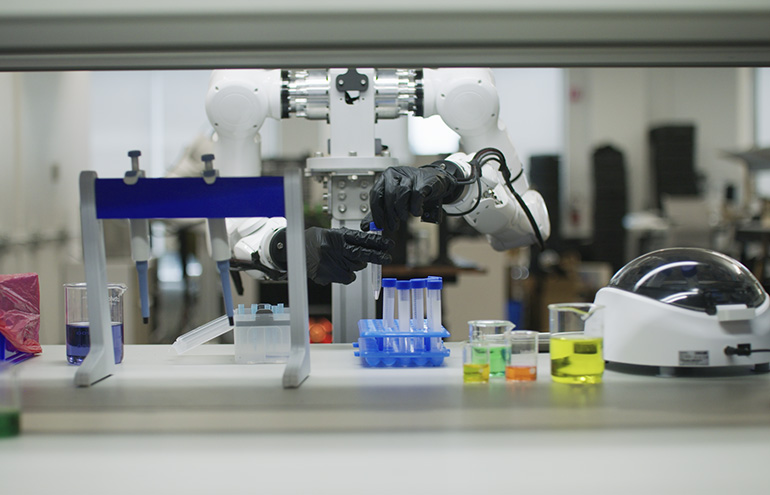
GENE showcases automated lab pipetting. Source: Genesis AI
GENE leverages simulation to speed up training
“Building robots has traditionally been one of the most hands-on tasks in engineering,” explained Genesis AI, which has built a simulation platform designed to bridge the gap between virtual environments and real-world conditions. The company stated that its advanced rendering engine and ultra-realistic physics simulations will produce precise and dependable models of actual scenarios, allowing robots to carry out tasks just as they would in reality.
According to the company, this advanced simulation capability will speed up the creation, testing, and refinement of its robotic AI systems. Development teams can train and assess models far more quickly than through conventional physical trials, which tend to be time-consuming, costly, and hard to expand, Genesis AI noted.
“Genesis is reshaping the future of robotics, moving us toward AI that can function effectively in everyday environments,” said Vinod Khosla, founder of Khosla Ventures and an investor in Genesis AI. “With its revolutionary foundation model driven by a human-focused data engine and its unique simulation technology, Genesis is set to dramatically accelerate development timelines and enable rapid deployment for commercial clients.”
Genesis AI announced that it will soon unveil its first multipurpose robot built on the technology revealed today. The company receives backing from Eclipse, Bpifrance, and HSG, along with tech leaders including Eric Schmidt and Xavier Niel, and AI experts Daniela Rus and Vladlen Koltun.
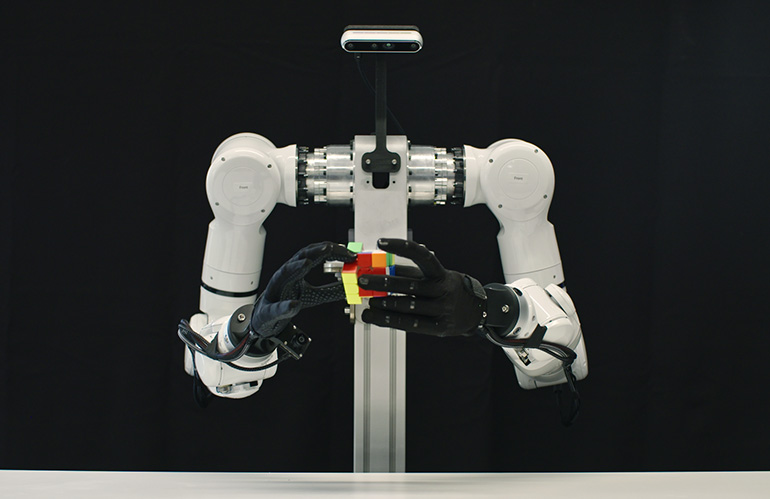
Genesis AI’s foundation model allows its robot to solve a Rubik’s Cube. Source: Genesis AI
“
