




Historically, crypto markets have been driven by a dominant narrative. Not today.
In one corner, miners are trying to break free of four-year cycles. IREN is being recast as an AI infrastructure company, with analysts pointing to data centers and compute demand as the real growth engine. In another corner, BitMine is doing the exact opposite, pouring billions deeper into Ether (ETH) even as losses mount.
The disconnect doesn’t stop there. Stablecoin balances have ballooned to over $300 billion, yet activity has dropped sharply. It reflects capital waiting, with no clear consensus on what comes next.
Meanwhile, institutions are building a parallel track. Tokenized Treasurys are now being used as collateral on exchanges, linking traditional finance and crypto markets more tightly than ever.
This week’s Crypto Biz delves into a market pulling in different directions.
Bernstein sees IREN pivoting from Bitcoin mining to a $3.7B AI cloud business
Analysts at Bernstein are reframing the story around IREN, arguing the company’s future may depend less on Bitcoin (BTC) mining and more on building out AI-focused data center capacity.
In a new report, Bernstein highlights IREN’s access to large-scale energy infrastructure as a key advantage, positioning it to support high-performance computing workloads tied to artificial intelligence.
IREN’s AI cloud segment could grow into a multibillion-dollar business over time, with estimates pointing to a potential $3.7 billion valuation. The company has already begun expanding its data center footprint and securing financing to support this shift, signaling a longer-term strategy that extends beyond crypto mining.
The transition reflects a broader trend among miners seeking more stable and diversified revenue streams as economic conditions in the mining sector deteriorate.
AI cloud is expected to become IREN’s dominant revenue stream very soon. Source: Bernstein
BitMine stacks another 101,000 ETH as unrealized losses grow
Tom Lee’s BitMine added another 101,000 ETH to its balance sheet, doubling down on its accumulation strategy even as its existing holdings remain deeply underwater. The latest purchase brings total investment to roughly $17.6 billion, reinforcing the company’s position as the largest corporate holder of Ether.
That aggressive buying streak comes amid more than $6.5 billion in unrealized losses, reflecting Ether trading well below BitMine’s average acquisition price, $2,248.55 at last look versus the average $3,621.34, according to DropsTab data.
The scale of the drawdown underscores the risk of concentrating corporate treasuries in a single volatile asset, especially when accumulation continues during price weakness.
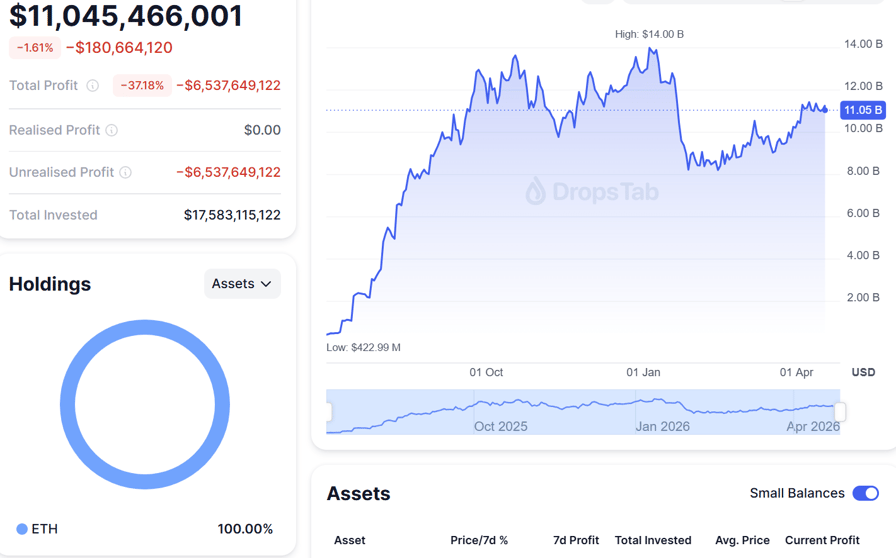
BitMine is deeply underwater on its ETH position. Source: DropsTab
Stablecoin supply rises as transfer volume drops nearly 20%
Stablecoin transfer activity fell sharply over the past month, with total volume dropping 19% to about $8.3 trillion, even as the overall market continued to expand, according to RWA.xyz data. At the same time, total supply climbed above $305 billion, while the number of holders and active addresses also edged higher.
The divergence points to a buildup of capital that isn’t moving. More dollars are entering or staying in stablecoins, but fewer are being used across blockchains. In practical terms, liquidity is rising, but activity is slowing, suggesting that users are holding rather than deploying funds.
Flows across individual assets tell a similar story. Tether’s USDt (USDT) led inflows with roughly $3.6 billion added, followed by USDC (USDC), while USDe (USDE) and PayPal USD (PYUSD) saw outflows.
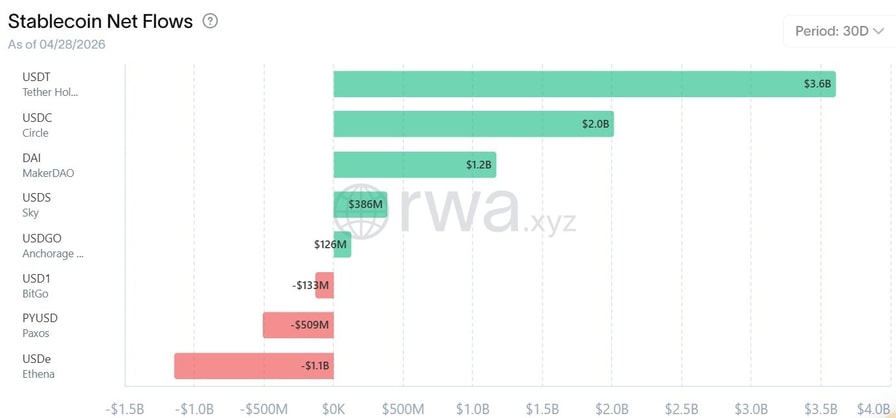
Stablecoin net flows over the last 30 days. Source: RWA.xyz
OKX integrates BlackRock’s tokenized Treasury fund as trade collateral
OKX has introduced BlackRock’s tokenized US Treasury fund, known as BUIDL, as eligible trading collateral for its institutional clients. This initiative follows a collaborative framework established with Standard Chartered, enabling users to pledge the asset as margin while it remains securely held within the bank’s regulated custody.
This approach redefines collateral management on digital asset exchanges. Rather than holding dormant cash or stablecoins, clients can utilize a productive, Treasury-backed asset that generates yield while simultaneously supporting their trading operations.
In certain setups, the collateral remains securely off-exchange under Standard Chartered’s supervision, while OKX creates a trading mirror. This arrangement is designed to minimize counterparty exposure without disrupting the trading process.
Crypto Biz provides a weekly overview of the business aspects of blockchain and crypto, delivered to your inbox every Thursday.
