




Fraud operations have expanded past conventional hacking strategies to incorporate strategies that exploit authentic companies and real-world infrastructure. By combining publicly obtainable information, weak identification verification processes, and operational gaps, risk actors are constructing scalable fraud workflows which are each low-cost and tough to detect.
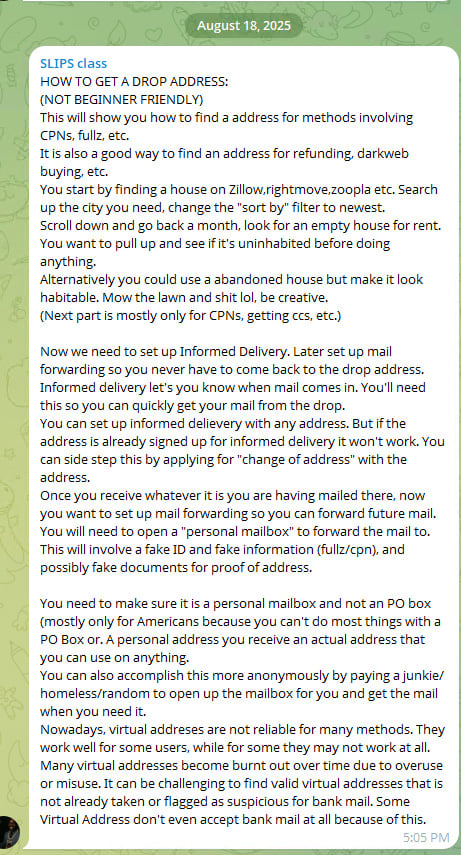
A tutorial shared in a fraud-focused chat group and analyzed by Flare analysts supplies step-by-step steering on the way to establish and exploit vacant residential properties to intercept delicate mail, revealing a low-tech however extremely efficient methodology for enabling identification theft and monetary fraud.
Not like conventional cybercrime strategies that depend on malware, phishing kits, or community intrusions, the strategy outlined on this article focuses nearly totally on abusing authentic companies and physical-world logistics.
The strategy blends open-source intelligence, postal service options, and faux identification fraud right into a coordinated workflow designed to achieve persistent entry to victims’ mail.
Turning vacant properties into fraud infrastructure
The tutorial begins with figuring out so-called “drop addresses”, actual residential properties which are briefly unoccupied and can be utilized to obtain mail with out instantly alerting the rightful occupants.
Menace actors are instructed to go looking actual property platforms corresponding to Zillow, Rightmove, or Zoopla, filtering for lately listed rental properties. By specializing in newly obtainable listings, attackers improve the probability that the property is vacant or between tenants.
The steering additional suggests reviewing older listings to establish properties which have remained unoccupied for prolonged intervals, growing their reliability as drop places.
In some instances, risk actors even advocate bodily sustaining deserted properties to make them seem occupied, decreasing the chance of drawing consideration whereas utilizing the tackle for fraudulent functions.
Menace actors share fraud playbooks, stolen credentials, and faux doc companies throughout darkish internet boards and Telegram channels.
Flare displays these sources repeatedly, so you possibly can detect publicity earlier than it allows account takeovers, mail fraud, or identification theft.
Sustain with risk actors without cost
Monitoring incoming mail to establish invaluable targets
As soon as an appropriate tackle is recognized, the following part includes using authentic digitalized postal companies for discovery and monitoring of incoming mail.
Knowledgeable Supply, as an example, is a free service that gives residential shoppers with digital previews of their incoming letter-sized mail and tracks bundle deliveries.
By registering these companies for the chosen tackle, attackers can monitor incoming correspondence remotely, permitting them to establish invaluable objects corresponding to monetary paperwork, bank cards, or verification letters earlier than bodily accessing the mailbox.
This transforms mail supply right into a type of intelligence gathering, enabling extra focused and environment friendly fraud.
If the tackle is already registered, the tutorial references change-of-address requests as a approach to regain management over mail supply. These companies are designed for authentic customers relocating their residence and are extensively obtainable by postal methods corresponding to USPS.
For instance, customers can submit a everlasting or a short lived Change of Deal with (COA) request on-line or in individual, enabling mail to be forwarded to a brand new location for intervals starting from a number of weeks as much as 12 months.
Extra companies, corresponding to Premium Forwarding, can consolidate and redirect all incoming mail on a recurring foundation.
Whereas these mechanisms embrace identification verification safeguards corresponding to requiring a small on-line fee tied to a billing tackle or presenting a sound photograph ID in individual, the tutorial means that actors understand these controls as doubtlessly inadequate or inconsistently enforced.
Particularly, the power to submit forwarding requests remotely, mixed with the reliance on address-linked verification somewhat than robust identification binding, might create alternatives for abuse if supporting identification data is compromised or fabricated.
Consequently, management over mail supply might, in some instances, be reassigned with out direct interplay with the authentic resident, turning a service supposed for comfort into a possible vector for unauthorized redirection.
At this stage, the operation strikes past passive focusing on and into lively monitoring, offering attackers with visibility that considerably will increase the success fee of downstream fraud.
Establishing persistence by mail forwarding
After confirming that invaluable mail is being delivered, the workflow shifts towards establishing long-term entry by mail forwarding companies.
Actors are instructed to create private mailbox accounts that enable them to redirect all incoming mail from the drop tackle to a separate location below their management.
As a result of these companies usually require identification verification, attackers depend on faux identities, cast paperwork, or bought private information to finish the method.
This marks a important transition from opportunistic interception to persistent entry. As soon as mail forwarding is in place, attackers now not must revisit the bodily location, decreasing publicity whereas sustaining steady entry to delicate data.
The usage of faux identities, usually involving fabricated private particulars or Credit score Privateness Numbers (CPNs), demonstrates how this method integrates with broader fraud ecosystems.
Fairly than working in isolation, drop tackle abuse turns into one part in a bigger pipeline that may help account takeovers, credit score fraud, and refund scams.
In apply, these faux identities can be utilized to register mailbox companies, submit forwarding requests, or obtain delicate monetary correspondence tied to sufferer accounts.
This enables actors to bridge the hole between digital compromise and real-world entry, enabling them to finish verification steps, intercept authentication supplies, or set up new accounts below assumed identities.
Consequently, management over a bodily tackle can change into an vital step in fraud operations that rely upon each identification credibility and entry to authentic communication channels.
A hybrid fraud mannequin mixing digital and bodily layers
The strategy outlined within the tutorial displays a broader evolution in fraud operations, the place digital intelligence gathering is mixed with physical-world manipulation.
Along with leveraging on-line platforms and postal companies, actors additionally describe utilizing people (generally recruited from susceptible populations) to bodily entry mailboxes or accumulate delivered objects.
This introduces a human layer into the operation, permitting attackers to outsource threat and additional distance themselves from direct involvement.
The exercise described within the tutorial displays a broader rise in mail-enabled fraud documented in latest reporting. In keeping with U.S. Postal Inspection Service–associated information, reviews of mail theft have elevated considerably in recent times, with theft from mail receptacles rising by 139% between 2019 and 2023.
Financially, the influence is substantial, with mail theft schemes linked to lots of of hundreds of thousands of {dollars} in suspicious exercise tied to test fraud.
On the identical time, abuse of postal redirection companies, much like the method referenced within the tutorial, has additionally grown, with change-of-address fraud growing sharply year-over-year. Collectively, these traits spotlight how management over bodily mail has change into invaluable.
On the identical time, the tutorial acknowledges operational challenges. Digital addresses and generally reused places are more and more flagged by monetary establishments, suggesting that defenders are starting to include address-based threat alerts into their detection fashions.
Consequently, actors emphasize the significance of discovering “clean” residential addresses that haven’t but been related to fraudulent exercise.
Collectively, these components illustrate a fraud mannequin that’s not pushed by technical sophistication, however by coordination, adaptability, and the strategic use of authentic methods.
Not an Remoted Tutorial / Fraud
Whereas this will appear to be an remoted tutorial, that is a part of a broader phenomenon or tutorials on the way to discover bodily drop tackle, some are without cost and others are paid for.
Increasing assault floor past conventional cybersecurity controls
The emergence of those strategies underscores a rising problem for organizations: most of the methods being abused: actual property platforms, postal companies, and identification verification processes, exist outdoors the scope of conventional cybersecurity defenses.
As fraud operations proceed to evolve, detection more and more is determined by correlating alerts throughout domains, together with tackle utilization patterns, mail forwarding exercise, and identification inconsistencies. With out this broader visibility, assaults that depend on authentic companies somewhat than technical exploits might proceed to evade typical safety controls.
Be taught extra by signing up for our free trial.
Sponsored and written by Flare.
