



AI-assisted growth has modified the best way engineers create and commit code. However writing code is not the bottleneck. The bottleneck is every little thing that occurs after git push.
From infrastructure provisioning, coverage enforcement, day-two operations, drift, compliance, to cross-team coordination. That also requires a number of steps, and no new instrument will repair it. That is an structure drawback. AI wants APIs, not UIs, and most platforms nonetheless aren’t constructed that means.
Present platforms
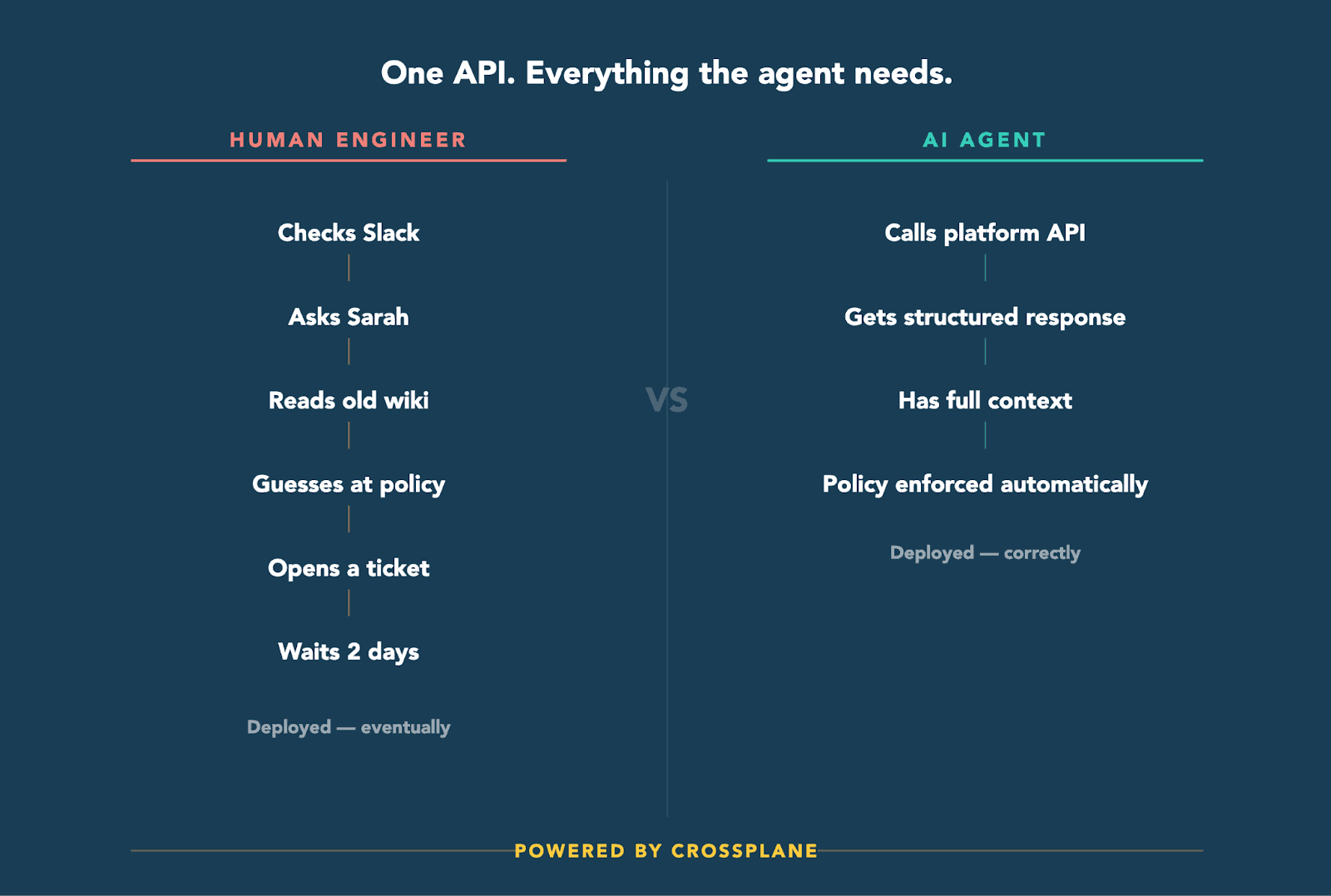
Speak to nearly any group, and also you’ll hear that the specified state lives in Git, whereas the precise state lives in cloud suppliers. Insurance policies are buried in pipeline configs. Organizational information exists in wikis nobody reads and in engineers who ultimately go away.
This has labored to date as a result of people labored with people to navigate the context switching and casual coordination required to get the job accomplished. Individuals fill within the gaps, ask the questions, and translate intent throughout programs.
However in a world the place AI brokers are embedded into our organizations, this workflow breaks down. The agent hits a wall, not as a result of it lacks functionality, however as a result of the platform wasn’t constructed for programmatic entry. It was constructed for people who can compensate for inconsistency.
Brokers require a unified, structured, machine-readable interface. They want express governance guidelines, readable historic patterns, and discoverable dependencies. With out that construction, autonomy stalls.
Platforms constructed on declarative management
Kubernetes launched a easy however highly effective management sample that modifications this fully. Each useful resource follows a constant schema:
yaml
apiVersion: instance.crossplane.io/v1
variety: Database
metadata:
  title: user-db
spec:
  engine: postgres
  storage: 100Gi
Desired state lives in spec, precise state is mirrored in standing, and controllers observe the distinction and reconcile constantly. That reconciliation is constant and computerized; no human is required to coordinate convergence.
Crossplane extends this mannequin past containers to all infrastructure and purposes: cloud databases, object storage, networking, SaaS programs, clusters, and customized platform APIs. The consequence isn’t simply infrastructure-as-code. It’s your total platform, infrastructure, and purposes as a single API. That distinction issues.
The three core parts that make this work in follow:
- Desired state: the declarative specification of what we expect the world needs to be. (Instance: The frontend service ought to have 3 replicas with 2 GB of reminiscence every.)
- Precise state: the operational actuality of what exists within the infrastructure. (Instance: The frontend service has 2 wholesome replicas, 1 pending.)
- Coverage: the foundations and governance that constrain operations. (Instance: Manufacturing modifications require approval between 9 AM and 5 PM PST.)
Controllers constantly reconcile desired state with precise state, and coverage is enforced at execution slightly than left to handbook overview. Context turns into a part of the system, not one thing exterior to it.
Why this mannequin works for brokers
An AI agent interacting with a Crossplane-managed platform doesn’t must orchestrate workflows throughout a number of programs. It interacts with a single API floor.
It may well uncover useful resource sorts through the Kubernetes API, examine standing fields for real-time operational state, watch sources for change occasions, and submit declarative intent. Since reconciliation handles mechanical execution, brokers don’t must coordinate step-by-step logic; they simply declare intent and let controllers deal with convergence.
This separation of considerations is essential. Controllers deal with mechanics, whereas brokers give attention to higher-level reasoning. And not using a management aircraft, brokers turn out to be fragile orchestrators. With one, they turn out to be declarative contributors.
When the whole platform is accessible by way of a single, constant API, the agent has every little thing it wants. No Slack messages and no tribal information required.
Coverage on the level of execution
In fragmented platforms, governance follows a lot of procedures: critiques, tickets, Slack threads. In a Kubernetes-native management aircraft, governance is architectural.
RBAC controls who can act. Admission controllers validate modifications earlier than they’re continued. Coverage engines similar to OPA and Kyverno implement constraints at runtime. Crossplane compositions encode organizational patterns straight into APIs. Each change flows by way of the identical enforcement path, no hidden approval steps, no undocumented exception paths.
This removes ambiguity for brokers fully. The system defines what’s allowed. Brokers function inside clearly outlined boundaries, and the platform enforces them mechanically.
Crossplane 2.0: Full-stack management
With Crossplane 2.0, compositions can embrace any Kubernetes useful resource, not simply managed infrastructure. Which means a single composite API can provision infrastructure, deploy purposes, configure networking, arrange observability, and outline operational workflows, multi functional place.
apiVersion: platform.acme.io/v1
variety: Microservice
metadata:
  namespace: team-api
  title: user-service
spec:
  picture: acme/user-service:v1.2.3
  database:
    engine: postgres
    measurement: medium
  ingress:
    subdomain: customers
Behind that abstraction might stay RDS situations, safety teams, deployments, companies, ingress guidelines, and monitoring sources. To a human developer or an AI agent, it’s a single API. That consistency is what permits automation to scale safely.
Day-two operations observe the identical sample. Crossplane’s Operation sorts convey declarative management to scheduled upgrades, backups, upkeep, and event-driven automation:
apiVersion: ops.crossplane.io/v1alpha1
variety: CronOperation
metadata:
  title: weekly-db-maintenance
spec:
  schedule: "0 2 * * 0"
  operationTemplate:
    spec:
      pipeline:
        - step: improve
          functionRef:
            title: function-database-upgrade
Operational workflows are actually first-class API objects. Brokers can examine them, set off them, observe their standing, and suggest modifications. No want for hidden runbooks.
The place to start out
This doesn’t require a start-from-scratch migration. Carry core infrastructure beneath declarative management first. Your current sources don’t should be changed; they simply should be unified behind a constant API.
For groups utilizing AI-assisted growth, engineers categorical intent and iterate shortly as instruments speed up implementation. As deployment decouples from launch, with modifications transport behind characteristic flags and programs reconciling towards the specified state, the platform should be deterministic and self-correcting, not reliant on somebody catching drift or operating the best command on the proper time.
That’s what a declarative management aircraft supplies. Crossplane ensures that intent has someplace protected, structured, and deterministic to land. With out it, AI will all the time be bolted onto human-centric workflows. With it, brokers turn out to be first-class contributors in infrastructure operations.
And that begins with a constant API.
And that begins with a constant API. Get began by trying out the Crossplane Docs, attending a group assembly, or watching CNCF’s Cloud Native Reside on Crossplane 2.0 – AI-Pushed Management Loops for Platform Engineering.
