



Farmers want real-time crop insights to allow them to monitor crop well being and keep vitality of the crops and forestall crop loss.
Delayed inspections could cause important yield loss. Some pest outbreaks require therapy inside 48 to 72 hours; lacking this window results in crop loss. With that mentioned, the United Nations (2021) talked about {that a} 40 p.c lack of crop because of pest infestation prices the economic system greater than $220 billion yearly.
The demand for real-time crop insights additionally addresses agriculture’s labor scarcity. About 56% of U.S. farmers have reported labor shortages.This lack of staff delays inspections, contributing to crop loss from poor well being checks.
The Knowledge Hole in Conventional Crop Monitoring
There’s a information hole in conventional crop monitoring, and this consists of restricted frequent monitoring and crop spatial blind spots. Handbook area scouting, stationary sensors, and periodic satellite tv for pc imagery are the widespread commonplace strategies of conventional crop monitoring.
A guide area scout covers restricted sections of a 500-acre farm day by day, permitting anomalies in some areas to go unnoticed. This ends in undetected illnesses and lacking early-stage points in a fraction of a big crop attributable to spatial blind spots.
This fragmented information limits the combination of a single location-specific view because of its unbiased operation monitoring. In impact, it causes delayed insights and never up-to-date information, figuring out the effectiveness and well timed prevention.
How Drones Allow Giant-Scale, Actual-Time Discipline Commentary
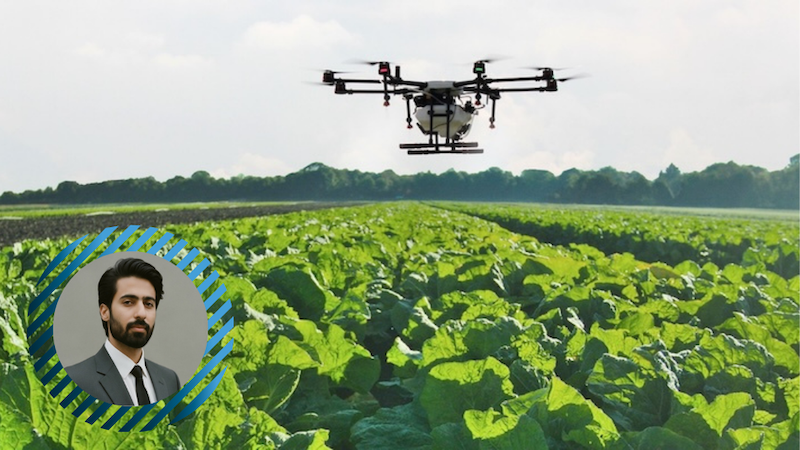
Drones allow large-scale, real-time area statement by bringing a wholly new outlook on area monitoring utilizing precision agriculture drones. It affords a quick and high-resolution aerial perspective. As an example, a drone can survey 1,000 acres inside hours, whereas a ground-based crew would require a number of days.
The drone surveillance of the croplands via unmanned aerial car (UAVs) has come into play primarily as a result of these aerial autos have varied functions. Drones are outfitted with multispectral and thermal sensors measuring Normalized Distinction Vegetation Index (NDVI), displaying vegetation well being via near-infrared gentle.
An article by Bashar Alsadik et al. (2024) signifies that UAVs can detect water stress and nitrogen deficiencies days earlier than bodily signs. The fast and repeatable assortment cycle affords the “where” and “when” of area circumstances throughout giant areas.
How RFID Provides Identification and Precision to Crop Knowledge
RFID provides identification and precision to crop information by offering an aerial view which exhibits the identification from the bottom. RFID will depend on radio frequencies for monitoring of tags connected to things.
With regard to agriculture, RFID tags have been utilized to animals, crops, and well being monitoring. These tags are sometimes very unobtrusive and positioned on single crops, saplings, or soil-moisture probes.
Using Extremely-Excessive Frequency (UHF) RFID tags in agriculture offers precision and browse ranges of as much as 10-12 meters. Their potential to be learn via any impediment and environmental challenges, like mud and rain, has made them advantageous over barcodes.
By giving a particular micro-zone a novel digital ID, location-specific crop insights develop into potential, thus enabling correct monitoring of plant cycles.
How Integrating Drones with RFID Creates Actual-Time Crop Insights
Integrating drones with RFID creates real-time insights by connecting aerial imaginative and prescient with the identification on the floor stage. The principle innovation is the drone being handled as a correct cellular RFID reader.
In utilized deployments, this integration workflow is commonly applied via a specialised agriculture drone service that manages UAV flight operations, RFID information seize, and synchronization with farm administration methods.
The Integration Workflow:
- Synchronization: The RFID reader “pings” the bottom tags because the drone flies over a bit of the sector.
- Knowledge Coupling: The aerial imagery and the distinctive ID of the tag beneath are captured by the system on the identical time.
- Localization: The drone’s GPS onboard timestamps and geo-locates the actual tag interplay.
- Actual-Time Processing: Integration information is distributed to the farm administration system, the place aerial well being information is linked to the particular plant RFID.
This automated area information assortment eliminates guide entry of knowledge whereas making certain the aerial information is expounded to an identifiable place
Sorts of Crop Insights Enabled by Drone-RFID Integration
Collectively, these two applied sciences can allow extra granular, location-specific crop insights:
Micro-Zone Stress Profiling: Crop insights particular to a selected tag’s space can pinpoint the precise rows that require therapy.
Exact Development Monitoring: By associating plant top with particular plant RFIDs over time, drones might help observe the exact development curves for varied seed sorts.
Early Pathogen Mapping: UAV-based area monitoring can point out a lower in NDVI. The system then checks the RFID-tagged location’s historical past to establish the trigger.
How These Insights Enhance Farming Selections and Outcomes
Understanding the precise underperforming zones, farmers can use Variable Fee Utility (VRA). As a substitute of blanket spraying, farmers will use the drone with RFID expertise to restrict software to particular zones.
In keeping with Chen (2025), precision agriculture with drones and IoT can result in waste discount by 40-60% and yield features of 20-30%. Furthermore, the intervention is considerably faster when real-time crop monitoring is in place.
A report by Schimmelpfennig (2018) proves precision can improve Useful resource Use Effectivity (RUE) by 15-20% in high-value specialty crops. Therefore, it turns into clear that crop information accuracy is probably the most treasured asset amongst at this time’s growers.
Actual-World Functions of Drone-RFID Good Fields
The adoption of this expertise from the lab to the actual world is now growing. A research by Orlandi et al. (2025) allowed steady upkeep of grape high quality via RFID-enabled agriculture and drone surveys.
A case by Patiluna et al. (2023) cited precision agriculture drones studying the RFID tags on seedlings, producing an instantaneous stock. The drones are working at a top of three meters and studying the tags with a 90% mark of certainty. The approach has reduce down the guide dealing with time by 90% compared with the traditional strategies (Patiluna et al., 2024).
The pilot initiatives show the combination of IoT in agriculture just isn’t a matter of the long run however, as an alternative, at this time’s benefit. It empowers the cultivation of environmentally pleasant and resource-efficient farming fashions.
Challenges in Reaching Actual-Time Insights By Integration
There are challenges in attaining real-time insights via integration which incorporates the next:
- Restrictions in Battery Life and Payload: Using an imaging machine along with a strong RFID reader significantly cuts down on the working time.
- Sign Interference: RFID indicators will be obstructed by giant timber or the presence of humidity, thus inflicting the tags to be “missed”.
- Knowledge Complexity: Knowledge collected and produced requires sensor-based farming methods and just about whole bandwidth.
- Regulatory Obstacles: Some locations nonetheless limit drone flights, which might restrict the monitoring of in depth areas or remoted fields.
The Way forward for Good Fields and Actual-Time Agriculture
Present analysis instructions counsel incremental motion towards larger ranges of automation in area monitoring. Future developments will in all probability embrace the usage of synthetic intelligence for real-time evaluation, performing information evaluation above.
The agricultural IoT integration is usually from small drone customers working collectively, with one detecting points whereas one other applies sources regionally. The supply of 5G deployment in rural areas reduces the time lag between detection and response of data-driven farming choices.
The mixture of drones with RFID expertise represents a measurable change in how area information will be collected and utilized at finer spatial scales. Using UAVs overlaying huge areas and actual RFID identification bridges the hole of conventional farming.
This convergence of applied sciences affords a decision of the issue in excessive definition that can result in higher decisions. The business shall be compelled to cope with each the challenges of sustainability and productiveness. As well as, the power to shortly produce beneficial info via expertise integration marks a profitable adaptation to market modifications.
