



Cluster API brings declarative administration to Kubernetes cluster lifecycle, permitting customers and platform groups to outline the specified state of clusters and depend on controllers to repeatedly reconcile towards it.
Much like how you should use StatefulSets or Deployments in Kubernetes to handle a gaggle of Pods, in Cluster API you should use KubeadmControlPlane to handle a set of management aircraft Machines, or you should use MachineDeployments to handle a gaggle of employee Nodes.
The Cluster API v1.12.0 launch expands what is feasible in Cluster API, lowering friction in widespread lifecycle operations by introducing in-place updates and chained upgrades.
Emphasis on simplicity and usefulness
With v1.12.0, the Cluster API venture demonstrates as soon as once more that this neighborhood is able to delivering a large amount of innovation, whereas on the identical time minimizing influence for Cluster API customers.
What does this imply in observe?
Customers merely have to alter the Cluster or the Machine spec (simply as with earlier Cluster API releases), and Cluster API will mechanically set off in-place updates or chained upgrades when attainable and advisable.
In-place Updates
Like Kubernetes does for Pods in Deployments, when the Machine spec adjustments additionally Cluster API performs rollouts by creating a brand new Machine and deleting the previous one.
This method, impressed by the precept of immutable infrastructure, has a set of appreciable benefits:
- It’s easy to clarify, predictable, constant and straightforward to purpose about with customers and engineers.
- It’s easy to implement, as a result of it depends solely on two core primitives, create and delete.
- Implementation doesn’t rely upon Machine-specific selections, like OS, bootstrap mechanism and so on.
Consequently, Machine rollouts drastically scale back the variety of variables to be thought of when managing the lifecycle of a number server that’s internet hosting Nodes.
Nevertheless, whereas benefits of immutability will not be underneath dialogue, each Kubernetes and Cluster API are present process an analogous journey, introducing adjustments that enable customers to attenuate workload disruption every time attainable.
Over time, additionally Cluster API has launched a number of enhancements to immutable rollouts, together with:
The brand new in-place replace function in Cluster API is the subsequent step on this journey.
With the v1.12.0 launch, Cluster API introduces help for replace extensions permitting customers to make adjustments on present machines in-place, with out deleting and re-creating the Machines.
Each KubeadmControlPlane and MachineDeployments help in-place updates primarily based on the brand new replace extension, and which means that the boundary of what’s attainable in Cluster API is now modified in a big approach.
How do in-place updates work?
The only approach to clarify it’s that after the consumer triggers an replace by altering the specified state of Machines, then Cluster API chooses the very best software to attain the specified state.
The information is that now Cluster API can select between immutable rollouts and in-place replace extensions to carry out required adjustments.
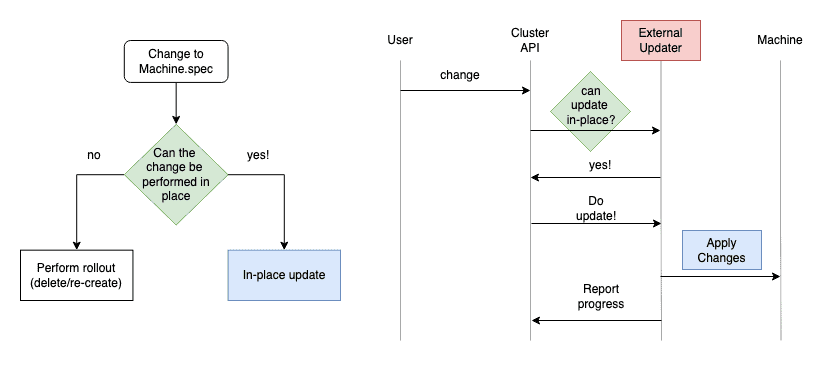
Importantly, this isn’t immutable rollouts vs in-place updates; Cluster API considers each legitimate choices and selects probably the most acceptable mechanism for a given change.
From the angle of the Cluster API maintainers, in-place updates are most helpful for making adjustments that don’t in any other case require a node drain or pod restart; for instance: altering consumer credentials for the Machine. Alternatively, when the workload will probably be disrupted anyway, simply do a rollout.
Nonetheless, Cluster API stays true to its extensible nature, and everybody can create their very own replace extension and determine when and find out how to use in-place updates by buying and selling in among the advantages of immutable rollouts.
For a deep dive into this function, be sure that to attend the session In-place Updates with Cluster API: The Candy Spot Between Immutable and Mutable Infrastructure at KubeCon EU in Amsterdam!
Chained Upgrades
ClusterClass and managed topologies in Cluster API collectively offered a strong and efficient framework that acts as a constructing block for a lot of platforms providing Kubernetes-as-a-Service.
Now with v1.12.0 this function is making one other essential step ahead, by permitting customers to improve by a couple of Kubernetes minor model in a single operation, generally known as a chained improve.
This enables customers to declare a goal Kubernetes model and let Cluster API safely orchestrate the required intermediate steps, moderately than manually managing every minor improve.
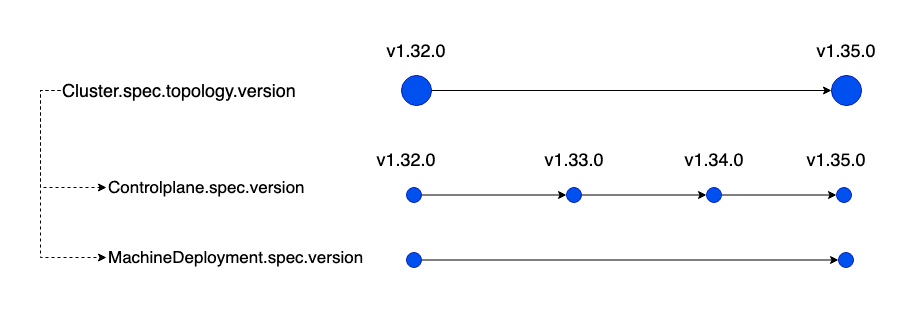
The only approach to clarify how chained upgrades work, is that after the consumer triggers an replace by altering the specified model for a Cluster, Cluster API computes an improve plan, after which begins executing it. Quite than (for instance) updating the Cluster to v1.33.0 after which v1.34.0 after which v1.35.0, checking on progress at every step, a chained improve permits you to go on to v1.35.0.
Executing an improve plan means upgrading management aircraft and employee machines in a strictly managed order, repeating this course of as many occasions as wanted to achieve the specified state. The Cluster API is now able to managing this for you.
Cluster API takes care of optimizing and minimizing the improve steps for employee machines, and actually employee machines will skip upgrades to intermediate Kubernetes minor releases every time allowed by the Kubernetes model skew insurance policies.
Additionally on this case extensibility is on the core of this function, and improve plan runtime extensions can be utilized to affect how the improve plan is computed; equally, lifecycle hooks can be utilized to automate different duties that have to be carried out throughout an improve, e.g. upgrading an addon after the management aircraft replace accomplished.
From our perspective, chained upgrades are most helpful for customers that wrestle to maintain up with Kubernetes minor releases, and e.g. they wish to improve solely as soon as per yr after which improve by three variations (n-3 → n). However be warned: the truth that now you can simply improve by a couple of minor model is just not an excuse to not patch your cluster regularly!
Launch workforce
I want to thank all of the contributors, the maintainers, and all of the engineers that volunteered for the discharge workforce.
The reliability and predictability of Cluster API releases, which is among the most appreciated options from our customers, is barely attainable with the help, dedication, and laborious work of its neighborhood.
Kudos to all the Cluster API neighborhood for the v1.12.0 launch and all the nice releases delivered in 2025!In case you are excited by getting concerned, find out about Cluster API contributing pointers.
What’s subsequent?
For those who learn the Cluster API manifesto, you’ll be able to see how the Cluster API subproject claims the proper to stay unfinished, recognizing the necessity to repeatedly evolve, enhance, and adapt to the altering wants of Cluster API’s customers and the broader Cloud Native ecosystem.
As Kubernetes itself continues to evolve, the Cluster API subproject will maintain advancing alongside it, specializing in safer upgrades, decreased disruption, and stronger constructing blocks for platforms managing Kubernetes at scale.
Innovation stays on the coronary heart of Cluster API, keep tuned for thrilling developments all through 2026!
Helpful hyperlinks:
Be taught extra about VMware Cloud Basis, a unified non-public cloud platform with built-in compute, storage, networking, safety and administration throughout all endpoints, enabling agile, scalable, and safe infrastructure for any workload.
This maintainer weblog was initially revealed on kubernetes.io and is republished right here with permission.
