



Picture by Writer
# Introduction
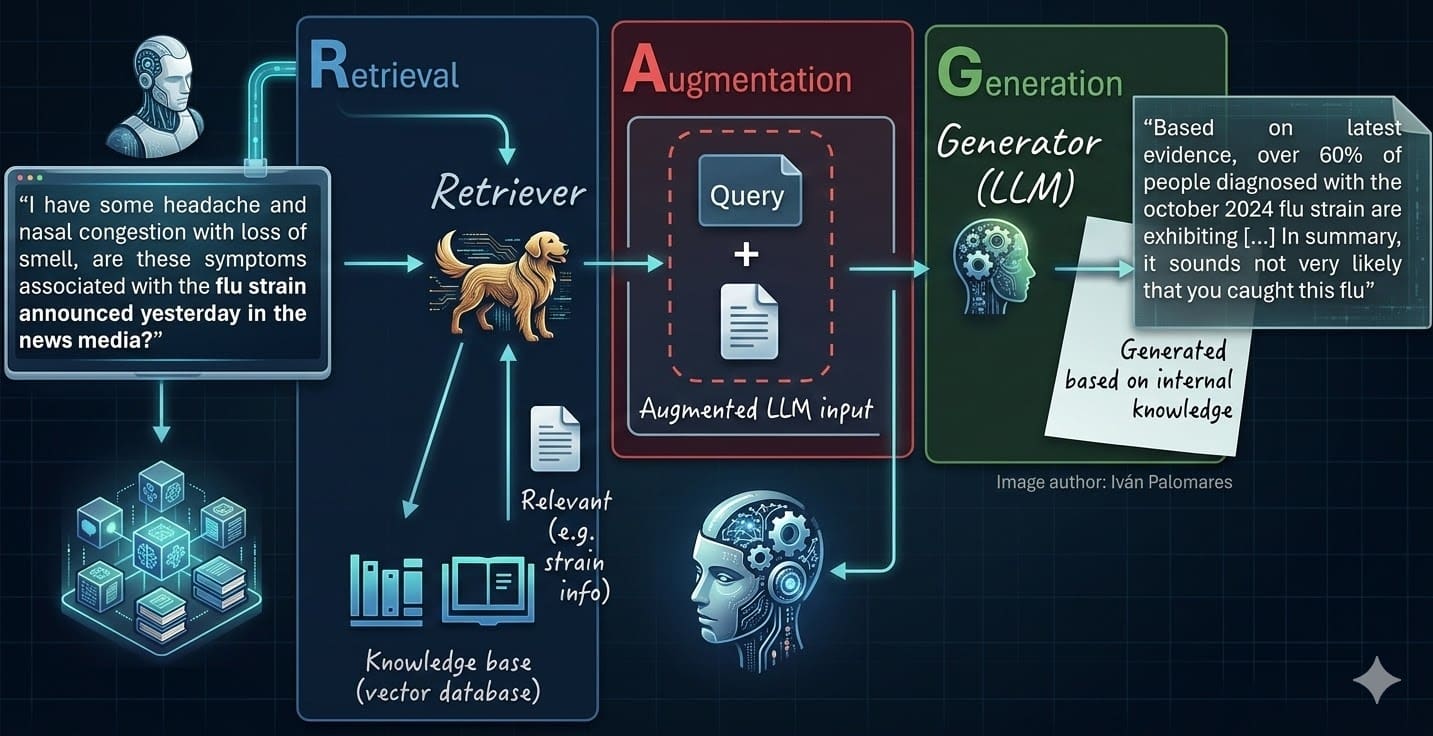
Retrieval-augmented era (RAG) methods are, merely put, the pure evolution of standalone giant language fashions (LLMs). RAG addresses a number of key limitations of classical LLMs, like mannequin hallucinations or an absence of up-to-date, related information wanted to generate grounded, fact-based responses to person queries.
In a associated article sequence, Understanding RAG, we offered a complete overview of RAG methods, their traits, sensible concerns, and challenges. Now we synthesize a part of these classes and mix them with the newest developments and methods to explain seven key steps deemed important to mastering the event of RAG methods.
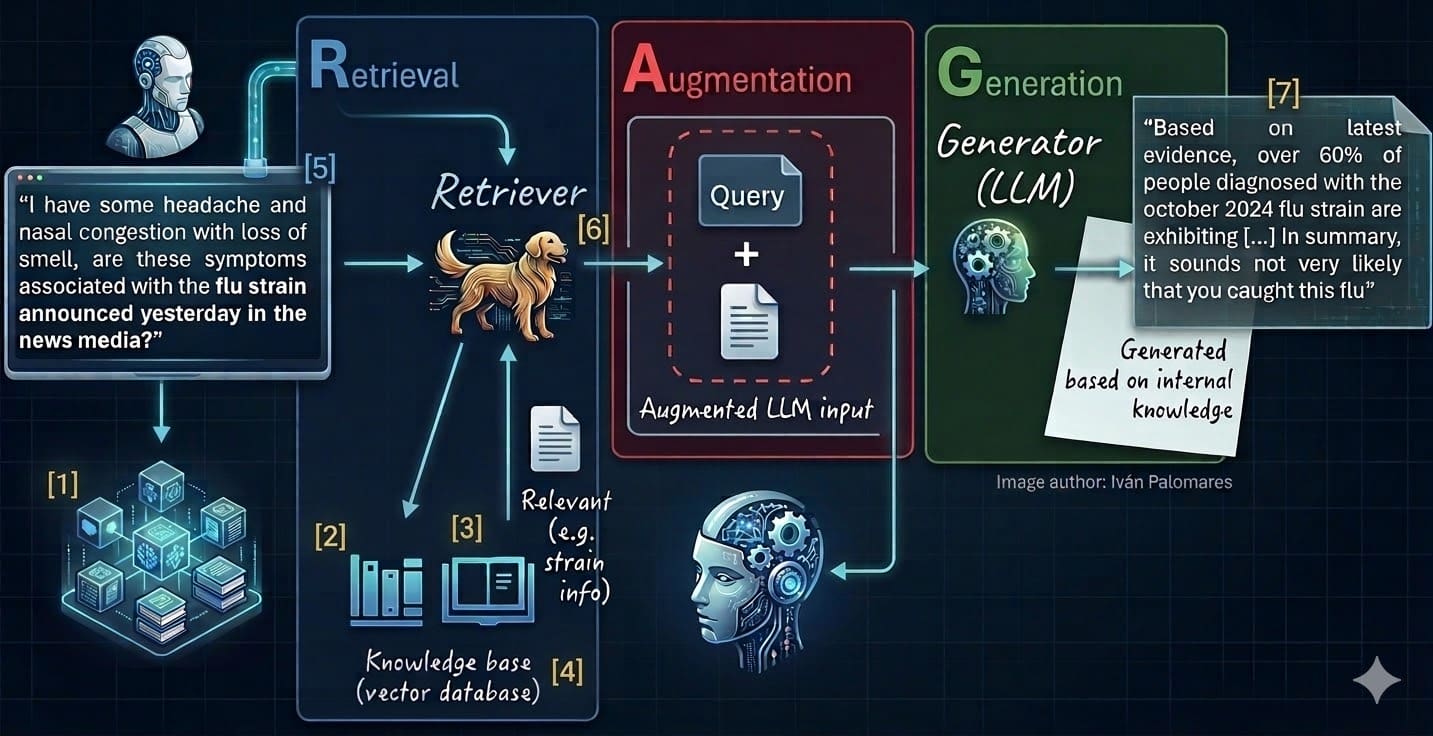
These seven steps are associated to completely different phases or parts of a RAG surroundings, as proven within the numeric labels ([1] to [7]) within the diagram beneath, which illustrates a classical RAG structure:
7 Steps to Mastering RAG Techniques (see numbered labels 1-7 and record beneath)
- Choose and clear information sources
- Chunking and splitting
- Embedding/vectorization
- Populate vector databases
- Question vectorization
- Retrieve related context
- Generate a grounded reply
# 1. Choosing and Cleansing Information Sources
The “garbage in, garbage out” precept takes its most significance in RAG. Its worth is immediately proportional to the relevance, high quality, and cleanliness of the supply textual content information it could possibly retrieve. To make sure high-quality information bases, establish high-value information silos and periodically audit your bases. Earlier than ingesting uncooked information, carry out an efficient cleansing course of by strong pipelines that apply vital steps like eradicating personally identifiable data (PII), eliminating duplicates, and addressing different noisy parts. This can be a steady engineering course of to be utilized each time new information is included.
You possibly can learn by this text to get an outline of information cleansing methods.
# 2. Chunking and Splitting Paperwork
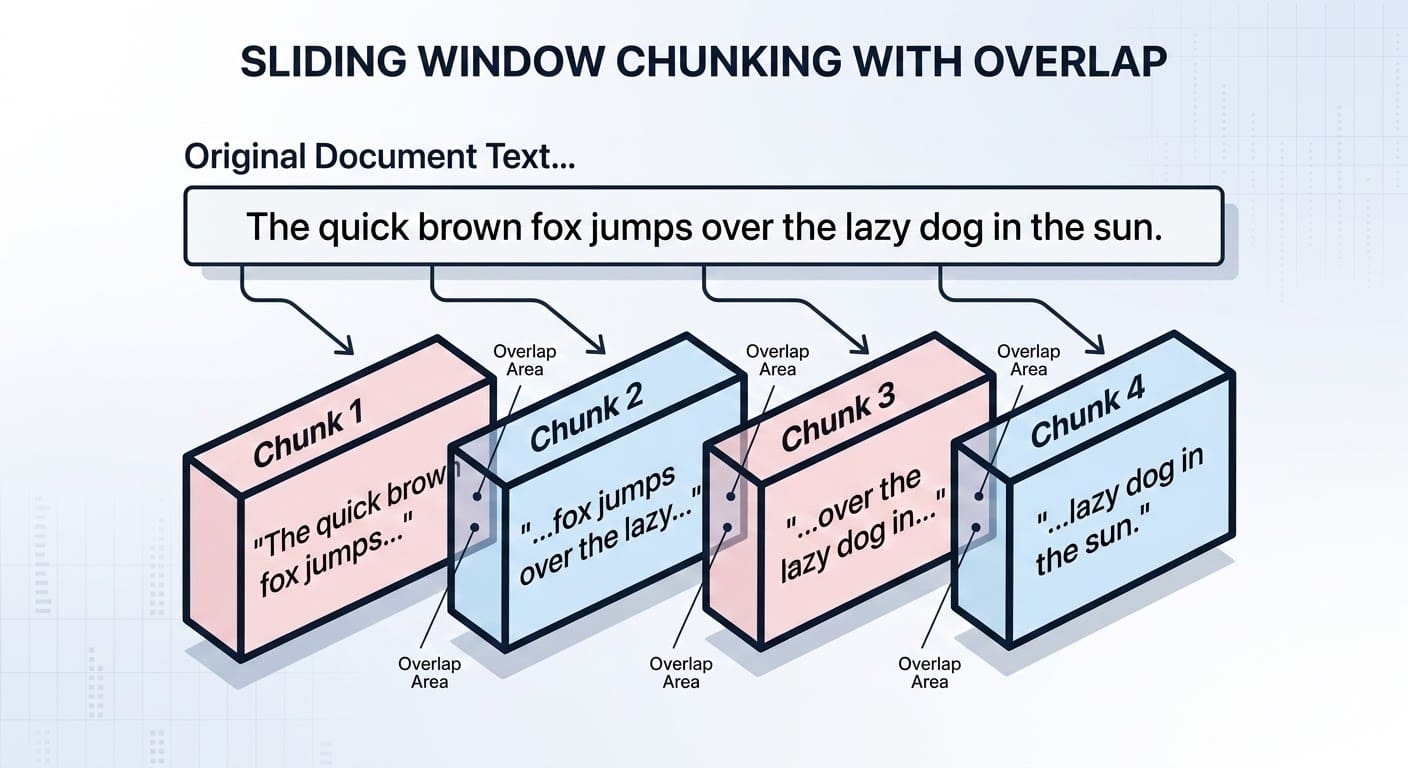
Many cases of textual content information or paperwork, like literature novels or PhD theses, are too giant to be embedded as a single information occasion or unit. Chunking consists of splitting lengthy texts into smaller elements that retain semantic significance and maintain contextual integrity. It requires a cautious method: not too many chunks (incurring doable lack of context), however not too few both — outsized chunks have an effect on semantic search in a while!
There are various chunking approaches: from these based mostly on character depend to these pushed by logical boundaries like paragraphs or sections. LlamaIndex and LangChain, with their related Python libraries, can definitely assist with this job by implementing extra superior splitting mechanisms.
Chunking may additionally think about overlap amongst elements of the doc to protect consistency within the retrieval course of. For the sake of illustration, that is what such chunking might seem like over a small, toy-sized textual content:
Chunking paperwork in RAG methods with overlap | Picture by Writer
In this installment of the RAG sequence, you may as well be taught the additional position of doc chunking processes in managing the context dimension of RAG inputs.
# 3. Embedding and Vectorizing Paperwork
As soon as paperwork are chunked, the subsequent step earlier than having them securely saved within the information base is to translate them into “the language of machines”: numbers. That is usually executed by changing every textual content right into a vector embedding — a dense, high-dimensional numeric illustration that captures semantic traits of the textual content. In recent times, specialised LLMs to do that job have been constructed: they’re referred to as embedding fashions and embrace well-known open-source choices like Hugging Face’s all-MiniLM-L6-v2.
Study extra about embeddings and their benefits over classical textual content illustration approaches in this text.
# 4. Populating the Vector Database
In contrast to conventional relational databases, vector databases are designed to successfully allow the search course of by high-dimensional arrays (embeddings) that symbolize textual content paperwork — a vital stage of RAG methods for retrieving related paperwork to the person’s question. Each open-source vector shops like FAISS or freemium options like Pinecone exist, and may present wonderful options, thereby bridging the hole between human-readable textual content and math-like vector representations.
This code excerpt is used to separate textual content (see level 2 earlier) and populate an area, free vector database utilizing LangChain and Chroma — assuming we have now a protracted doc to retailer in a file referred to as knowledge_base.txt:
from langchain_community.document_loaders import TextLoader
from langchain_text_splitters import RecursiveCharacterTextSplitter
from langchain_community.embeddings import HuggingFaceEmbeddings
from langchain_community.vectorstores import Chroma

# Load and chunk the information
docs = TextLoader("knowledge_base.txt").load()
chunks = RecursiveCharacterTextSplitter(chunk_size=500, chunk_overlap=50).split_documents(docs)

# Create textual content embeddings utilizing a free open-source mannequin and retailer in ChromaDB
embedding_model = HuggingFaceEmbeddings(model_name="all-MiniLM-L6-v2")
vector_db = Chroma.from_documents(paperwork=chunks, embedding=embedding_model, persist_directory="./db")
print(f"Successfully stored {len(chunks)} embedded chunks.")
Learn extra about vector databases right here.
# 5. Vectorizing Queries
Person prompts expressed in pure language will not be immediately matched to saved doc vectors: they should be translated too, utilizing the identical embedding mechanism or mannequin (see step 3). In different phrases, a single question vector is constructed and in contrast in opposition to the vectors saved within the information base to retrieve, based mostly on similarity metrics, essentially the most related or comparable paperwork.
Some superior approaches for question vectorization and optimization are defined in this half of the Understanding RAG sequence.
# 6. Retrieving Related Context
As soon as your question is vectorized, the RAG system’s retriever performs a similarity-based search to search out the closest matching vectors (doc chunks). Whereas conventional top-k approaches typically work, superior strategies like fusion retrieval and reranking can be utilized to optimize how retrieved outcomes are processed and built-in as a part of the ultimate, enriched immediate for the LLM.
Take a look at this associated article for extra about these superior mechanisms. Likewise, managing context home windows is one other vital course of to use when LLM capabilities to deal with very giant inputs are restricted.
# 7. Producing Grounded Solutions
Lastly, the LLM comes into the scene, takes the augmented person’s question with retrieved context, and is instructed to reply the person’s query utilizing that context. In a correctly designed RAG structure, by following the earlier six steps, this normally results in extra correct, defensible responses that will even embrace citations to our personal information used to construct the information base.
At this level, evaluating the standard of the response is important to measure how the general RAG system behaves, and signaling when the mannequin may have fine-tuning. Analysis frameworks for this finish have been established.
# Conclusion
RAG methods or architectures have grow to be an nearly indispensable facet of LLM-based purposes, and business, large-scale ones hardly ever miss them these days. RAG makes LLM purposes extra dependable and knowledge-intensive, and so they assist these fashions generate grounded responses based mostly on proof, generally predicated on privately owned information in organizations.
This text summarizes seven key steps to mastering the method of developing RAG methods. After you have this basic information and expertise down, you can be in a very good place to develop enhanced LLM purposes that unlock enterprise-grade efficiency, accuracy, and transparency — one thing not doable with well-known fashions used on the Web.
Iván Palomares Carrascosa is a frontrunner, author, speaker, and adviser in AI, machine studying, deep studying & LLMs. He trains and guides others in harnessing AI in the actual world.
