



# Introduction
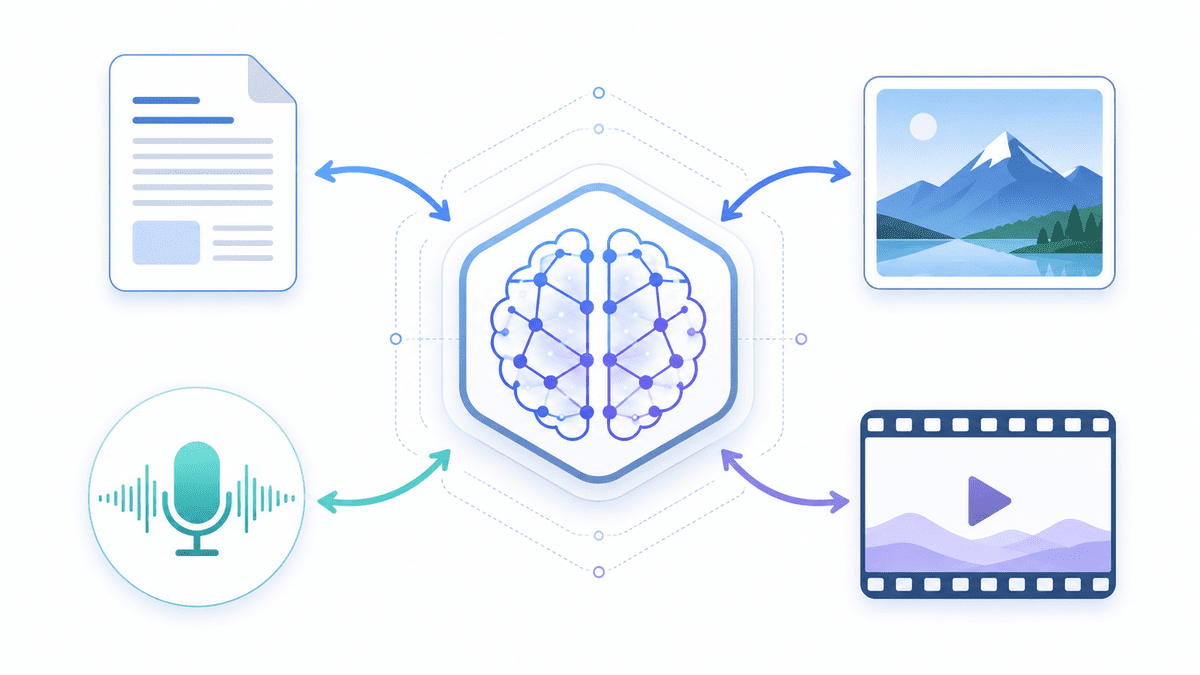
Twelve months ago, omni AI models seemed more like a theoretical promise than a practical tool for developers. The majority of multimodal setups still relied on a patchwork of specialized models operating behind the scenes: one handling text, another processing images, yet another dealing with speech, and occasionally a separate one for video. The notion of a single unified model capable of interpreting diverse input formats and producing outputs across different modalities felt like a distant aspiration.
That landscape is beginning to shift. Open source omni and multimodal models now offer a significantly more cohesive approach to processing text, images, audio, and video. Certain models can examine images and documents, transcribe or reason about audio content, interpret video frames, and reply in written form. Others push the envelope further by producing speech, generating images, or enabling real-time multimodal exchanges.
In this guide, we’ll explore five open source omni AI models that are driving innovation in this domain. It’s worth noting that not every model featured here qualifies as a fully “any-to-any” system, and that distinction is important.
Some models accommodate multiple input types but produce only text output, whereas others facilitate speech generation, image creation, or real-time audio-video engagement. Our aim is to clarify what each model genuinely brings to the table.
# 1. NVIDIA Nemotron 3 Nano Omni 30B A3B Reasoning
NVIDIA Nemotron 3 Nano Omni 30B A3B Reasoning is a robust open omni model engineered for enterprise-level multimodal comprehension. It accepts video, audio, images, and text as input and produces text-based outputs.
This positions it as a strong choice for applications like video and speech evaluation, document intelligence, chart interpretation, optical character recognition (OCR), transcription, graphical user interface (GUI) comprehension, and multimodal question answering.

Image from Introducing NVIDIA Nemotron 3 Nano Omni
The model is constructed on a 31B-parameter Mamba2-Transformer hybrid Mixture-of-Experts framework, with approximately 3B active parameters per token. This design enables it to balance strong reasoning performance with more efficient inference.
It further supports an extended 256K-token context window, making it well-suited for processing lengthy documents, prolonged transcripts, meeting recordings, training videos, and other content-rich enterprise materials.
What distinguishes Nemotron 3 Nano Omni is its practical emphasis on real-world workflows rather than superficial multimodal demonstrations. It is purpose-built for scenarios such as customer support, media analysis, document review, AI assistants, browser agents, email agents, and GUI automation.
Best for: video and speech evaluation, document intelligence, OCR, chart interpretation, GUI workflows, automatic speech recognition (ASR), and enterprise multimodal Q&A.
# 2. Google Gemma 4 12B IT
Google Gemma 4 12B IT belongs to Google DeepMind’s open Gemma model family and is crafted as a compact, efficient multimodal model tailored for local and self-hosted AI deployments. It accepts text, images, audio, and video inputs and generates text-based outputs.
This makes it a practical choice for tasks like visual question answering, document and PDF comprehension, OCR, chart understanding, audio transcription, speech translation, coding, logical reasoning, and multimodal assistant workflows.

Image from InfoQ
The 12B Unified model is particularly noteworthy because it employs an encoder-free multimodal architecture. Rather than depending on separate vision or audio encoders, it maps raw image patches and audio waveforms directly into the language model’s embedding space via lightweight linear layers.
Gemma 4 12B supports an extended 256K-token context window, which proves valuable when working with lengthy documents, large codebases, prolonged conversations, and multimodal inputs that blend text, images, audio, and video frames.
Best for: efficient multimodal assistants, document comprehension, image and audio reasoning, video-frame analysis, coding, multilingual tasks, and local AI deployments.
# 3. Qwen3-Omni 30B A3B Instruct
Qwen3-Omni 30B A3B Instruct ranks among the most capable open omni models available today. It is architected as a natively end-to-end multilingual omni-modal model that accepts text, images, audio, and video as input and responds in both text and natural speech.
This makes it ideal for building AI assistants capable of seeing, listening, understanding, and responding in real time. It can be deployed for speech recognition, speech translation, audio captioning, music analysis, OCR, image question answering, video comprehension, and audio-visual dialogue.

Image from Qwen/Qwen3-Omni-30B-A3B-Instruct
The model leverages a Mixture-of-Experts architecture with a Thinker-Talker design. The Thinker component manages multimodal understanding and reasoning, while the Talker component facilitates natural speech output. This dual design empowers Qwen3-Omni to support both deep multimodal reasoning and low-latency spoken exchanges.
One of its most significant advantages is real-time audio and video interaction. Unlike many multimodal models that operate on a slow upload-and-response cycle, Qwen3-Omni is engineered for streaming scenarios with natural turn-taking and instantaneous text or speech replies.
It also boasts robust multilingual capabilities, covering 119 text languages, 19 speech input languages, and 10 speech output languages. This makes it especially valuable for global deployments, multilingual voice assistants, accessibility tools, and audio-video systems that must function across diverse languages.
What sets Qwen3-Omni apart is how closely it approaches the vision of a true omni assistant. It doesn’t merely interpret multiple input formats; it also generates natural speech, follows system prompts, supports agent-like workflows, and tackles complex audio-visual tasks.
Best for: open omni assistants, real-time speech interaction, video comprehension, audio reasoning, multilingual deployments, audio-visual dialogue, and text/speech outputs.
# 4. DeepSeek Janus-Pro 7B
DeepSeek Janus-Pro 7B is a unified multimodal model centered on both visual understanding and image generation. It isn’t a full omni model spanning text, audio, image, and video, but it stands out as an important open model because it consolidates image comprehension and image creation within a single framework.
This makes it a practical choice for tasks like visual question answering, image reasoning, image captioning, text-to-image generation, and multimodal creative workflows.
Janus-Pro is built on DeepSeek-LLM-7B and uses a novel autoregressive
The framework divides visual processing into separate pathways for comprehension and creation. This approach addresses a frequent challenge in multimodal systems, where a single visual encoder must handle both interpreting an image and producing a new one.
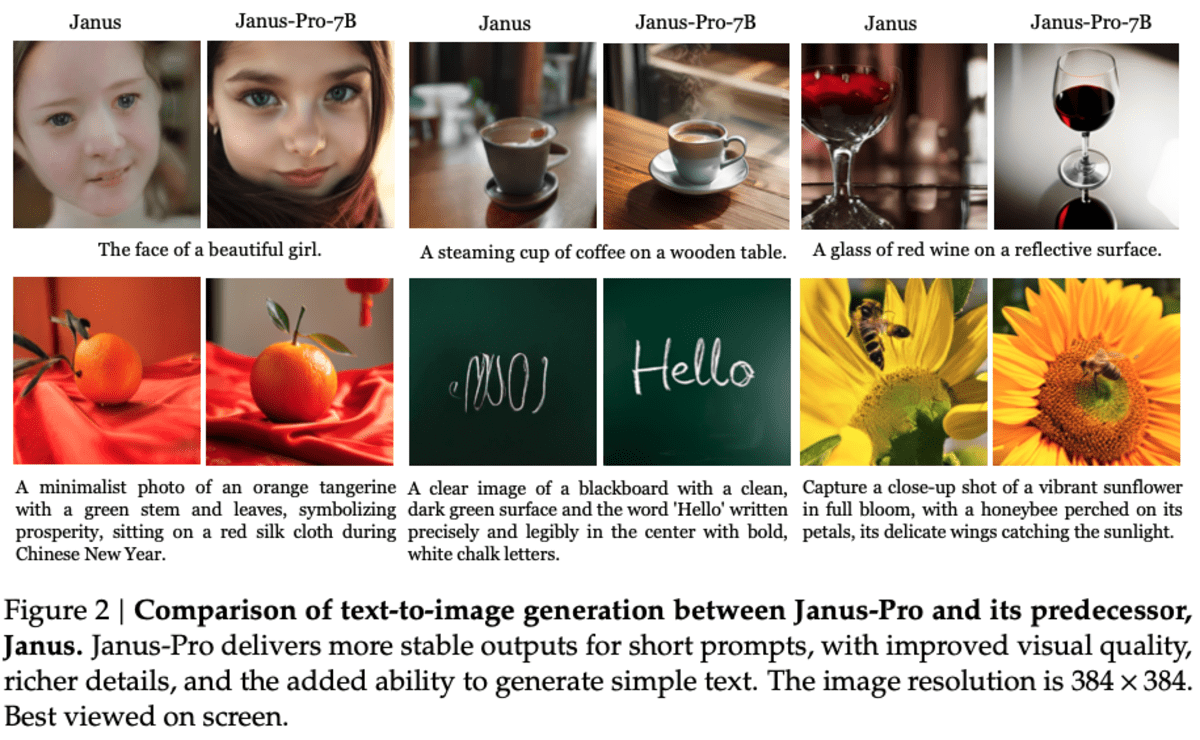
Image from: deepseek-ai/Janus-Pro-7B
For understanding images, Janus-Pro relies on SigLIP-L as its vision encoder and accepts inputs at a resolution of 384 x 384. For generating images, it employs a dedicated image tokenizer, enabling the model to create visuals from textual descriptions.
What sets Janus-Pro apart is its straightforward yet efficient architecture. By separating visual comprehension from visual generation while still leveraging a unified transformer, the model gains greater versatility and delivers strong performance on both fronts.
Best for: image comprehension, visual reasoning, image captioning, visual question answering, and text-to-image creation.
# 5. MiniCPM-o 4.5
MiniCPM-o 4.5 ranks among the most compelling open omni models available, as it is engineered for vision, speech, and full-duplex multimodal live streaming. It can ingest text, images, video, and audio, then produce both text and speech outputs.
This makes it well suited for creating live AI assistants capable of seeing, listening, and speaking simultaneously. It can power real-time voice conversations, video comprehension, OCR, document parsing, visual question answering, speech-based interaction, and multimodal assistant workflows.
The model contains a total of 9B parameters and integrates components including SigLIP2, Whisper-medium, CosyVoice2, and Qwen3-8B. This combination delivers robust visual, speech, and language abilities while keeping the model compact enough for practical local deployment.

Image from openbmb/MiniCPM-o-4_5
What distinguishes MiniCPM-o 4.5 is its full-duplex multimodal streaming capability. Unlike conventional multimodal models that wait for a complete upload before responding, MiniCPM-o 4.5 can handle continuous video and audio streams while simultaneously generating text and speech replies.
It can also support proactive interaction. This means the model can continuously observe a live scene and autonomously decide when to speak, comment, or respond, rather than only reacting after the user issues a direct prompt.
MiniCPM-o 4.5 also excels at visual understanding and OCR. It handles high-resolution images, high-frame-rate videos, and documents of varying aspect ratios, making it practical for document parsing, screen comprehension, and real-world visual AI applications.
Another significant benefit is deployment flexibility. The model supports PyTorch inference on NVIDIA GPUs, along with llama.cpp, Ollama, GGUF quantized formats, vLLM, and SGLang. This makes it easier for developers to run the model locally on GPUs, personal computers, and even certain edge devices.
Best for: real-time multimodal assistants, live video and audio comprehension, speech interaction, OCR, document parsing, edge AI, and full-duplex omni-modal applications.
# Final Thoughts
Omni models are growing in importance as AI evolves from basic chatbots into systems that people can rely on in practical, real-world scenarios. In everyday workflows, information rarely arrives in a single format. People work with text, images, documents, audio, video, screenshots, meetings, charts, and live conversations. For AI to become genuinely useful, it must handle all of these inputs in a natural way.
In the past, constructing this type of system typically required stitching together multiple models: one for speech, one for vision, one for OCR, one for text reasoning, and another for generation. That approach works, but it introduces complexity, latency, and greater engineering overhead. Every additional model increases the number of components developers need to manage.
The shift underway now is fundamentally different. More capabilities are being embedded directly within the model itself. Rather than connecting numerous separate systems, omni models are beginning to process multiple modalities within a single architecture. This makes real-time interaction far more practical, because the model can see, listen, reason, and respond with significantly lower latency.
This is particularly critical for live AI assistants, voice agents, video analysis tools, document intelligence systems, accessibility solutions, and agentic workflows. When multimodal comprehension is built into the model, the experience becomes smoother and more intuitive for the user.
Abid Ali Awan (@1abidaliawan) is a certified data scientist professional who loves building machine learning models. Currently, he is focusing on content creation and writing technical blogs on machine learning and data science technologies. Abid holds a Master’s degree in technology management and a bachelor’s degree in telecommunication engineering. His vision is to build an AI product using a graph neural network for students struggling with mental illness.
