



**3 US Stocks To Watch In August 2026 After Big Earnings Week**
The latest earnings week has handed investors a clear shortlist of US stocks to watch in August. Three of the market’s largest companies just reported, and Wall Street split its verdict between reward and punishment. The divide came down to one test, which AI spender could prove that customers are paying for the build. It left the winners with strong setups and one laggard facing a cautious road into August.
### Microsoft (NASDAQ: MSFT)
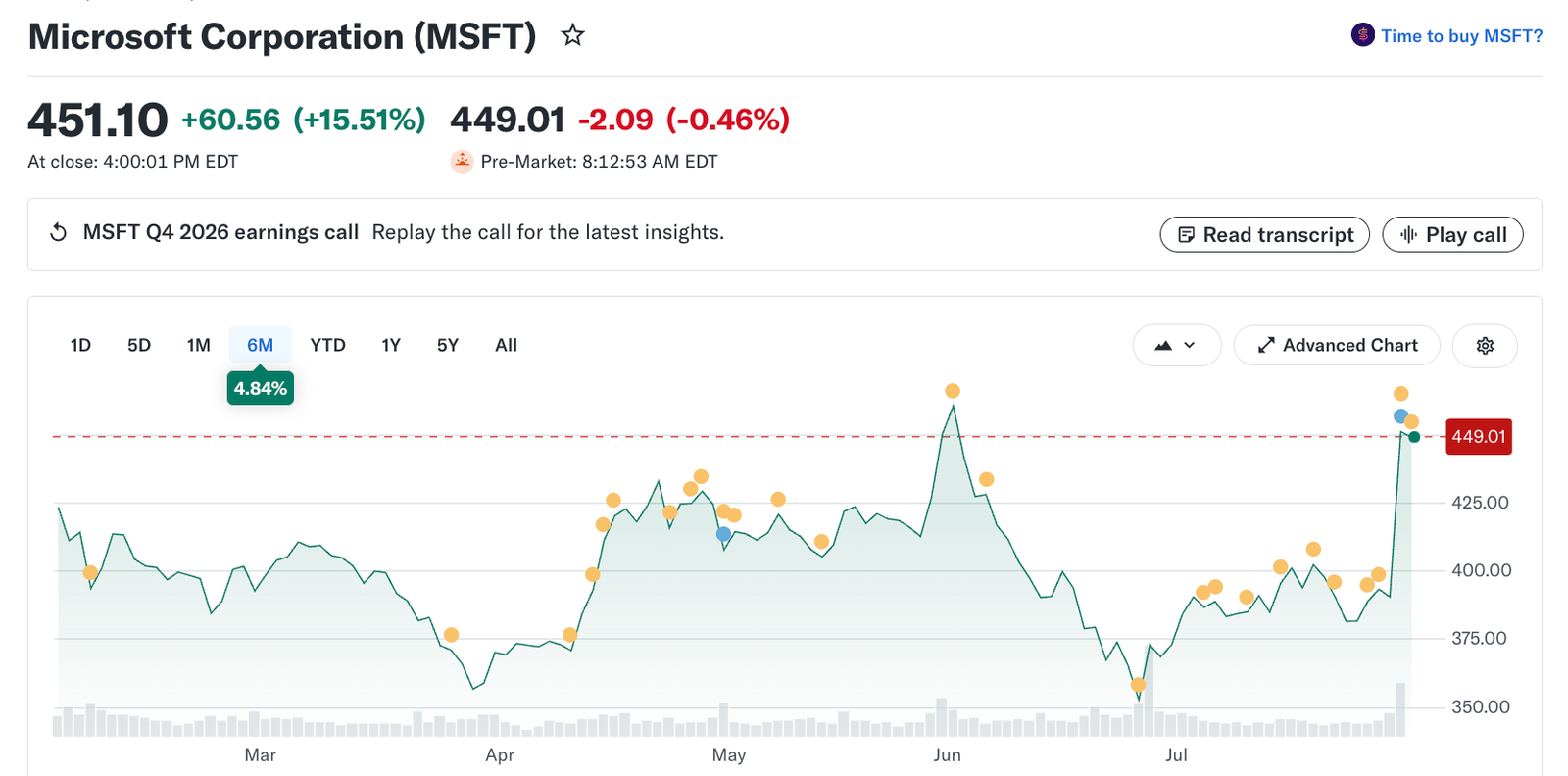
Microsoft soared about 15% to near $451 after its July 29 results, its biggest jump in months. Trading volume, the number of shares changing hands, hit its highest since June 22, which shows strong conviction behind the buying. Yet the rally is not fully convincing. That volume still sits below the heavy selling of late June, so buyers have not fully overpowered sellers.
The fundamentals explain the jump. Microsoft spent $41 billion on capital expenditure, the cost of building AI data centers, but backed it with a $678 billion book of signed customer contracts. That locked-in demand proves the spending is funded by real orders, which is the bullish case. It also guided Azure cloud growth toward 45%, and faster growth at that scale points to rising future revenue.
Wall Street agrees. The stock holds a Strong Buy rating, with 24 of 25 firms on Buy, signaling broad expectations of more upside. Only Barclays trimmed its target, a lone caution that matches the soft volume.
### Amazon (NASDAQ: AMZN)
Amazon carries the strongest analyst support of the three, making it one of the more bullish US stocks to watch into August. All 28 covering firms rate it Buy, with none on Hold or Sell, and every major desk raised its price target after earnings. That rare unanimity gives Amazon the cleanest bull case of the week.
The business explains the confidence. Amazon Web Services, its cloud arm, reaccelerated, and the company disclosed a $496 billion backlog of signed customer demand. When Alphabet and Meta raised their AI spending, investors sold both stocks, fearing spending with no proven payoff. Amazon raised spending too, but its backlog proved customers had already agreed to pay, so the stock rose instead.
There is a catch worth knowing. Amazon’s headline $5.75 per share reads like a huge beat, but most of it came from a one-time paper gain on its Anthropic stake, not from the core business. Strip that out, and profit still rose a healthy 43%, so the bull case holds. The real pressure is cash, because heavy AI spending has pushed free cash flow, the money a company keeps after building, into the red over the past year.
### Meta Platforms (NASDAQ: META)
Meta is the outlier among the top US stocks to watch. The stock fell about 8% to near $539 and now sits roughly 23% below its mid-July high. Unlike Microsoft and Amazon, Meta disclosed no backlog of signed demand, so it cannot yet prove the AI build will pay off. Its core apps also earned less, as Family of Apps operating income, the profit from Facebook, Instagram and WhatsApp, slipped to $23.4 billion from $25 billion. The strongest ad engine on earth delivered a weaker bottom line.
The chart warns of more risk. Meta’s CMF trended lower even as the price climbed from early June to mid-July, and a deep correction followed. It still has not cleared the 0.05 line that would confirm buyers are back, so the same bearish drop could repeat.
Analysts stay loyal but nervous. Meta keeps a Strong Buy, yet at least ten firms cut price targets overnight, including Citi to $800 from $850. That lower ceiling with unchanged ratings signals near-term caution even from believers.
### FAQ
**What was the key test that divided the winners from the laggard?**
The key test was whether AI spenders could prove that customers are actually paying for the build. Microsoft and Amazon showed backed-up demand through massive signed contracts and backlogs, while Meta could not demonstrate the same level of committed demand, leading to investor caution.
**Why did Microsoft’s stock jump 15% after earnings?**
Microsoft’s stock jumped due to strong fundamentals, including $41 billion in capital expenditure tied to AI data centers backed by $678 billion in signed customer contracts, and guidance pointing toward accelerated Azure cloud growth.
**What is the concern around Microsoft’s rally?**
The rally is not fully convincing because trading volume remains below late-June levels, indicating that sellers have not been fully overpowered by buyers, and institutional money, as measured by Chaikin Money Flow, has not yet reclaimed its recent peak.
**Why is Amazon’s earnings considered a “beat” despite a one-time gain?**
Amazon’s earnings beat largely because of a one-time paper gain on its Anthropic stake, but even excluding that item, profit rose 43%. The core business remains strong, supported by a $496 billion backlog and reaccelerating AWS growth.
**Why is Meta different from Microsoft and Amazon?**
Meta is different because it lacks the visible proof of customer demand for AI, reported weaker core app earnings, and saw its free cash flow collapse. Unlike the others, it cannot demonstrate that its AI investments will pay off imminently, leading to price target cuts and technical weakness.
### Conclusion
August 2026 is shaping up to be a test of durability for big tech. Microsoft and Amazon emerge with reinforced bullish cases, backed by contract backlogs and proven customer willingness to pay. Meta, however, faces skepticism and technical selling pressure, highlighting that even the strongest ad engine can struggle when AI cash burn outpaces tangible proof of return. As investors parse these dynamics, the divide between reward and punishment is likely to persist through the month.
