



# The Rise and Fall of Heavy-Duty Truck Manufacturing in Detroit
Detroit earned its nickname as Motor City largely because of passenger cars. But for decades, the city and its surrounding area were also the beating heart of America’s heavy-duty truck industry. The Big Three automakers — Ford, General Motors, and Chrysler (through its Dodge division) — all built massive Class 7 and Class 8 trucks designed to haul semitrailers across the country. Alongside them, independent manufacturers like Federal Motor Truck Company and Fruehauf Trailer Company carved out their own impressive legacies.
## How It All Started
The story of American trucking begins with the Model T. Ford’s revolutionary automobile proved that vehicles could do far more than just carry passengers. In 1914, a Detroit blacksmith and wagon maker named August Fruehauf saw enormous potential. When a local lumber merchant asked him to build a single-axle trailer that could be attached to a Model T roadster, Fruehauf took the challenge. The concept was a resounding success, and he quickly opened a factory to mass-produce semitrailers for all kinds of hauling applications.
Other entrepreneurs followed suit. Companies like Detroit Trailer Company and Martin Rocking Fifth Wheel Company sold accessories that allowed standard Model T frames to pull heavy loads. One firm, Smith Form-a-Truck Company, even developed a conversion kit that reinforced and extended a basic Ford chassis, adding a trailer pivot and heavier rear wheels fitted with solid rubber tires for better grip.
## Ford’s Truck Legacy
Ford wasted no time getting into the truck business in a serious way. In 1917, the company introduced the Model TT — its first dedicated truck. Based on the Model T car chassis, it featured a longer wheelbase, a stronger frame, a heavier rear axle, and a worm-drive transmission that replaced the car’s original bevel-drive unit. Buyers typically added their own custom bodies or trailers, often ordering them from carriage builders.
Demand grew fast. Ford produced 41,000 Model TTs in 1918, and by 1920, more than 135,000 had been built at Ford’s Highland Park plant in Michigan. In 1927, the company replaced the Model TT with the Model AA, which offered beefed-up frames and axles, a four-speed transmission, and stamped steel wheels for added durability.
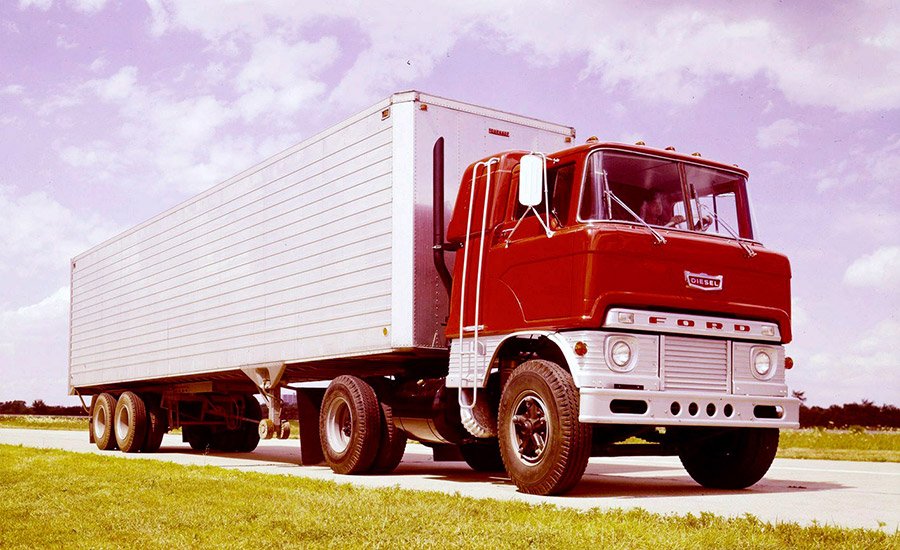
The Model BB arrived in 1933 with a flathead V-8 engine, a longer wheelbase, and a pair of rear wheels for carrying heavy loads. As regulations changed in the mid-1930s, cab-over-engine designs gained popularity because they offered a shorter wheelbase, a longer trailer, and better maneuverability. Ford embraced the trend with a distinctive COE design featuring a tall, oval-shaped radiator and a bulbous front end.
By the 1950s, Ford had developed the hugely popular C-Series, which featured a forward-hinged tilt cab for easy engine access. The trucks helped Ford capture over 31 percent of the U.S. truck market by 1957. In the 1960s, Ford launched the H-Series tilt-cab trucks, offering more than 500 engine-axle-transmission combinations.
To keep up with demand, Ford opened a state-of-the-art assembly plant on the northeast side of Louisville, Kentucky, in 1969. The massive facility employed over 3,500 people and was billed as the largest truck assembly plant in the world under one roof. The W-Series tractor was the first truck to roll off its line. Over the next decade, the plant expanded seven times to cover three million square feet. By 1979, it had built its one-millionth vehicle.
However, Ford shocked the industry in 1997 when it sold its heavy-duty truck operations to Daimler’s Freightliner division. At the time, heavy trucks only accounted for 10 percent of Ford’s total volume but required 40 percent of its factory floor space. Today, Ford trucks can still be seen hauling semitrailers in parts of Africa, Europe, and the Middle East, where vehicles like the F-Max are built in Turkey by Ford Otosan.
## General Motors and the GMC Brand
General Motors dominated the heavy-duty truck scene for many years. Shortly after its founding in 1908, GM acquired several companies, including Chicago-based Randolph Motor Car Company, Rapid Motor Vehicle Company, and Reliance Motor Truck Company. The GMC nameplate first appeared in 1911, and the brand quickly became synonymous with commercial vehicles.
In 1928, GM opened a massive truck factory in Pontiac, Michigan. The eight-million-dollar facility was hailed as the largest plant in the world devoted exclusively to building commercial vehicles. It featured multiple assembly lines that mass-produced medium and heavy-duty trucks, as well as buses. Sophisticated material handling systems — including escalators, chain conveyors, and electric hoists — moved parts and chassis through the facility with remarkable efficiency.
GMC’s output grew steadily. In 1928, the company produced more than 26,700 trucks. By 1934, it had unveiled its first cab-over-engine models, which allowed for greater payload capacity by shifting weight distribution to 33 percent on the front axle and 67 percent on the rear. In a landmark test run in 1935, a GMC T-46 tractor pulled a semitrailer loaded with nine tons from Chicago to Los Angeles and back in just over 146 hours, averaging 30 mph.
By the late 1930s, GMC had formed a diesel engine division and began developing the 71-Series powerplant for heavy-duty trucks. During World War II, production shifted to military vehicles, with GMC manufacturing over 583,900 units in various configurations.
After the war, GMC launched its H-Series in 1949. Within two years, the HDCR-650 model became the best-selling diesel truck in America. By 1951, GMC had surpassed Dodge to become the third-largest truck builder in the country, trailing only Ford and International Harvester. The company offered an incredible range — 75 basic model series, 224 different body and chassis types, and nine engine displacements.
GMC also pioneered automatic transmissions in heavy-duty trucks, introduced fiberglass body panels, and experimented with turbine engines during the 1950s and 1960s. Its radical DLR8000 tractor debuted at the 1958 Chicago Auto Show, featuring a compact cab just four feet deep that allowed for maximum-length semitrailers on all state highways.
GM’s final major entry into the heavy truck market was the General, a tandem-axle tractor introduced in 1977. A decade later, GM Volvo Heavy Truck Corporation was formed as a joint venture with Volvo, and production gradually shifted away from the Pontiac plant. In 1988, GM partnered with Penske Corporation to create Detroit Diesel Corporation, which was later acquired by DaimlerChrysler in 2020 and now operates as a subsidiary of Daimler Truck North America.
## Dodge and Chrysler’s Truck Ambitions
Dodge also has deep roots in truck manufacturing. The Dodge Division of Chrysler Corporation acquired Graham Brothers Company in 1928, a leading manufacturer of medium and heavy-duty trucks. Graham operated a large factory in Evansville, Indiana, and later added a Detroit assembly plant. When demand surged in the early 1920s, Chrysler absorbed the Graham brand into Dodge in 1929.
Dodge built a new truck plant in Warren, Michigan, that opened in 1938. Designed by the legendary architect Albert Kahn, the 693,000-square-foot factory could produce up to 700 vehicles per day. It featured an elaborate network of material handling conveyors spanning thousands of feet, overhead monorail systems, and advanced welding techniques. The plant was a masterpiece of industrial efficiency.
During World War II, Dodge mass-produced military trucks and earned a reputation for durability and performance. After the war, the company’s B-Series trucks featured redesigned cabs, improved visibility, and the iconic ram hood ornament. In the 1950s and 1960s, Dodge offered trucks equipped with powerful Hemi V8 engines, and it partnered with Cummins Engine Company to mass-produce diesel-powered rigs.
In 1964, Chrysler attempted to acquire Mack Trucks Inc., but the federal government blocked the deal, citing antitrust concerns. To stay competitive, Dodge developed heavy-duty COE tilt cabs and opened a dedicated 100,000-square-foot plant in Warren in 1966 for assembling large diesel trucks. Heavy truck production was eventually consolidated at the Sherwood Assembly Plant, which operated until the mid-1970s. The Big Horn series, produced from 1973 to 1975, represented Dodge’s final serious push in the heavy truck market.
## Independent Giants: Federal and Fruehauf
Detroit was not just home to the Big Three. Independent manufacturers also played a vital role. Federal Motor Truck Company operated from 1910 to 1959 and was one of the largest independent truck builders in the United States. Unlike many competitors who only built chassis, Federal constructed its own cabs and bodies in-house, sourcing engines and transmissions from companies like Buda, Continental, Cummins, Hercules, and Waukesha.
Federal’s 500,000-square-foot assembly plant on the Southwest Side of Detroit featured a continuous-chain conveyor running along a 600-foot-long final assembly line. All Federal truck frames used a distinctive “fish belly” design for added strength at stress points. In 1927, the company reached peak production of 7,600 units in a single year. Federal survived the Great Depression and thrived with wartime military contracts, but declining sales in the early 1950s led to its eventual closure in 1959.
Fruehauf Trailer Company was equally iconic. Founded by August Fruehauf, the company’s flagship facility was located on Harper Avenue on Detroit’s Northeast Side. Fruehauf pioneered numerous innovations in trailer design, including automatic coupling systems, liftgates, torsion bar suspensions, and lightweight materials like aluminum and stainless steel. One of its most celebrated products was the Aerovan, a streamlined trailer whose design was said to be inspired by the principles of airplane aerodynamics.
Fruehauf’s business expanded dramatically in the late 1930s and early 1940s, leading to the construction of a massive new factory in 1939. However, mismanagement and financial difficulties in the 1970s and 1980s eventually caught up with the company. Fruehauf declared bankruptcy in 1996 and was acquired by Wabash National Corporation.
## Frequently Asked Questions
**Q: Why did Detroit become a hub for heavy truck manufacturing?**
A: Detroit already had deep roots in automotive engineering, a skilled workforce, and established supply chains from the passenger car industry. The city’s central location and access to major waterways and rail networks also made it ideal for transporting large components.
**Q: What was the most important truck innovation from this era?**
A: The cab-over-engine (COE) design was arguably the most transformative. By placing the driver’s cab over the engine, manufacturers could create shorter wheelbases that allowed for longer trailers, improving cargo capacity and maneuverability.
**Q: Why did Ford exit the heavy-duty truck business?**
A: Ford sold its heavy truck operations in 1997 because heavy trucks represented only a small fraction of its overall volume but consumed a disproportionate amount of factory space and resources. At the time, Ford was also earning significant profits from SUVs, which offered better per-unit returns.
**Q: Did any of these companies still make trucks today?**
A: Yes. While Ford exited heavy-duty truck production in North America, GMC continues to operate under General Motors as a prominent truck brand. Dodge no longer exists as a standalone truck maker, but Chrysler’s parent company still manufactures light commercial vehicles.
**Q: What happened to Fruehauf?**
A: Fruehauf experienced financial and legal difficulties in the 1970s and 1980s due to poor management decisions. It filed for bankruptcy in 1996 and was purchased by Wabash National Corporation.
**Q: Were trucks built in Detroit during World War II?**
A: Yes. All three major manufacturers — Ford, GM/GMC, and Dodge — shifted significant portions of their truck production to military vehicles during World War II, producing hundreds of thousands of units in various configurations for the war effort.
## Conclusion
The heavy-duty truck manufacturing era in Detroit represents a remarkable chapter in American industrial history. From the humble beginnings of August Fruehauf’s single-axle trailer in 1914 to the massive, highly automated assembly plants of the 1960s and 1970s, Detroit’s truck builders helped shape the modern freight and logistics landscape. The Big Three automakers — Ford, GM/GMC, and Dodge/Chrysler — alongside independent pioneers like Federal Motor Truck Company and Fruehauf Trailer Company, established a legacy of engineering excellence and manufacturing innovation.
While many of these names have faded from the heavy truck market or evolved into different forms, their influence remains visible on highways across North America and beyond. The trucks, factories, and engineering breakthroughs that came out of Detroit helped build the infrastructure of modern commerce and continue to inspire manufacturers and engineers today.
Thank you for reading
