



Key Insights
- Warden has reframed itself round an agentic pockets and a Do-It-For-Me financial system, the place customers delegate intent, and the pockets carries execution end-to-end with no handbook motion from the person.
- Warden splits the agentic pockets into separate roles inside one interface: Agent Hub handles discovery, Warden Studio handles agent creation, Agent Passports deal with id and permissions, and Statistical Proof of Execution (SPEX) information execution.
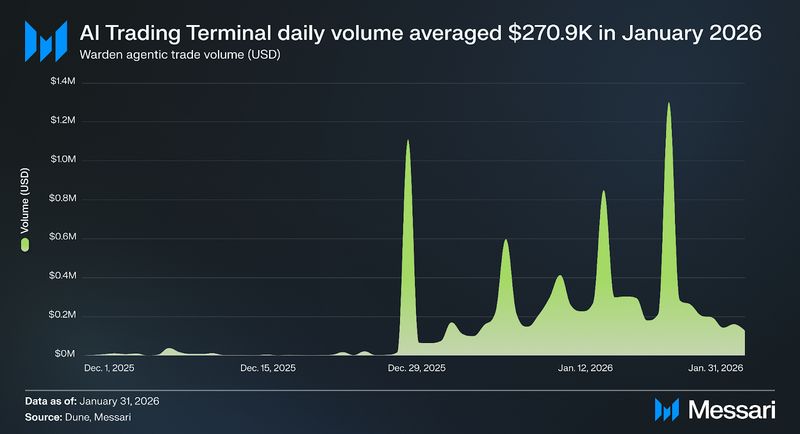
- Warden launched Buying and selling Terminal and Betflix in This autumn 2025, averaging $270.9K and $1.4 million in every day buying and selling quantity, respectively, displaying Warden is already driving repeat, high-frequency execution contained in the agentic pockets.
- The Moltbook & OpenClaw safety incidents showcase how Warden solves frequent points as agent distribution scales. Warden’s strategy is to bind brokers to identities with scoped permissions, after which go away an execution file for customers and integrators to examine.
- The WARD token launched on Feb. 4, 2025, with preliminary alternate listings on Kraken, Kucoin, MexC, Binance Alpha, and Bitget.
Introduction
Warden is a Layer-1 community designed to embed AI into onchain purposes, with the purpose of creating agent outputs constant and secure sufficient to be consumed by contracts and workflows with out counting on just one social gathering to confirm outcomes. In August 2025, Warden launched Manifesto 2.0, formalizing a method to get verifiable brokers into actual person workflows.
Warden’s core execution verification mechanism is named Statistical Proof of Execution (SPEX). SPEX checks agent outputs probabilistically by sampling and validator consensus. The design trades deterministic ensures for decrease value and latency, with specific false-accept and false-reject charges that may be tuned by pattern dimension and acceptance thresholds.
Following the discharge of the manifesto, Warden started concentrating on person adoption inside the Agent Hub, a product the place groups publish brokers and assets, customers uncover them, and every name produces a receipt that downstream contracts can belief. Agent Passport anchors id and portability, and Warden Studio covers constructing, testing, and monitoring. Collectively, these parts reposition Warden from an agent framework to an agentic pockets, the place customers uncover and run brokers instantly in-wallet as a substitute of by a separate app.
Warden carried out its token technology occasion (TGE) on Feb. 4, 2026, launching the WARD token. Warden now has a dwell coordination token for the community to pay for safety, fund incentives, and run governance utilizing the identical asset that customers maintain and transact with. As Warden’s agentic pockets thesis has moved into product, the roadmap now focuses on scaling distribution, driving repeat in-wallet utilization, and bettering execution continuity for customers.
Web site / X / Discord / Docs
Warden’s Agentic Pockets Thesis
Agentic wallets are rising as the sensible interface between AI and crypto as a result of they focus intent, execution, and agent discovery right into a single floor. As an alternative of customers hopping between apps and chains to finish a workflow, the pockets can route execution throughout venues within the background whereas preserving the person in a single place. For DeAI, the present downside is executing actions that customers can audit and management.
An agentic pockets goals to resolve this downside by making extra advanced actions really feel like a single motion to the person. A person states an consequence, and the pockets coordinates the steps:
- “Swap $200 USDC on Base into SOL and stake it.”
- “Move my idle stablecoins into the best net yield under 3 percent drawdown.”
- “Open a 2x ETH perp with a stop-loss at 5 percent and take-profit at 12 percent.”
These agent workflows break when the pockets can interpret the request however can not execute it end-to-end. The person would possibly get a chat response, however nonetheless has to manually bridge, swap, approve, and signal throughout a number of apps. In that method, “agentic wallet” is only a new UI on prime of the identical handbook workflows.
Warden’s Do-It-For-Me financial system is a guess that the agentic pockets can deal with these steps with out sacrificing person security. For this to work, Warden has to do three issues properly: make brokers simple to seek out contained in the pockets, run full workflows throughout chains and venues, and preserve third-party brokers identifiable and permission-scoped because the Agent Hub scales.
Warden Studio and the Agent Hub
Warden’s guess on agentic wallets depends on unifying agent improvement, discovery, and execution inside a single surroundings, giving builders a direct path to deploy brokers the place customers already maintain belongings. Warden Studio and the Agent Hub are the 2 surfaces that make this attainable, with Warden Studio serving as an agentic workshop the place brokers are constructed and printed, and the Agent Hub as {the marketplace} the place customers discover new brokers, run workflows, and obtain receipts of their actions.
Warden Studio
The alpha model of Warden Studio launched in January 2026 and is the developer console for constructing, testing, and publishing brokers instantly into Warden’s app. Warden Studio offers builders with a direct path from agent improvement to distribution, permitting builders to publish brokers as in-app Neighborhood Brokers with out requiring separate infrastructure. Brokers deployed by Studio are additionally minted on Warden Chain with Agent Passports, giving every agent an ERC-8004 appropriate secure id that may be referenced and tracked over time.
Studio is the place Warden turns agent publishing right into a repeatable, systematic launch course of. Builders can publish brokers constructed with present frameworks, together with broadly used stacks like LangChain and OpenClaw, instantly into the Agent Hub. Warden Studio intends to shorten the event lifecycle from prototype to dwell itemizing and to present builders enough visibility to watch and iterate after launch.
AVRs are Warden’s packaging format for instruments and knowledge sources that brokers can name asynchronously. Briefly, they’re the reusable elements that enable brokers to carry out as multi-purpose scripts. An AVR would possibly wrap a pricing feed, a buying and selling API, or an offchain compute step, then expose it in a manner that a number of brokers can reuse. AVR reuse is essential as a result of a well-maintained AVR can energy many brokers, and fixes or safety critiques could be utilized throughout the complete catalog.
Two design decisions in Warden Studio tie again to the agentic pockets and the “Do-It-For-Me” financial system:
- Id is required for publishing: If brokers are going to turn out to be installable workflows, customers want a transparent view of what ran and who printed it to allow them to consider popularity and permissions. Warden’s Agent Passport ties id to listings and retains it transportable throughout the ecosystem.
- Monetization is embedded instantly into the agent publication workflow: Warden offers built-in fee capabilities and billing choices instantly in Studio so builders can begin incomes instantly with none further integration work.
Warden Studio is designed to stop the agentic pockets from turning into a listing of one-off, unmaintained brokers. By linking publishing to agent passports and integrating built-in monetization instruments, Warden goals to assist builders set up a monitor file and earn ongoing income for sustaining and updating brokers over time.
Agent Hub and Neighborhood Brokers
The Agent Hub is the place Warden turns the provision of brokers from Studio into utilization, packaging brokers as in-wallet merchandise. The Agent Hub is each a market and an execution floor, as builders publish brokers and assets to the Hub whereas customers uncover them. Nevertheless, the Hub additionally wants a typical output format that survives outdoors its personal surroundings. Warden’s resolution for that is receipts. Every agent run produces a receipt that information what was requested, what the agent used, and what it returned. Receipts are what make agent outputs transportable by recording this info in a format that different methods can confirm.
Warden’s agent execution lifecycle is straightforward and maps on to the intent-to-execution downside, which arises at any time when an agent’s output must set off actual onchain motion with out drifting from what the person meant:
- Activity: The person or utility request is shipped to an agent, usually paired with assets similar to knowledge or AVRs that the agent can use.
- Verified name: SPEX verifies a statistical pattern and commits an onchain receipt for the run.
- Settled motion: The ensuing state change is then tied again to the receipt, so the end result stays auditable.
Warden’s Agentic Pockets differentiates itself from different LLM chat wrappers by enabling end-to-end execution throughout chains and venues. Nevertheless, multi-step workflows can nonetheless collapse mid-run, leaving customers with partial execution or a distinct consequence than requested. This solely works when intent stays intact all through the complete run and when the system can present what occurred in a manner that different methods can confirm.
Neighborhood Brokers make sustaining constant intent from request to execution a lot more durable, since permissionless publishing rapidly expands stock, and spam, cloned, and malicious brokers usually seem first. The much less apparent threat on this surroundings is permission creep, the place an agent asks for broad authority to carry out a slim activity. If Warden needs customers to route onchain actions by brokers contained in the Agent Hub, Warden must make it apparent which developer account printed the agent, what the agent is allowed to do, and what the agent truly does in the meanwhile of use. Warden plans to mitigate these id dangers through passports, permissions for scope, and receipts for auditability.
New Brokers & Integrations
Since mid-December 2025, Warden has been filling out the Agent Hub with production-grade brokers, whereas Warden Studio’s alpha launch provides third events a direct publishing path into {the marketplace}. In parallel, Warden has been including integrations that preserve these brokers usable inside a single move, so customers shouldn’t have to take handbook steps outdoors Warden.
Past the default Warden Agent, current releases have targeted on repeat workflows and in-wallet execution, together with:
- Clever DCA: Automates scheduled swaps on Uniswap throughout Ethereum, Base, BSC, and Arbitrum, with activity administration similar to checklist, monitor, or deactivate constructed into the agent move. Warden shipped further DCA workflow controls in early January 2026.
- Portfolio Evaluation Agent: A read-only Neighborhood Agent that analyzes portfolios utilizing CoinGecko and Alchemy throughout Solana and EVM wallets. It delivers monitoring and efficiency breakdowns with out requiring transactional authority, which units an early norm for scoped brokers because the group catalog expands.
- Caesar Analysis: Added with the Neighborhood tab launch on Dec. 18, 2025, Warden launched Caesar-powered analysis brokers for each crypto and scientific analysis, increasing onchain and offchain analysis inside the Hub. Crypto Analysis focuses on crypto-specific matters, similar to initiatives, traits, and blockchain knowledge, whereas Deep Analysis focuses on scientific analysis, together with summarizing peer-reviewed literature and evaluating research and experimental outcomes.
New integrations that assist these workflows in-wallet embrace:
- Arbitrum: In late 2025, Warden added assist for Arbitrum, extending the attain of Hub workflows with out altering the person floor. Arbitrum has successfully turn out to be the default chain for Buying and selling Terminal customers, since Warden routes perps funding and execution by it even when customers begin from different supported networks.
- ZeroDev: Aimed toward eradicating the mechanical friction that breaks multi-step flows, ZeroDev offers account abstraction through gasoline sponsorship and transaction batching, permitting Warden to break down workflows that might usually require repeated approvals and gasoline administration right into a tighter execution sequence. For agentic wallets, this reduces the variety of instances a person has to step again in simply to maintain a workflow transferring.
- OneBalance: Targets cross-chain execution continuity by unified balances, price abstraction (pay gasoline with completely different tokens), and built-in cross-chain routing. OneBalance is supposed to let the brokers from the Hub execute throughout chains with out turning the person expertise right into a sequence of chain switches and handbook transfers.
Studio and the Agent Hub increase agent distribution, however distribution solely compounds when workflows stay in a single move and delegation stays bounded by clear parameters. Warden’s most up-to-date integrations are aimed toward preserving execution contained in the pockets by eradicating the operational steps that normally break delegation. Collectively, they kind the inspiration for a real agentic pockets.
Behavior Loops: The AI Buying and selling Terminal & Betflix
For Warden’s Agentic Pockets to succeed, Warden wants greater than agent provide and integrations, as it might solely turn out to be the default when customers return for constant, high-frequency workflows. Since late November 2025, Warden has leaned on two repeat-use merchandise that pressure-test the agentic pockets floor: perps buying and selling and swipe-based micro-bets.
AI Buying and selling Terminal
Warden launched the AI Buying and selling Terminal on Nov. 28, 2025, positioning it as an in-wallet perps interface constructed on Hyperliquid. The terminal consists of the flexibility to set market and restrict orders, a devoted buying and selling pockets that accepts USDC deposits from Arbitrum, Ethereum, Base, and BSC, and embedded market tooling similar to charts, order e-book, and AI indicators. On Dec. 30, 2025, Warden added a aggressive buying and selling program with rewards, designed to maintain perpetual exercise constant contained in the app.
Perpetual futures buying and selling is an space the place the agentic pockets thesis is battle-tested by a posh workflow and low tolerance for error. As of Feb. 3, 2026, every day quantity topped $1 million on two separate days since launch, and averaged $270,870 in January 2026. This stage of utilization suggests the terminal is already functioning as an actual execution floor. The terminal is designed to hold intent by funding, order placement, and place administration with out dragging the person into operational steps mid-flow. Warden mitigates the chance of errors by requiring specific confirmations in every workflow and by having customers evaluation order particulars earlier than opening a place, thereby drawing a transparent boundary between delegation and management.
Betflix
Launched on Oct. 21, 2025, Betflix is Warden’s quickest suggestions loop for high-throughput testing of the agentic pockets. It’s a swipe-based prediction recreation the place customers swipe proper or left to go lengthy or quick. Every spherical lasts 5, 15, or 30 seconds, positions auto-close or liquidate, and outcomes show instantly. Bets are at present restricted to $2, $5, or $10, with 100x leverage, and gameplay makes use of a separate Betflix pockets funded with USDC on Solana. As a result of customers can repeat the identical motion dozens of instances in a single sitting, latency, settlement timing, and edge circumstances turn out to be far more essential. Just like the AI Buying and selling Terminal, Betflix makes use of a separate pockets that isolates the product’s threat from the remainder of the account.
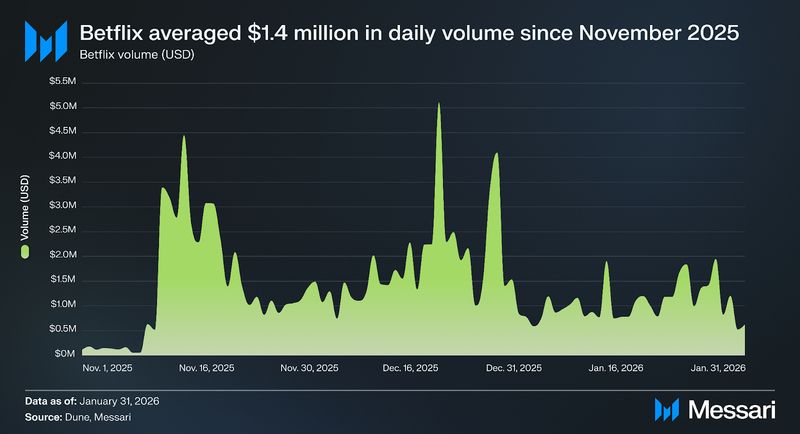
Betflix averaged $1.4 million in every day quantity from Nov. 1, 2025, by Jan. 31, 2026, demonstrating a stage of exercise that gives Warden with one other venue to check its intent-to-execution mannequin in an actual surroundings. Alongside Buying and selling Terminal, Betflix provides a repeat, high-frequency use case that retains customers coming again contained in the pockets, demonstrating that Warden can keep execution continuity below load, with clear management factors that preserve person intent from drifting as workflows pace up or turn out to be extra advanced.
Belief and Security Rails
Warden is already operating actual execution contained in the pockets, with the Agent Hub filling out, workflows getting quicker, and extra of the person journey being consolidated from throughout a number of apps and chains onto a single floor. Nevertheless, that progress raises the stakes as brokers achieve broader authority and the Agent Hub shifts towards permissionless brokers. In that surroundings, belief needs to be encoded within the product by id, scoped permissions, and an execution file that continues to be verifiable outdoors Warden.
Warden addresses this with layered controls throughout id, permissions, and auditability:
- Verification: Warden makes use of Statistical Proof of Execution (SPEX) as a probabilistic verification layer for duties with non-deterministic outputs, together with LLM-driven workflows. In an agentic pockets, the agent output from a person response is commonly the enter to a transaction. For non-deterministic workflows, reproducibility will not be a security test, so SPEX replaces deterministic reproducibility with a probabilistic execution test to present different methods one thing stronger than popularity to reference.
- Id: Warden formalizes agent id by Agent Passports generated throughout publication. A Passport consists of id, agent metadata, and monetization settings, and is created as a part of the Studio publishing move. This makes the builder and the agent model seen on the level of use. Passports implement the ERC-8004 commonplace, positioning Warden as an early mainnet adopter of onchain agent id. As Neighborhood Brokers scale, id turns into more and more essential as a result of a permissionless catalog invitations impersonation, and customers want a secure solution to distinguish actual brokers from clones earlier than granting permissions or operating a workflow.
- Confirmations and Scope: Warden retains specific affirmation steps in execution flows, together with commerce placement within the Buying and selling Terminal. On the pockets aspect, commonplace chat-driven actions additionally finish in person affirmation, with the agent surfacing transaction particulars earlier than execution. Though these are fundamental patterns, they matter extra in an agentic pockets as a result of intent has real-world penalties.
- Proof of Inference and Auditability: Proof of Inference serves because the persistent file of agent runs, tying inputs and outputs to an execution occasion that different methods can confirm and reference. Proof of Inference must be considered because the receipts that bridge between offchain inference and onchain settlement, enabling downstream contracts to devour outcomes with out bespoke integrations. That is what retains delegation inspectable as soon as third-party brokers publish into the Agent Hub.
Moltbot as a Case Research
The current Moltbook and OpenClaw (previously Clawd and Moltbot) incidents are a helpful benchmark for Warden as a result of they expose the actual assault floor of agent methods at scale. Moltbook is a social feed constructed round AI agent accounts, whereas OpenClaw is the companion agent framework being deployed to run these accounts and automate actions throughout platforms. What made this wave of adoption notable was how rapidly it unfold as soon as setup turned simpler. As quickly as non-technical customers may deploy brokers, attackers instantly started concentrating on id, tokens, and permission edges, as a result of these customers had no technical functionality to put in correct safeguards. Wiz reported {that a} fundamental misconfiguration uncovered round 35,000 e-mail addresses, non-public messages, and about 1.5 million API authentication tokens. With these tokens, an attacker can impersonate an agent and take actions that look reputable to customers and downstream methods. Moreover, a separate evaluation by ZeroLeaks exhibits how rapidly agent methods fail when safety defaults are lacking, scoring simply 2/100 on its resistance to immediate injection and system immediate extraction assaults. The evaluation indicated immediate injection assaults succeeded 91.3% of the time, and system immediate extraction assaults succeeded 84.6% of the time, which is sufficient for attackers to reliably hijack agent conduct and exfiltrate delicate knowledge.
Warden’s security mannequin secures the very vulnerabilities Moltbook and OpenClaw uncovered. When brokers are simple to deploy and might act on behalf of customers, attackers goal id, authority, and auditability:
- Id: Within the case of Moltbook, leaked tokens and lookalike accounts made impersonation really feel reputable on the UI layer by merely cloning a Moltbook profile. If Warden’s publish-path id had been the default, agent id would resolve to an Agent Passport created at publication, tied to a secure onchain id and model that features popularity. Whereas it doesn’t make credential theft unattainable, it offers a a lot clearer floor for distinguishing an actual agent from a clone earlier than a person runs it or grants permissions.
- Authority & Containment: One of the crucial obtrusive failure modes round OpenClaw is {that a} compromise in a single place turns into entry all over the place, as a result of the agent floor and the person’s primary stability usually share the identical authority boundary. If Warden’s pockets segmentation had been in place, abuse of a single move could be contained to solely that move, relatively than impacting the complete account.
- Auditability: It’s clear from each the Moltbook and OpenClaw incidents that the harm is commonly invisible till it’s too late. API tokens get copied, a bot begins behaving in a different way, and the one actual proof is a feed of posts or a session transcript that may be edited, deleted, or misplaced. If Warden’s execution file mannequin had been utilized, profitable implementation would create a receipt tied to a selected agent id and model, with the inputs, referenced assets, and ensuing actions captured as a sturdy artifact. SPEX provides a verification step for non-deterministic workflows, so downstream methods have concrete steering when deciding whether or not to simply accept an output. Whereas this won’t cease each takeover, it turns compromises into one thing observable and attributable. With a SPEX integration, operators can level to particular receipts generated by Proof of Inference, determine when conduct diverged, and quarantine the offending agent model earlier than it causes additional harm.
WARD TGE
WARD Token Era Occasion
WARD’s TGE occurred on Feb. 4, 2026, gaining over $350 million in buying and selling quantity within the first 24 hours. Token provide, distribution, and utility are lined in our final Pulse Report.
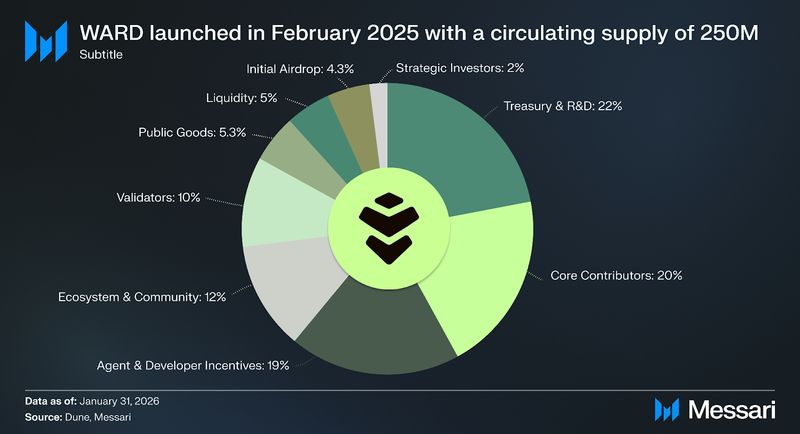
Warden has indicated further alternate listings scheduled for February 2026. As of Feb. 4, 2026, alternate listings embrace KuCoin, Kraken, Bitget, and MEXC, with perps accessible through Aster.
Conclusion
Warden’s most up-to-date updates have centered on creating an agentic pockets. The Agent Hub handles distribution and discovery inside the pockets, whereas Warden Studio permits the event of latest brokers. Agent Passports signify possession and provides brokers a persistent id. Direct in-app funds incentivize builders to keep up brokers as a substitute of transport as soon as and leaving. With strong infrastructure in place, Warden attracted robust every day quantity on the Buying and selling Terminal and Betflix. Regardless of each being solely months outdated, the constant quantity in each merchandise signifies Warden’s Agentic Pockets can deal with excessive throughput whereas sustaining constant intent-to-execution.
Current Moltbook and OpenClaw incidents have highlighted extreme points associated to id gaps, permission sprawl, and invisible execution. Warden’s stack is structured to mitigate these failures by Passports, scoped permissions, and an execution file designed to outlive malicious inputs and weak third-party integrations.
Lastly, WARD launched on Feb. 4, 2026, because the community coordination token, giving the agentic pockets a local asset to cost execution, fund incentives, and anchor governance across the similar workflows customers run day after day. Early CEX distribution throughout Kraken, KuCoin, MEXC, and Bitget units Warden as much as scale distribution and liquidity whereas it expands the Agent Hub and Studio. Close to-term, the query is how properly Warden continues to deal with execution high quality at scale, together with preserving the Hub curated sufficient to stay helpful, open sufficient to develop, and secure sufficient that customers proceed delegating extra actions contained in the pockets relatively than taking any handbook motion.
