



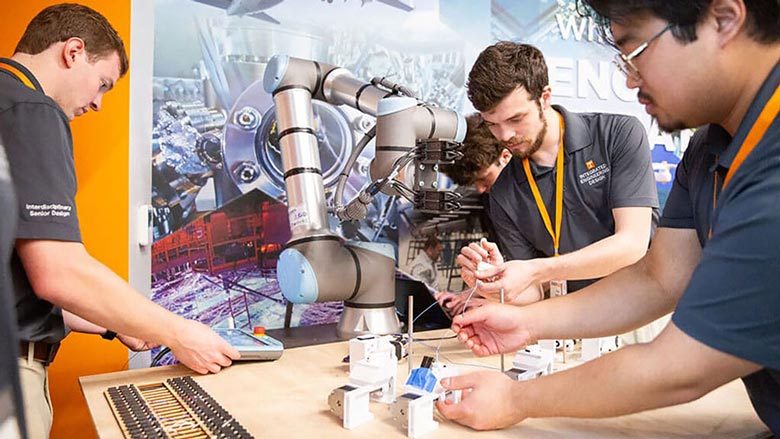
Due to their complexity, wiring harnesses are historically troublesome to assemble with automation. Nonetheless, a staff of younger engineers on the College of Tennessee is tackling the problem. They’re utilizing a six-axis collaborative robotic to automate meeting steps resembling terminal insertion and wire routing.
“Wiring harnesses are essential for controlling the electrical components of an automobile and transmitting power to every part of the vehicle,” says Keith Stanfill, Ph.D., P.E., a mechanical engineering professor and director of UT’s built-in engineering design program. “The bundled units of wires and cables are accountable for air baggage, ABS brakes, local weather management and engine administration.
“Their assembly is one of the most labor-intensive and complex aspects of manufacturing,” explains Stanfill. “Being able to automate the process would help the auto industry with labor shortages, rising production volumes, cost efficiency and quality control.”
An interdisciplinary senior design staff at UT was not too long ago tasked with that problem. They’re working with engineers at Nissan Motor Co. to develop a solution to totally automate the wiring harness meeting course of.
The challenge options six college students from the Tickle Faculty of Engineering and one scholar from the Haslam Faculty of Enterprise. The engineers hail from a number of disciplines, together with laptop, electrical and mechanical engineering.
“The mission of the integrated engineering design program is to increase the number of horizontal and vertical design interactions for engineering undergraduates,” explains Stanfill.
“Horizontal interactions allow students across the University of Tennessee to collaborate in interdisciplinary courses on authentic design challenges,” Stanfill factors out. “Vertical interactions provide opportunities for seniors to first-year students within their own discipline to work together on real-world design problems.”
Searching for fast solutions on meeting and manufacturing subjects?
Attempt Ask ASM, our new sensible AI search instrument.
Ask ASM
To graduate, all engineering seniors have to finish a capstone design challenge. The bulk do a challenge inside their very own self-discipline. Nonetheless, the interdisciplinary senior design (ISD) program supplies a solution to work with college students from nonengineering applications.
“Each team has at least one business student, because all engineering projects ultimately have a business driver behind them,” says Stanfill. “Each group is coached by faculty from the business and engineering schools.”
The tasks cowl quite a lot of subjects starting from additive manufacturing to robotic leak detection and e-bike batteries to orthopedic implants. One group of scholars is at the moment within the strategy of analyzing, designing and testing becoming a member of mechanisms to be used in hypersonic automobiles.
The sponsoring firm supplies a number of liaisons for the technical and enterprise elements of the tasks. For example, the wire harness automation staff meets repeatedly with Aaron Corridor, an engineer at Nissan’s meeting plant in Smyrna, TN.
“At Nissan, engaging with student teams from the University of Tennessee on real-world challenges through ISD projects offers significant benefits,” says Corridor. “It brings fresh perspectives and innovative solutions to our projects, helps us build a talent pipeline by identifying and nurturing potential future employees, and enhances our brand visibility and reputation within the academic community.”
Two ISD groups are at the moment engaged on the wiring harness challenge. One is targeted on streamlining the design of connectors, wire chopping and termination for automation. The opposite group is trying to completely automate the routing and administration of wires throughout harness fabrication.
The latter staff is utilizing a UR10e cobot. As well as, they’re exploring purposes that contain power sensors and imaginative and prescient system expertise.
The aim for the 2 groups is to have a completely built-in system with a completely pinned wiring harness prepared for wrapping earlier than the scholars graduate in mid-Could.
The engineers began the challenge by making a software program program that gives the robotic with details about the place the connectors are situated and the place the wires must go. Then, this system autogenerates a path for the robotic.
“Both ends of the wires have to be inserted into two specific connectors, but there’s a general path the wire has to follow to make the subsequent taping of the harness easier,” says Stanfill. “The program knows the location of the connectors and the pegs, and [the robot] uses that knowledge to generate an optimal path.”
In line with Stanfill, automotive wiring harnesses are difficult to automate for a number of distinctive causes. “Wires are flexible, but robots and other automation systems are optimized for more rigid elements,” he factors out. “There are lots of alternatives for tangling.
“Wiring connectors are also designed to provide acoustic feedback, such as a clicking sound, when terminated wires are properly inserted, requiring a system with precision and compliance to thread the needle and feedback to sense proper insertion,” explains Stanfill.
“The terminations on the wires are tiny and must be aligned precisely so they can lock into the connector and function properly,” says Stanfill. “Operators manually building the harness hear a click when the pin is inserted correctly and feel a minimally perceptible bump.”
A few of the largest obstacles that the engineers have encountered contain excessive precision and the repeatability wanted for pinning wires into connectors. Different challenges embrace wire administration, and correct staging and alignment of wires previous to gripping with a robotic finish effector.
The tip effectors had been customized to seize the terminated ends of precut wires from a staging space and insert them.
“The staging area used by the team required careful pre-alignment of the terminated wires,” notes Stanfill. “A follow-on challenge staff is investigating methods to eradicate the staging space for a extra steady termination-to-pinning course of.
“The team stuck with the smallest wire diameters used in the low-complexity cable selected for prototyping,” provides Stranfill. “This cable has 47 wires and 7 connectors. There are two completely different wire gauges used on this harness.
“The biggest lesson learned from the project so far is that automating wire harness fabrication is possible,” says Stanfill. “However, harnesses and connectors should be designed for automation from the beginning.
“Reshoring wiring harness production only makes sense logistically and financially if automation is possible,” provides Stanfill.
For extra data on automated wire harness meeting, learn these articles.
