



Robust fraud prevention programs require oversight at every customer touchpoint — from account registration to checkout, from login to customer support interactions. Once this is in place, it delivers granular, step-by-step visibility into how users engage.
While this is an essential layer of awareness, properly aggregating diverse data sets supplies the context needed to uncover sophisticated fraud techniques and spot emerging patterns early.
Below, we walk through a real-world fraud scenario illustrating relevant data visibility across 4 levels — each necessary for building a competitive fraud program in today’s ever-changing landscape.
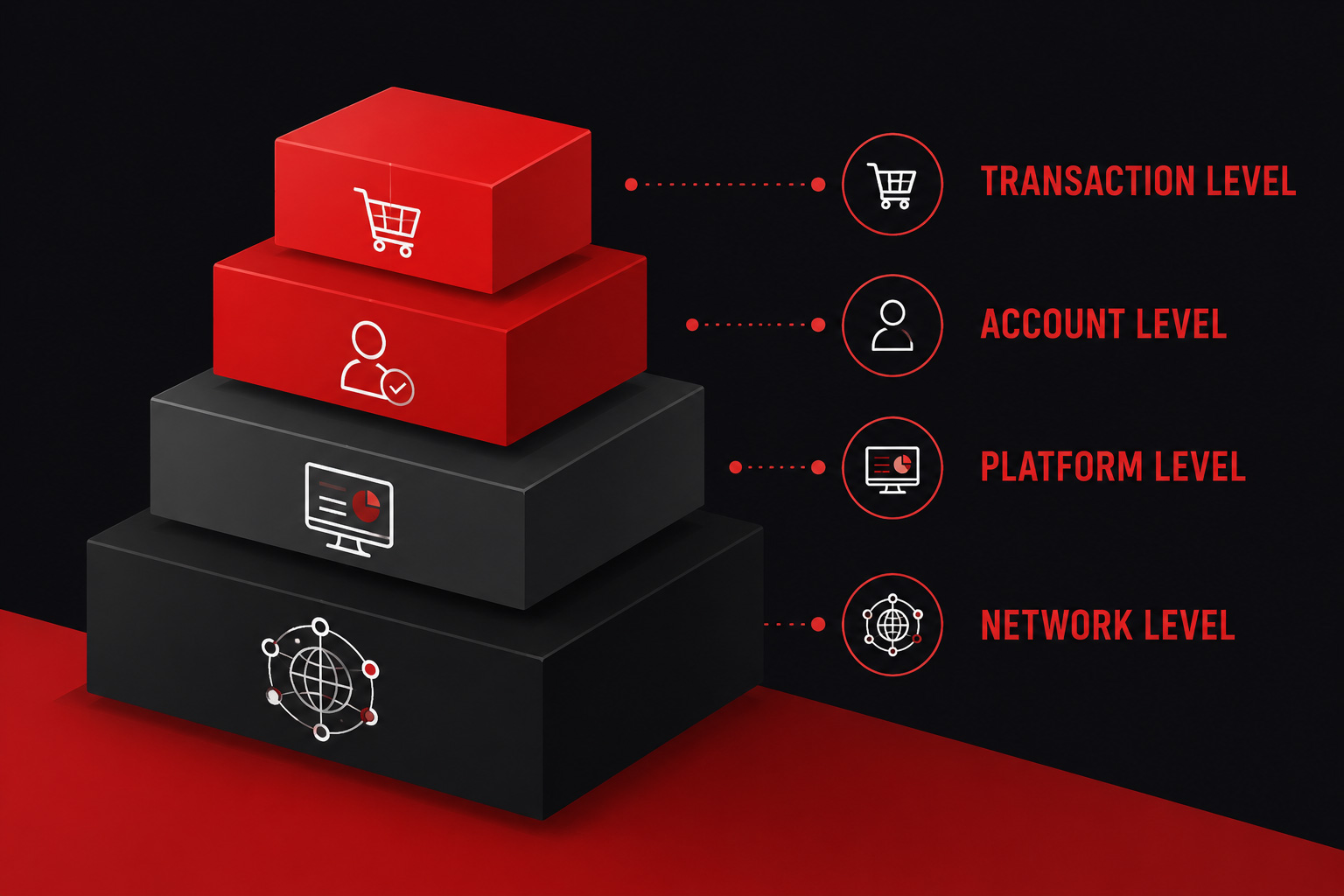
Transaction Level: Individual user actions monitored and evaluated in isolation.
Typically, a fraud program gets its start when chargebacks force attention to transaction performance at the point of sale.
Fraudsters don’t give up easily. When one avenue is blocked, they pivot to the next — payment fraud morphs into Account Takeovers, deposits shift to transfers, and Account Takeovers escalate into identity fraud, synthetic IDs, and Mule Accounts.
These shifts happen in seconds and ripple across organizations in multiple ways.
In response, teams deploy checks at each touchpoint. This works for many standalone fraud incidents but can lead to higher rates of both false positives and false negatives.
Account Level: How the account behaves over time.
Device intelligence, spending patterns, geolocation, behavioral biometrics, and step-up verification interactions all reveal evidence of account-level exploits such as Account Takeovers (ATOs).
The value of monitoring at this level becomes especially apparent when comparing a fraudster’s actions against the account’s historical behavior. Fraudsters can’t replicate what has been established as “trusted” activity and still accomplish their goals.
Instead, they attempt to change payment details, bypass automated checks, pass verifications after what amounts to an unusual number of tries, link new addresses or regions, and more.
When tracked properly, fraudster activity becomes distinctly recognizable, giving teams greater confidence and precision.
Platform Level: How clusters of accounts behave across a single platform.
By effectively monitoring both “trusted” and “confirmed fraud” account activity, teams gain deeper insights that reduce friction for legitimate interactions, boost customer satisfaction, and lower false positive rates.
Additionally, fraud rings and multi-account schemes are rapidly identified through geolocation, device intelligence, IP analysis, and more — shrinking the window during which multi-account exploits remain active on the platform.
Build an effective fraud program that catches threats at every level without draining your budget or harming the customer experience.
Sign up for a free trial today for 1,000 free credits!
Schedule A Demo
Network Level: Partnerships with specialized providers that offer data enrichment and decisioning based on cross-network intelligence.
Up to this point, we’ve focused on the rich data available to teams operating independently. By partnering with a solution provider, your fraud program taps into the collective experience of all other subscribers.
“What’s new to you isn’t new to us.”
Example Fraud Case: A fraudster is determined to attack a particular stored-value platform — for this example, a bank. The fraudster comes armed with standard tools: payment data, identity information, and insider knowledge about the system. Most fraudsters have access to these and can roll out new tactics on short notice.
For this scenario, we’ll use a common approach: the fraudster discovers the target identity uses “Bank X,” then logs in to accomplish three things — funnel funds in from other compromised accounts, request a card for an “Authorized User” (the fraudster themselves), and wire money out to a third compromised account off-platform.
Transaction Level: The account login happens through customer service — a channel that is often underserved and heavily dependent on Knowledge-Based Verifications (KBVs). The fraudster comes armed with bureau data and is ready to clear these checks.
The fraudster resets access credentials and orders an authorized card for a new user on the account. All too often, this process doesn’t receive adequate scrutiny.
The fraudster examines the account’s spending history and replicates the same dollar amounts for incoming transfers and outgoing withdrawals — mirroring what past transaction summaries show.
From a transaction-level standpoint, the fraudster flies under the radar, clearing each isolated verification they were prepared for. The clock keeps ticking until the genuine account holder finally reaches out to customer service to report the issue. What started at customer service is only caught — finally — at customer service.
From an Account Perspective, this fraudster displays numerous red flags:
Contacting customer service from a previously unassociated phone number
Modifying contact details
The elapsed time before ordering a secondary card
The relationship between the authorized user and the account holder
The sequence and timing of transfers and withdrawals
The device used to interact with the platform and initiate these suspicious actions
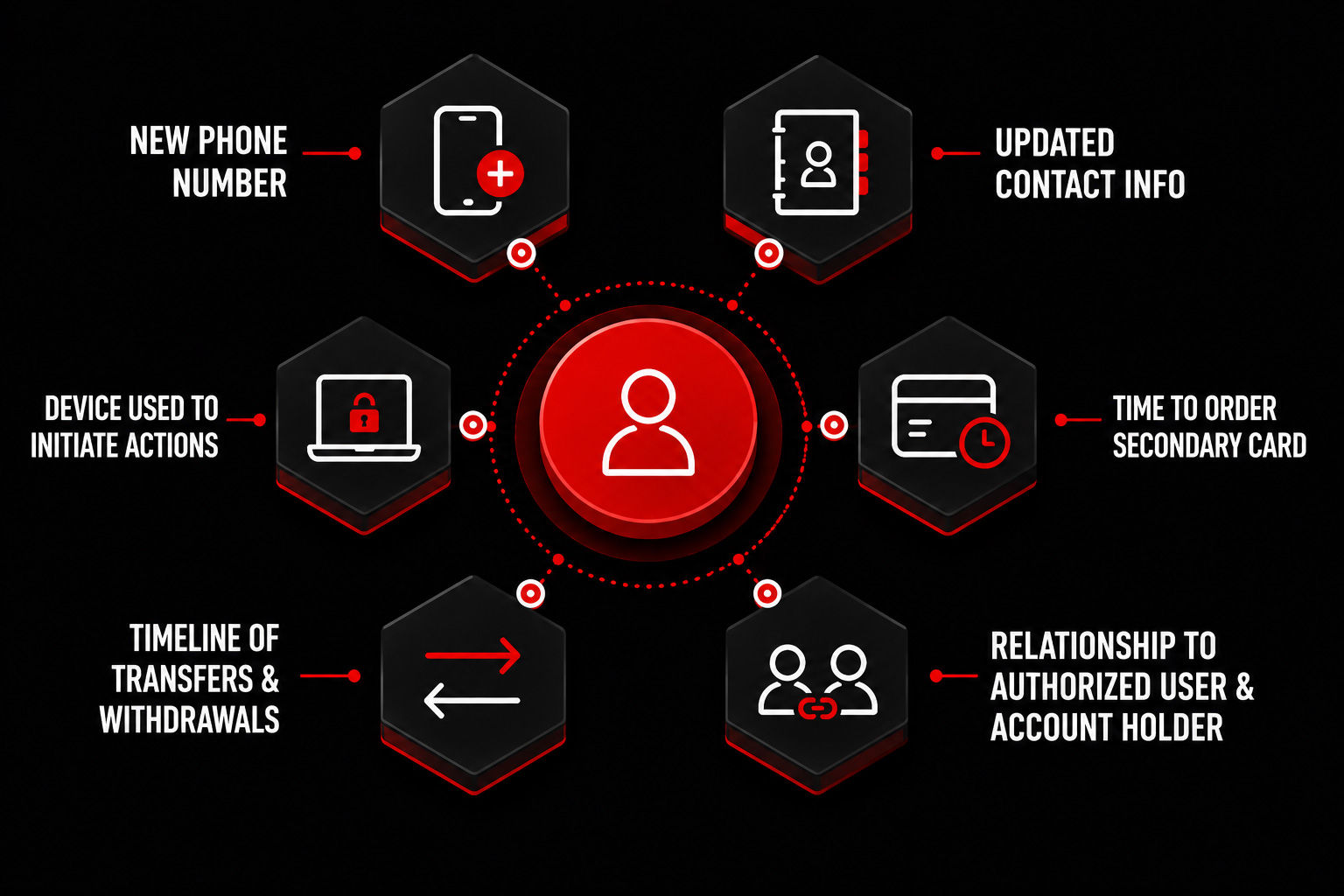
Any of these interactions can be monitored and paired with corresponding verifications. Again, emphasizing accuracy is essential — when viewing the story from this vantage point, confidence in your assessment should be strong.
From a Platform Perspective, it’s unlikely this scenario played out only once. By tracking these events automatically, teams can surface other occurrences and pinpoint shared regions, IPs, devices, and behavioral patterns that go beyond any single account’s activity. These findings then inform downstream decisions.
This entire scheme unfolds in a matter of hours. As noted, fraudsters rarely limit themselves to one account at a time. Chances are, many other accounts are walking through this same playbook right now. The speed of your response is critical to avoiding significant financial damage.
Key indicators include:
The shipping address tied to the “authorized card / user”
Device fingerprinting
User geolocation
Geolocation of the withdrawals
Dollar amounts (though clever fraudsters mimic each account’s habits, many gradually escalate amounts over time, making this a valuable signal)
Originating funding institutions
…among others
Viewing the situation from a Network Perspective empowers teams to automatically flag known suspicious data points such as:
The phone number that dialed into customer service
The device used to access the platform
The shipping address used for the authorized card / user
The name associated with the authorized user
…and additional signals.
By drawing on network intelligence, teams can harness insights gathered from peer organizations to make real-time decisions and apply those learnings downstream across the entire platform.
Schedule a consultation with one of IPQS Fraud Experts today!
Sponsored and written by IPQS.
