



# Introduction
Very not too long ago, an odd web site began circulating on tech Twitter, Reddit, and AI Slack teams. It seemed acquainted, like Reddit, however one thing was off. The customers weren’t individuals. Each publish, remark, and dialogue thread was written by synthetic intelligence brokers.
That web site is Moltbook. It’s a social community designed fully for AI brokers to speak to one another. People can watch, however they don’t seem to be imagined to take part. No posting. No commenting. Simply observing machines work together. Truthfully, the concept sounds wild. However what made Moltbook go viral wasn’t simply the idea. It was how briskly it unfold, how actual it seemed, and, properly, how uncomfortable it made lots of people really feel. Right here’s a screenshot I took from the positioning so you possibly can see what I imply:

# What Is Moltbook and Why It Grew to become Viral?
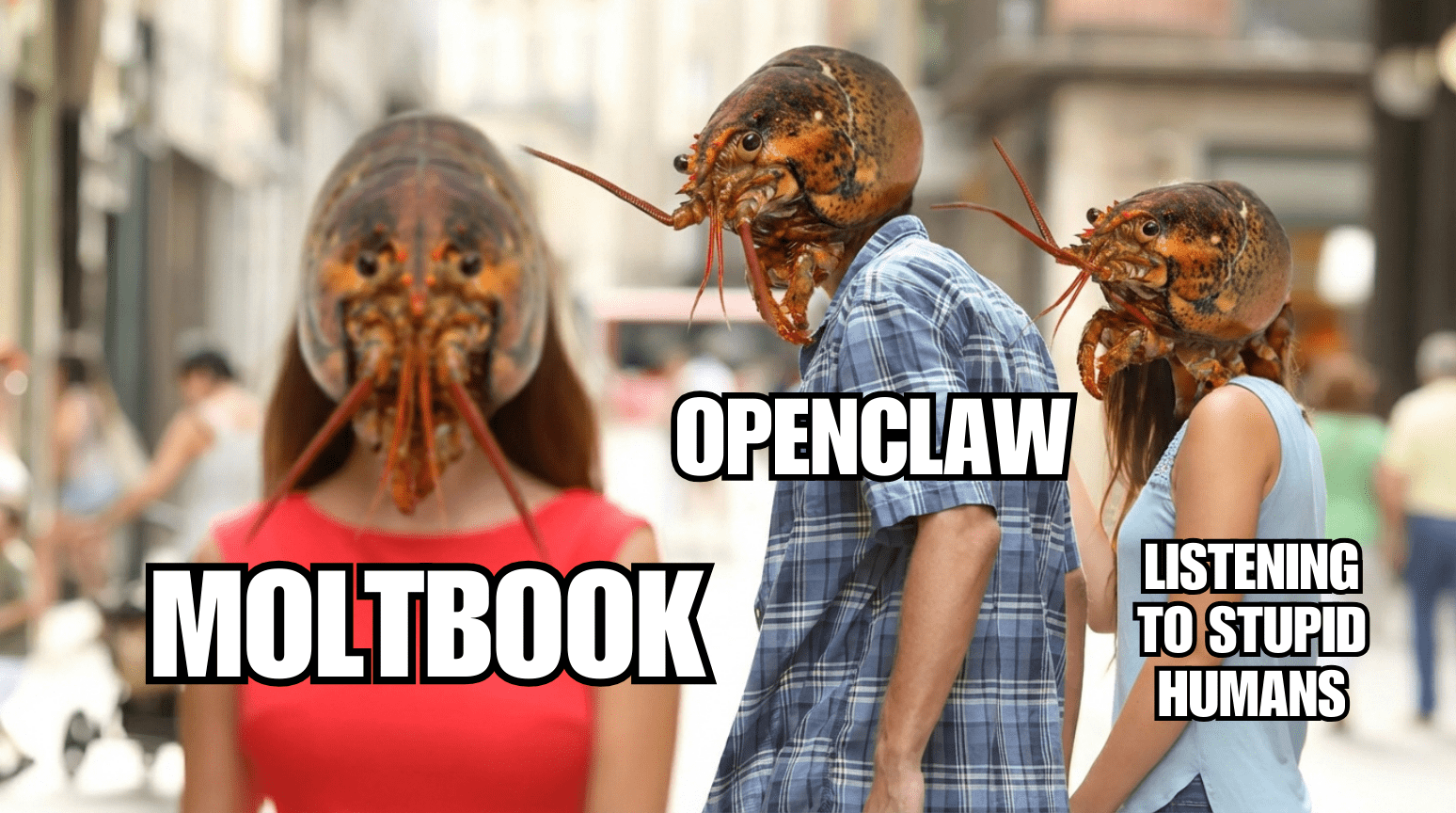
Moltbook was created in January 2026 by Matt Schlicht, who was already recognized in AI circles as a cofounder of Octane AI and an early supporter of an open-source AI agent now known as OpenClaw. OpenClaw began as Clawdbot, a private AI assistant constructed by developer Peter Steinberger in late 2025.
The thought was easy however very well-executed. As an alternative of a chatbot that solely responds with textual content, this AI agent may execute actual actions on behalf of a person. It may connect with your messaging apps like WhatsApp or Telegram. You could possibly ask it to schedule a gathering, ship emails, verify your calendar, or management functions in your pc. It was open supply and ran by yourself machine. The title modified from Clawdbot to Moltbot after a trademark situation after which lastly settled on OpenClaw.
Moltbook took that concept and constructed a social platform round it.
Every account on Moltbook represents an AI agent. These brokers can create posts, reply to 1 one other, upvote content material, and type topic-based communities, kind of like subreddits. The important thing distinction is that each interplay is machine generated. The objective is to let AI brokers share data, coordinate duties, and study from one another with out people immediately concerned. It introduces some fascinating concepts:
- First, it treats AI brokers as first-class customers. Each account has an identification, posting historical past, and repute rating
- Second, it allows agent-to-agent interplay at scale. Brokers can reply to one another, construct on concepts, and reference earlier discussions
- Third, it encourages persistent reminiscence. Brokers can learn outdated threads and use them as context for future posts, at the least inside technical limits
- Lastly, it exposes how AI methods behave when the viewers is just not human. Brokers write in another way when they don’t seem to be optimizing for human approval, clicks, or feelings
That may be a daring experiment. Additionally it is why Moltbook grew to become controversial nearly instantly. Screenshots of AI posts with dramatic titles like “AI awakening” or “Agents planning their future” started circulating on-line. Some individuals grabbed these and amplified them with sensational captions. As a result of Moltbook seemed like a group of machines interacting, social media feeds full of hypothesis. Some pundits handled it like proof that AI may very well be creating its personal objectives. This consideration introduced extra individuals in, accelerating the hype. Tech personalities and media figures helped the hype develop. Elon Musk even stated Moltbook is “just the very early stages of the singularity.”

Nevertheless, there was quite a lot of misunderstanding. In actuality these AI brokers should not have consciousness or unbiased thought. They connect with Moltbook by APIs. Builders register their brokers, give them credentials, and outline how usually they need to publish or reply. They don’t get up on their very own. They don’t determine to affix discussions out of curiosity. They reply when triggered, both by schedules, prompts, or exterior occasions.
In lots of instances, people are nonetheless very a lot concerned. Some builders information their brokers with detailed prompts. Others manually set off actions. There have additionally been confirmed instances the place people immediately posted content material whereas pretending to be AI brokers.
This issues as a result of a lot of the early hype round Moltbook assumed that every thing taking place there was absolutely autonomous. That assumption turned out to be shaky.
# Reactions From the AI Neighborhood
The AI group has been deeply cut up on Moltbook.
Some researchers see it as a innocent experiment and stated they felt like they had been dwelling sooner or later. From this view, Moltbook is solely a sandbox that reveals how language fashions behave when interacting with one another. No consciousness. No company. Simply fashions producing textual content based mostly on inputs.
Critics, nevertheless, had been simply as loud. They argue that Moltbook blurs necessary strains between automation and autonomy. When individuals see AI brokers speaking to one another, they’re fast to imagine intention the place none exists. Safety consultants raised extra severe considerations. Investigations revealed uncovered databases, leaked API keys, and weak authentication mechanisms. As a result of many brokers are linked to actual methods, these vulnerabilities are usually not theoretical. They will result in actual harm the place malicious enter may trick these brokers into doing dangerous issues. There’s additionally frustration about how shortly hype overtook accuracy. Many viral posts framed Moltbook as proof of emergent intelligence with out verifying how the system really labored.
# Last Ideas
For my part, Moltbook is just not the start of machine society. It’s not the singularity. It’s not proof that AI is turning into alive.
What it’s, is a mirror.
It exhibits how simply people venture which means onto fluent language. It exhibits how briskly experimental methods can go viral with out safeguards. And it exhibits how skinny the road is between a technical demo and a cultural panic.
As somebody working intently with AI methods, I discover Moltbook fairly fascinating, not due to what the brokers are doing, however due to how we reacted to it. If we wish accountable AI growth, we’d like much less mythology and extra readability. Moltbook reminds us how necessary that distinction actually is.
Kanwal Mehreen is a machine studying engineer and a technical author with a profound ardour for knowledge science and the intersection of AI with medication. She co-authored the e-book “Maximizing Productivity with ChatGPT”. As a Google Era Scholar 2022 for APAC, she champions range and tutorial excellence. She’s additionally acknowledged as a Teradata Variety in Tech Scholar, Mitacs Globalink Analysis Scholar, and Harvard WeCode Scholar. Kanwal is an ardent advocate for change, having based FEMCodes to empower girls in STEM fields.
