



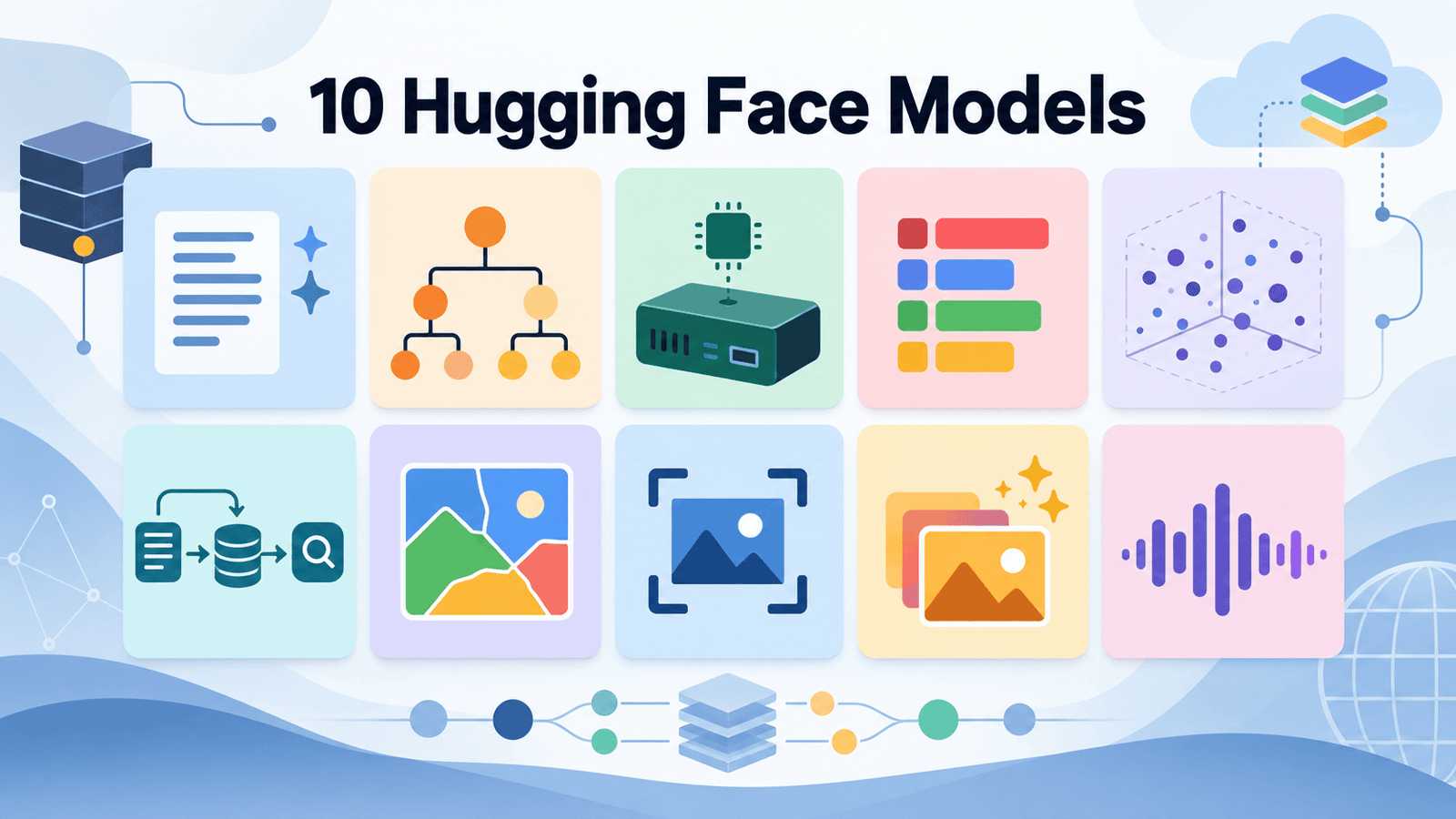
# The 10 Machine Learning Models Every Practitioner Should Know in 2026
The open-source model ecosystem has exploded over the past several years. With millions of repositories now publicly available on model hosting platforms, the real question facing practitioners today isn’t whether models exist — it’s which ones are reliable, well-licensed, and actually suited to production workloads.
This guide walks through ten models that have earned their place in real-world machine learning pipelines. They span text generation, reasoning, retrieval, vision, multimodal understanding, image synthesis, and speech recognition — the core capabilities most professionals rely on regularly.
## Getting Started: Shared Setup Requirements
Before diving in, make sure your environment has the latest versions of the core libraries:
“`bash
pip install -U transformers diffusers sentence-transformers
“`
Many of the models below share a common loading pattern. When working with instruction-tuned chat models, always use the built-in chat template rather than passing a raw string to the tokenizer. This ensures proper formatting, special token insertion, and generation prompts are applied correctly.
A typical loading and generation workflow looks like this:
“`python
from transformers import AutoModelForImageTextToText, AutoProcessor
model_id = “your-chosen-checkpoint”
processor = AutoProcessor.from_pretrained(model_id)
model = AutoModelForImageTextToText.from_pretrained(
model_id, torch_dtype=”auto”, device_map=”auto”
)
messages = [{“role”: “user”, “content”: “Your prompt here”}]
text = processor.apply_chat_template(messages, tokenize=False, add_generation_prompt=True)
inputs = processor(text=text, return_tensors=”pt”).to(model.device)
outputs = model.generate(**inputs, max_new_tokens=200)
print(processor.decode(outputs[0][inputs[“input_ids”].shape[1]:], skip_special_tokens=True))
“`
The `torch_dtype=”auto”` flag loads weights in whatever precision the model card specifies, while `device_map=”auto”` handles distributing layers across available GPUs automatically. When decoding, the slice operation removes the input tokens so that only the model’s generated response is returned.
—
## Foundation and Reasoning Models
### 1. Qwen3.8-27B — The Community’s Go-To Base Model
Qwen3.8-27B has emerged as the most popular community base model, with derivative repositories on the platform exceeding 151,000 — more than double the footprint of comparable models from other leading labs. Monthly compressed format downloads for the Qwen family surpass 39 million, dwarfing equivalent download figures for other major model families.
What makes this model particularly compelling is its native multimodality. It processes images and video alongside text through a single checkpoint, eliminating the need for separate vision-language model weights. This simplifies dependency management and deployment complexity considerably. The weights are released under the permissive Apache 2.0 license.
At roughly 56 GB of VRAM in BF16 precision, or around 16 GB with 4-bit quantization using standard quantization libraries, it occupies a practical middle ground between usability and capability. For local experimentation on consumer hardware, consider the `google/gemma-4-E2B-it` variant instead, which runs comfortably on laptops and single consumer GPUs.
**Important note:** Always include the full version number in the checkpoint ID to avoid loading outdated checkpoints from the same family.
### 2. DeepSeek-V4.1-Flash — Frontier Reasoning in a Mixture-of-Experts Architecture
DeepSeek-V4.1-Flash is a massive mixture-of-experts model with 552 billion total backbone parameters. Despite that enormous size, it only activates approximately 8 billion parameters per token during the initial processing phase and 16 billion during text generation. This sparse activation pattern is what makes a model of this scale practically deployable.
The model supports contexts stretching up to one million tokens and carries an MIT license, making it one of the most permissive frontier-grade models available. On coding benchmarks, it achieves 74.2 on DeepSWE v1.1 and 90.6 on Terminal-Bench 2.1, ranking among the strongest open-weight results for software engineering tasks.
Given the scale of this model, a direct Python loading snippet is unrealistic for most practitioners. The recommended approach is to use a serving framework:
“`bash
vllm serve deepseek-ai/DeepSeek-V4.1-Flash –tensor-parallel-size 8
“`
The tensor parallel size should be adjusted based on your available GPU count. Alternatively, Hugging Face Inference Providers offer an API-based route that removes the infrastructure management burden entirely.
One caveat: earlier API model names such as `deepseek-chat` and `deepseek-reasoner` were not Hub checkpoint identifiers. If you previously used those endpoints, consult the current DeepSeek API documentation for updated names.
### 3. Gemma 4 — Edge and On-Device Deployment
Released by Google in spring 2026, the Gemma 4 family covers the increasingly important use case of running models on resource-constrained devices. The lineup spans four sizes, from the ultra-lightweight E2B variant designed for smartphones and laptops to the 31B Dense variant for more capable hardware.
All four checkpoints ship under the Apache 2.0 license, a significant shift from the source-available licensing that governed earlier Gemma releases. This opens the door to commercial deployment without additional restrictions.
The E2B variant is the recommended starting point for anyone exploring on-device inference. While the 31B Dense variant captured attention on leaderboards at launch, the smaller variants are what make this family genuinely useful for production edge scenarios — mobile apps, embedded systems, and offline-capable tools.
—
## Retrieval and Representation Models
### 4. ModernBERT-base — Efficient Text Classification and NER
Not every natural language processing task benefits from a generative decoder. For fine-tuned text classification, named entity recognition, and indexing in retrieval-augmented generation pipelines, encoder-only models deliver superior efficiency.
ModernBERT-base extends the original BERT architecture’s context window to 8,192 tokens and incorporates Flash Attention, making it significantly faster than standard BERT at longer sequence lengths. It excels when fine-tuned on labeled domain data and is not intended for zero-shot prompting.
A minimal fine-tuning setup using the Trainer API looks like this:
“`python
from transformers import AutoTokenizer, AutoModelForSequenceClassification, Trainer, TrainingArguments
model_id = “answerdotai/ModernBERT-base”
tokenizer = AutoTokenizer.from_pretrained(model_id)
model = AutoModelForSequenceClassification.from_pretrained(model_id, num_labels=4)
args = TrainingArguments(output_dir=”modernbert-classifier”, num_train_epochs=3,
per_device_train_batch_size=16, eval_strategy=”epoch”)
trainer = Trainer(model=model, args=args, train_dataset=train_ds, eval_dataset=eval_ds)
trainer.train()
“`
After fine-tuning on domain-specific labeled data, ModernBERT consistently outperforms zero-shot baselines while maintaining inference speeds suitable for production throughput on standard GPU hardware.
### 5. Qwen3-Embedding-0.6B — Leading Dense Retrieval Embeddings
Qwen3-Embedding-0.6B currently sits at the top of the open-weight Massive Text Embedding Benchmark leaderboard for its parameter count class. With 596 million parameters and a default output dimension of 1,024, it produces high-quality dense vector representations for retrieval tasks.
A distinguishing technical detail: this model uses last-token pooling with L2 normalization rather than mean pooling. It also expects an instruction prefix when encoding query inputs. The sentence-transformers library handles both of these details automatically.
“`python
from sentence_transformers import SentenceTransformer
model = SentenceTransformer(“Qwen/Qwen3-Embedding-0.6B”)
query = model.encode(“What is retrieval-augmented generation?”, prompt_name=”query”)
documents = model.encode([
“RAG grounds language model outputs in external documents.”,
“Gradient descent minimizes a loss function iteratively.”
])
“`
Computing similarity with cosine similarity between queries and documents is straightforward, and the resulting embeddings integrate directly with any vector database that accepts dense float arrays — including FAISS, Pinecone, Weaviate, and others.
For hybrid search scenarios requiring dense, sparse, and multi-vector representations simultaneously from a single model across over 100 languages, BAAI’s bge-m3 remains a strong alternative worth evaluating.
### 6. all-MiniLM-L6-v2 — The Ubiquitous Production Baseline
all-MiniLM-L6-v2 accumulated 1.55 billion downloads in the first seven months of 2026 alone, averaging roughly 220 million downloads per month. Its dominance in production environments cannot be overstated — when you inherit a codebase and find an embedding model at its core, there is a very high probability it is this one.
Using sentence-transformers, the model is straightforward to work with:
“`python
from sentence_transformers import SentenceTransformer
model = SentenceTransformer(“sentence-transformers/all-MiniLM-L6-v2”)
sentences = [
“Retrieval-augmented generation improves factual accuracy.”,
“RAG systems ground language model outputs in external documents.”,
“The weather in Bangkok is humid in September.”
]
embeddings = model.encode(sentences)
“`
Pairwise similarity computation reveals that semantically related sentences cluster together, which is the engine behind semantic deduplication, document retrieval, and document clustering pipelines operating at scale across the industry.
The model’s known limitations — sensitivity to domain shift and limited multilingual coverage — make it a valuable baseline against which newer embedding models can be measured. Understanding its behavior helps practitioners decide whether the migration cost of upgrading is justified.
—
## Vision and Multimodal Models
The next three models involve hardware requirements, licensing conditions, or API stability considerations that are still evolving. Always consult the model card quick-start for the most current loading instructions.
### 7. SAM 3 — Open-Vocabulary Image and Video Segmentation
SAM 3 extends Meta’s Segment Anything framework into open-vocabulary territory. Where its predecessor required precise point or box prompts drawn directly on an image, SAM 3 accepts a text description and automatically segments every instance of the described concept within the frame.
For video applications, the same checkpoint powers both image and video processing modes — the difference lies in the model class you instantiate. The video variant includes a memory-based tracker that maintains consistent object identities across frames, while the image variant processes each frame independently without tracking.
One access requirement: SAM 3 is a gated repository. You must log in to your account and accept the model’s terms on the Hub before the weights become downloadable. The model card contains the current processor API and complete loading instructions.
### 8. DINOv3 — Self-Supervised Vision Feature Extraction
DINOv3 represents the current standard for general-purpose vision feature extraction. Unlike CLIP, which learns image representations by aligning them with textual descriptions, DINOv3 relies entirely on visual self-supervision. The result is feature representations that transfer more effectively across tasks like dense image retrieval, linear-probe classification, and semantic correspondence.
The ViT-B checkpoint is identified as `facebook/dinov3-vitb16-pretrain-lvd1689m`. Before loading this model, check the license carefully — Meta uses a custom license for the DINO family rather than the Apache 2.0 license, and commercial usage terms differ from the other models in this guide. The model card details the register token structure, which affects how patch-level features are extracted from the output tensor.
### 9. FLUX.2 — The New Standard for Open-Weight Image Generation
FLUX.2, released by Black Forest Labs in late 2025, replaced FLUX.1-dev as the reference point for open-weight image quality. The 4B klein variant (`black-forest-labs/FLUX.2-klein-4B`) is Apache 2.0 licensed and demands approximately 13 GB of VRAM. Its four-step distillation process makes inference substantially faster than the workflows required by FLUX.1-dev.
Licensing is a critical consideration with this model. The larger dev variant operates under a non-commercial license, and commercial deployment requires purchasing a separate license directly from Black Forest Labs. Confirm exactly which variant you are loading and review the license terms before any commercial use.
For applications where rendered text inside generated images is a requirement, Qwen-Image-2512 is worth evaluating as an Apache-licensed alternative with stronger text rendering capabilities.
—
## Audio Models
### 10. Whisper large-v3-turbo — The Multilingual Speech Recognition Workhorse
Whisper large-v3-turbo no longer holds the top position on the Open ASR Leaderboard. Several newer models now lead by a margin of a few points on average word error rate. Despite being surpassed on benchmarks, Whisper remains the model every speech practitioner should know and understand.
The reasons are straightforward: coverage of over 90 languages, an MIT license, and a three-line integration via the transformers library. For the vast majority of applications, the accuracy gap does not justify the added complexity of switching to a less mature or more restrictive model.
“`python
from transformers import pipeline
transcriber = pipeline(
“automatic-speech-recognition”,
model=”openai/whisper-large-v3-turbo”
)
“`
Transcribing a local file with segment-level timestamps is as simple as:
“`python
result = transcriber(“your_audio_file.mp3”, return_timestamps=True)
print(result[“text”])
print(result[“chunks”][:3])
“`
The `return_timestamps=True` parameter provides segment-level timing, while `return_timestamps=”word”` delivers word-level timestamps — a capability that enables subtitle generation and audio search indexing without requiring a separate alignment step. If your use case demands top accuracy for a specific language or accent, benchmark the current leaderboard leaders against your own audio data before committing.
—
## Quick Reference: Model Summary
| Model | Primary Use Case | Checkpoint | License | Key Notes |
|——-|—————–|————|———|———–|
| Qwen3.8-27B | Text generation with native multimodal input | `Qwen/Qwen3.8-27B` | Apache 2.0 | ~56 GB VRAM BF16; ~16 GB with 4-bit quantization |
| DeepSeek-V4.1-Flash | Frontier reasoning and coding | `deepseek-ai/DeepSeek-V4.1-Flash` | MIT | 552B MoE; multi-GPU serving or inference providers |
| Gemma 4 | Edge and on-device deployment | `google/gemma-4-E2B-it` to `google/gemma-4-31B-it` | Apache 2.0 | Four sizes; E2B runs on consumer hardware |
| ModernBERT-base | Text classification, NER, RAG indexing | `answerdotai/ModernBERT-base` | Apache 2.0 | 8,192-token context; standard GPU hardware |
| Qwen3-Embedding-0.6B | Dense retrieval and RAG | `Qwen/Qwen3-Embedding-0.6B` | Apache 2.0 | 596M parameters; instruction prefix required for queries |
| all-MiniLM-L6-v2 | Production embeddings and baseline | `sentence-transformers/all-MiniLM-L6-v2` | Apache 2.0 | CPU-compatible; limited multilingual coverage |
| SAM 3 | Open-vocabulary segmentation | `facebook/sam3` | Custom SAM License | Gated repository; accept terms before download |
| DINOv3 | Vision feature extraction | `facebook/dinov3-vitb16-pretrain-lvd1689m` | Custom DINOv3 License | Review commercial terms before deployment |
| FLUX.2 klein 4B | Open-weight image generation | `black-forest-labs/FLUX.2-klein-4B` | Apache 2.0 (dev variant non-commercial) | ~13 GB VRAM; four-step distillation |
| Whisper large-v3-turbo | Multilingual speech recognition | `openai/whisper-large-v3-turbo` | MIT | 90+ languages; word and segment timestamps |
—
## Frequently Asked Questions
**Q: Why does the article recommend checking for updated checkpoint names rather than hardcoding them?**
A: Model families on public repositories receive frequent updates, and older checkpoints may lack improvements or bug fixes. Always verify the latest release identifier on the hosting platform before deploying to production.
**Q: What is the difference between mean pooling and last-token pooling for embeddings?**
A: Mean pooling averages the token-level representations across an entire sequence, while last-token pooling uses only the representation associated with the final token. Different models are optimized for different pooling strategies, and using the wrong one can degrade retrieval quality.
**Q: Can I run any of these models on a CPU-only machine?**
A: Several models in this guide — notably all-MiniLM-L6-v2 and the smaller Gemma 4 variants — can run on CPU. Larger models like Qwen3.8-27B and DeepSeek-V4.1-Flash require GPU acceleration for reasonable inference speeds.
**Q: What should I do if a model’s license does not permit commercial use?**
A: Evaluate whether the Apache 2.0 or MIT licensed alternatives listed in the guide can meet your needs. If not, reach out to the model’s publisher to negotiate a commercial license before deploying in a product that generates revenue.
**Q: How do I know when it’s time to replace a model in my production pipeline?**
A: Monitor task-specific benchmarks, track inference latency and cost trends, and periodically test newer models against your production data. The decision should be driven by your specific accuracy, latency, and cost requirements — not by following every new release.
**Q: Are the hardware estimates in this article exact?**
A: Hardware estimates are approximate and depend on batch size, sequence length, quantization method, and framework optimizations. Treat them as planning guidelines rather than precise requirements.
**Q: Why are some models gated on the hosting platform?**
A: Gated access is a mechanism used by model authors to control distribution, often due to licensing restrictions, safety considerations, or terms of use from the underlying training data. Always review and accept the terms before attempting to download gated weights.
**Q: What is a mixture-of-experts model and why does it matter?**
A: A mixture-of-experts architecture activates only a subset of the model’s total parameters for each input token, routing the input to specialized “expert” layers. This allows for dramatically larger total model capacity without proportionally increasing computational cost per inference, making frontier-scale models more practical to deploy.
—
## Conclusion
The ten models covered in this guide represent the task categories that form the backbone of professional machine learning work in 2026: text generation, complex reasoning, edge deployment, fine-tuned classification, dense retrieval, production-grade embeddings, open-vocabulary segmentation, vision feature extraction, image generation, and speech recognition.
Three takeaways stand out beyond the individual model selections. First, understanding which models have been superseded by their successors is just as valuable as knowing the current leaders — each progression in the list reflects concrete architectural and capability improvements that define what to look for in the next generation.
Second, the download patterns for certain established models reveal an important truth about how machine learning infrastructure evolves in practice. Research and benchmarks advance rapidly, but production systems tend to lag behind by years. The gap between the current best-performing model and the one running in most real-world pipelines is real and measurable. Recognizing this gap is what empowers practitioners to make grounded decisions about when to invest in upgrading.
Third, licensing and hardware requirements are not afterthoughts — they are first-order constraints that determine whether a model can realistically be used in a given deployment context. Every model in this guide notes its license and hardware requirements explicitly for this reason.
The ecosystem continues to evolve at a rapid pace, and the models that matter today may be succeeded by newer architectures within months. Building the habit of evaluating models based on your actual task requirements, deployment constraints, and data characteristics — rather than benchmark rankings alone — is the most durable skill a practitioner can develop.
Thank you for reading
