



Key Insights
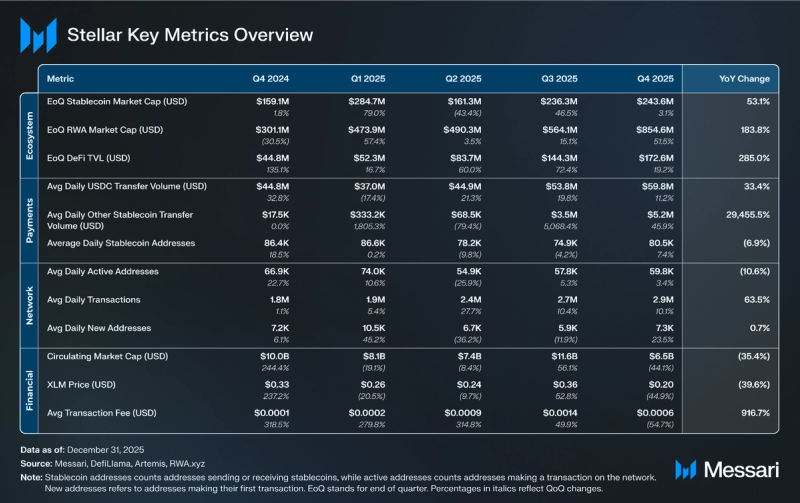
- Stellar’s RWA market cap (excluding stablecoins) surpassed $1 billion on Jan. 21, and elevated 184% in 2025 from $301 million to $855 million. The rise was pushed primarily by the issuance of latest property akin to treasuries from Spiko and actual property from RedSwan, alongside the expansion of Franklin Templeton’s U.S. Authorities Cash Fund (BENJI) and Etherfuse’s authorities debt choices.
- On Jan. 22, the X-Ray privateness protocol improve went reside on Stellar, laying the groundwork for zero-knowledge (ZK) cryptography so builders can construct privacy-preserving, regulatorily compliant purposes on the community.
- Stellar’s stablecoin market cap elevated 53% year-over-year from $159 million to $244 million, pushed by PayPal’s PYUSD launch on the community in September, and USDC’s 45% YoY improve in market cap to $223 million.
- U.S. Financial institution is testing customized issuance of its personal stablecoin on Stellar, underscoring the community’s institutional attraction because of its reliability (>99.99% uptime), affordability (settlement at <$0.01 USD), and built-in asset controls for regulatory compliance.
- Stellar is realizing elevated DeFi composability, thereby reaching larger capital effectivity and DeFi TVL, as extra protocols are launched and issued property are adopted on the community. This contains lending and borrowing protocol Templar, which is able to quickly assist freely transferable RWAs on Stellar.
Primer
The Stellar community (XLM) is a Layer-1 blockchain constructed for monetary services. It presents builders good contracts performance and a protocol optimized for funds, with a design supposed to maintain charges low and to supply transaction speeds that may scale with elevated adoption. Monetary establishments and innovators worldwide challenge property and settle funds on the Stellar community, which has processed billions of operations with hundreds of thousands of accounts.
The community has been working for over a decade since its launch in 2014 and has operated by way of the Stellar Consensus Protocol (SCP) since November 2015, after briefly working on a modified model of the Ripple Protocol Consensus Algorithm.
Underneath the SCP, there are not any financial rewards for validators, who function the community by way of Proof-of-Settlement (PoA) by way of a system of federated voting. Stellar good contracts went reside in February 2024.
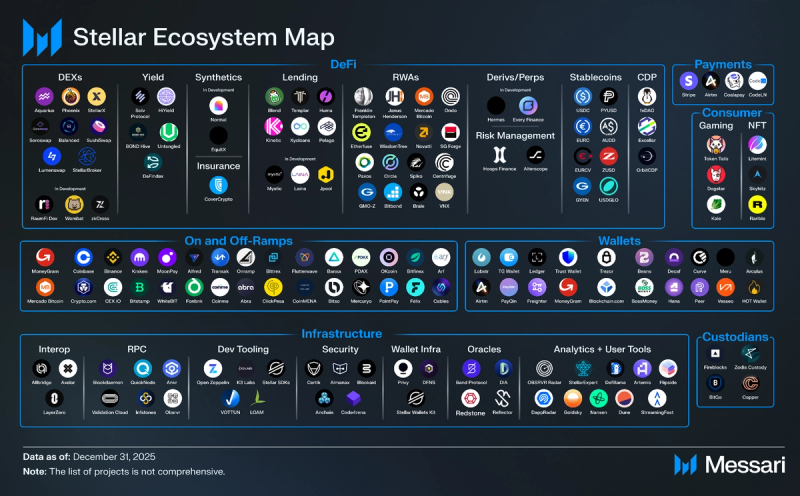
Improvement of the Stellar community and development of the Stellar ecosystem are supported by the Stellar Improvement Basis. A lot of key options, merchandise, and instruments constructed on the community deal with on a regular basis monetary providers use instances. A worldwide community of Anchors, akin to MoneyGram Worldwide, supplies the on and off-ramps that join Stellar to conventional monetary rails, whereas the Stellar Disbursements Platform (SDP) is a turnkey resolution for sending digital funds. Community options for property embody multi-signature accounts and authorization flags to regulate entry, whereas the Stellar Asset Sandbox contains no-code instruments for asset issuance and administration. Moreover, Path Funds, powered by Stellar’s Decentralized Trade (SDEX), allow a distinct asset to be despatched than what’s obtained by the recipient tackle. For a full primer on the Stellar Ecosystem, check with Messari’s ecosystem overview report.
Web site / X / Discord
Key Metrics
SDF Commentary
Crew Commentary Disclaimer
The Undertaking Crew Commentary part of this report was written by José Fernández da Ponte, President and Chief Development Officer at Stellar Improvement Basis (SDF), and displays the views, opinions, and forward-looking statements of SDF solely. This part is included to supply further context on the undertaking’s technique, priorities, and outlook and doesn’t essentially replicate the views or opinions of Messari, Inc.
Over the previous yr, Stellar has continued to show that blockchain can ship tangible impression for on a regular basis monetary providers and other people the world over. We’ve seen real-world property and stablecoins achieve significant traction, over 30% in developer development during the last yr – 3x quicker than the business common, and establishments are more and more exploring what onchain finance can supply. The mix of those developments isn’t only a signal of development, it’s a sign that the demand for onchain monetary providers is accelerating and broadening throughout the market.
Our focus has been on enabling builders and enterprises to create real-world purposes that transfer past experimentation. New issuers and protocols are bringing revolutionary merchandise to market, and liquidity infrastructure is guaranteeing that markets stay environment friendly and globally accessible. Every further participant strengthens the ecosystem, reinforcing the Stellar community’s skill to deal with monetary exercise at scale.
Institutional adoption continues to be a defining pressure. From international organizations to NGOs and authorities companies – the Stellar community is being embedded into fee flows, treasury operations, and settlement programs. This yr, we’re targeted on scaling these relationships, serving to enterprises transition confidently from pilots to reside deployments. The purpose is easy: make it simple for establishments to belief, combine, and depend on the Stellar community as a part of their core operations.
We’re additionally investing within the underlying infrastructure. Efficiency, reliability, and safety stay priorities. By means of enhancements in throughput, latency, and end-to-end settlement effectivity, the community is positioned to assist high-volume use instances like card funds, cross-border transfers, and programmable stablecoins. Privateness upgrades and zero-knowledge capabilities are opening new prospects for purposes that require confidentiality whereas remaining absolutely compliant – a essential basis for the subsequent wave of institutional adoption.
Wanting forward, the items are in place for a significant acceleration in 2026. The convergence of rising enterprise engagement, increasing onchain property, deeper liquidity, and enhanced DeFi composability units the stage for compounding adoption.
Stellar was constructed for real-world finance, and our focus stays on delivering each pace and reliability. By growing adoption, strengthening infrastructure, and increasing participation throughout the ecosystem, we’re enabling international finance to remodel and function extra effectively, securely, and at scale.
Ecosystem Evaluation
Actual World Property
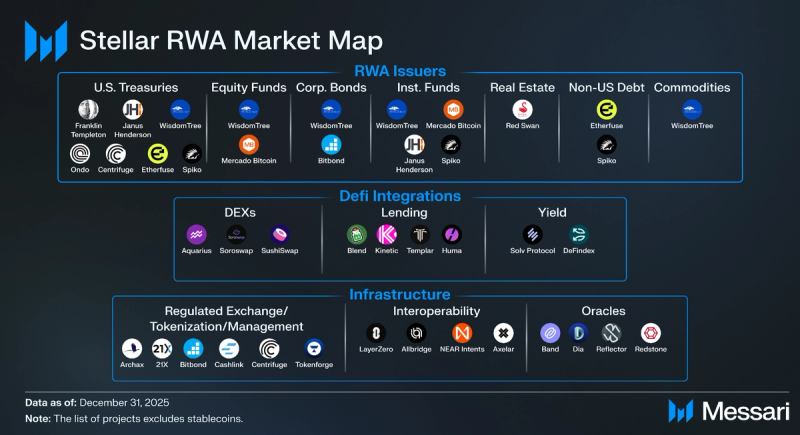
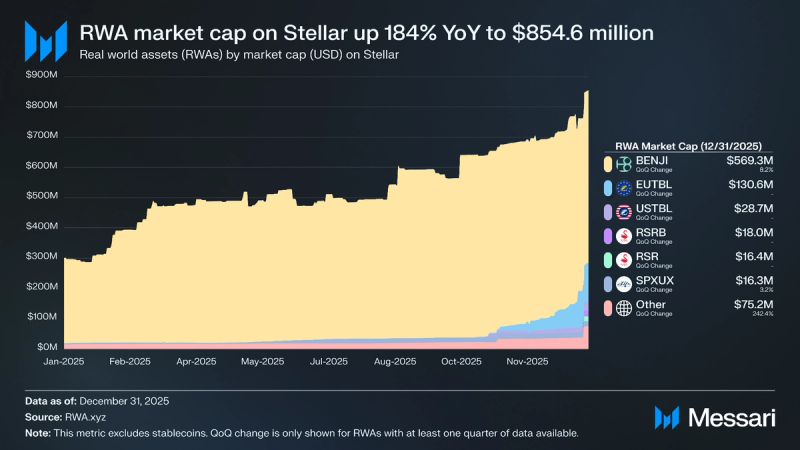
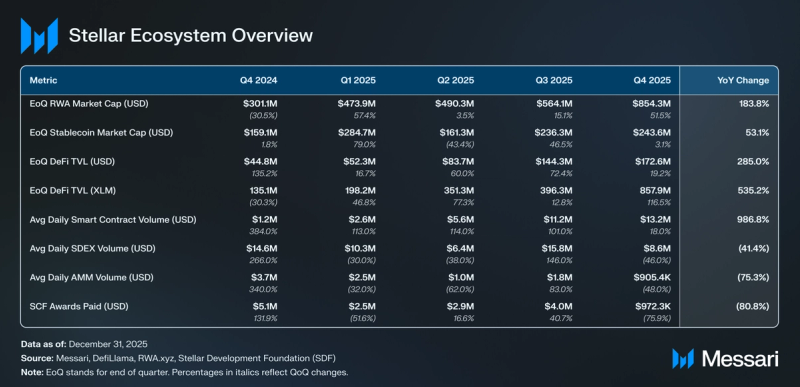
The RWA market cap on Stellar (excluding stablecoins) surpassed $1 billion on Jan. 21, and elevated 183.8% in 2025 from $301.1 million to $854.6 million. The vast majority of this achieve got here from BENJI, which grew 101.9% YoY from $282.0 million to $569.3 million. Every BENJI token represents one share of Franklin Templeton’s onchain U.S. Authorities Cash Fund (FOBXX). The vast majority of the rest of the expansion got here from the 19 newly issued RWAs in 2025. Standouts embody:
- Spiko: In November, Spiko built-in Stellar and closed 2025 with $130.6 million in EU T-Payments Cash Market Fund (EUTBL) and $28.7 million in US T-Payments Cash Market Fund (USTBL) issued on the community. Spiko additionally launched its Money and Carry Greenback (SPKCC) and Money and Carry Euro (eurSPKCC) on the community on the finish of December.
- RedSwan: In September, RedSwan Digital Actual Property introduced that it had tokenized $100 million in business actual property on Stellar, comprising multifamily and hospitality properties. These embody possession curiosity in R&B Oak Park (RSRB), a 104-unit multifamily property in suburban Chicago, and Sedona Ranch (RSR), a 268-unit multifamily property in Odessa, Texas.
- Etherfuse: Etherfuse points “stablebonds,” the place every stablebond is a tokenized fund of short-term government-issued treasury bonds from a given nation or jurisdiction. These embody Mexico (CETES), the European Union (EUROB), Brazil (TESOURO), the Republic of Korea (KTB), and the US (USTRY). Moreover, Etherfuse presents MXNe, a peso-dominated secure worth issued with Brale and backed by CETES. Whereas the stablecoin market is at present dominated nearly completely by U.S. greenback stablecoins, like USDC and USDT, Etherfuse goals to deliver 100 sovereign currencies onchain as yield-bearing property, performing because the “AWS of sovereign debt.” Present use instances for these stablebonds embody performing as yield-bearing stablecoins composable in DeFi and being tradable with each other for about 4 foundation factors (bps), an institutional-grade international alternate (FX) price not accessible to retail customers elsewhere.
Moreover, in December, State Avenue introduced its upcoming tokenized personal liquidity fund (SWEEP) will launch on Stellar later in 2026. For additional particulars on Stellar’s RWA ecosystem, see Messari’s State of Stellar: Actual-world Property report.
DeFi Composability for RWAs
Composability in DeFi refers back to the permissionless skill of property, protocols, and their underlying good contracts to seamlessly work together and combine with one another. In doing so, collective capital effectivity and TVL of the DeFi ecosystem improve as property are productive in nested methods. For instance, depositing tokens right into a Stellar AMM generates LP tokens, which may then be used as collateral on an overcollateralized lending and borrowing protocol like Mix. Liquidity, capital effectivity, and TVL improve additional as new protocols and property are launched.
Stellar community is supposed for actual property, utilized by actual folks, with actual exercise. DeFi composability for RWAs is important for that. Nevertheless, laws at present forestall the overwhelming majority of RWAs from being freely transferable and thus absolutely composable. Nonetheless, notable issuers of freely transferable RWAs on Stellar embody Etherfuse (mentioned above), and Centrifuge, which wraps present tokenized securities like JTRSY (tokenized U.S. treasuries) into freely transferable tokens by way of its deRWA token customary. Additional DeFi composability for present and new RWAs is a precedence for SDF in 2026, which has set a purpose to signal 15 new enterprises in 2026, with not less than 5 deployed on the community by year-end. Goal organizations embody Forbes World 2000 firms, main worldwide NGOs and authorities companies that may use the Stellar community to energy funds, treasury administration, settlement, and different monetary workflows.
On the protocol degree, a main instance of DeFi composability for RWAs is Templar, an interoperable, permissionless overcollateralized lending and borrowing protocol that launched on Stellar in November 2025. At present, customers on Stellar can deposit XLM to borrow USDC. The protocol is interoperable by way of NEAR’s multi-party computation (MPC) community, permitting customers to provide an asset on one community to borrow an asset on one other, for instance, depositing native BTC to borrow U.S. greenback stablecoins on Ethereum. Assist on Templar for a lot of further property on Stellar is deliberate, together with Franklin Templeton’s BENJI, PayPal’s PYUSD, Centrifuge’s deRWAs, and solvBTC by way of Solv Protocol.
Token For Regulated Exchanges (T-REX)
In November 2025, a proposal was made to introduce Token for Regulated Exchanges (T-REX), to allow permissioned alternate for regulatorily compliant tokens. Necessities for these tokens embody, however usually are not restricted to, KYC and AML, identification verification, investor accreditation, freezing for regulatory enforcement, restoration mechanisms for misplaced or compromised wallets, and compliance hooks for regulatory reporting. As soon as launched, T-REX will allow DeFi composability inside a permissioned surroundings for regulatorily compliant tokens separate from the Stellar community’s permissionless DeFi ecosystem.
Stablecoins
In November 2025, U.S. Financial institution introduced that it’s testing the customized issuance of its personal stablecoin on Stellar. Mike Villano, Senior Vice President and Head of Digital Asset Merchandise at U.S. Financial institution, cited Stellar’s built-in clawback characteristic, which permits the issuer of an asset to reclaim it, as key, given the financial institution’s authorized necessities for buyer protections. Along with this, the community’s different built-in asset controls, 99.99% uptime over a decade, billions in annual fee quantity, and 3-5 second settlement at the price of a U.S. cent present the reliability and configurability required by regulated establishments.
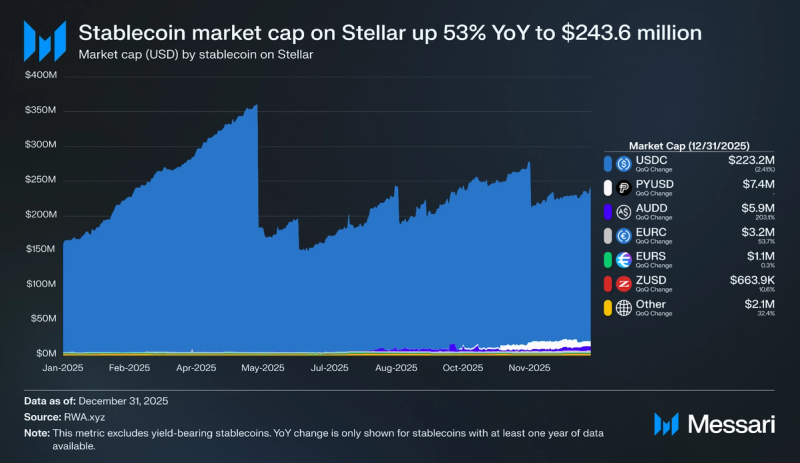
In 2025, the stablecoin market cap on Stellar elevated 53.1% year-over-year from $159.1 million to $243.6 million, pushed by USDC’s 44.6% YoY improve to $223.2 million and PayPal’s PYUSD launch on the community in September 2025. The launch of PYUSD is especially helpful for these already aware of and immediately utilizing PayPal’s present monetary infrastructure built-in with PYUSD, and marks a second main U.S. greenback stablecoin provided on the community, delivering near-immediate settlement and lowered friction for on a regular basis transactions in addition to entry to PayFi options for small companies.
In October 2025, Visa introduced assist for USDC, EURC, PYUSD, and USDG on Stellar. In November, digital funds supplier Wirex, a principal member of Visa, introduced assist for stablecoin settlement utilizing USDC and EURC on Stellar. Card fee settlement made by way of Wirex is now settled in stablecoins immediately onchain with Visa with out reliance on middleman banks or legacy fiat programs. As a substitute, Wirex Pay, the corporate’s onchain stablecoin infrastructure, allows real-time card and banking funds immediately from self-custody wallets. Advantages embody quicker, close to real-time settlement, decrease charges, and 24/7 availability.
Past USDC and PYUSD, the market cap of the Australian digital greenback (AUDD) elevated 44x in 2025 from $128,950 to $5.9 million, surpassing $1 billion in transaction quantity. Different notable stablecoins on Stellar embody Circle’s EURC, STASIS’s EURS, and GMO Belief’s ZUSD.
DeFi
DeFi TVL
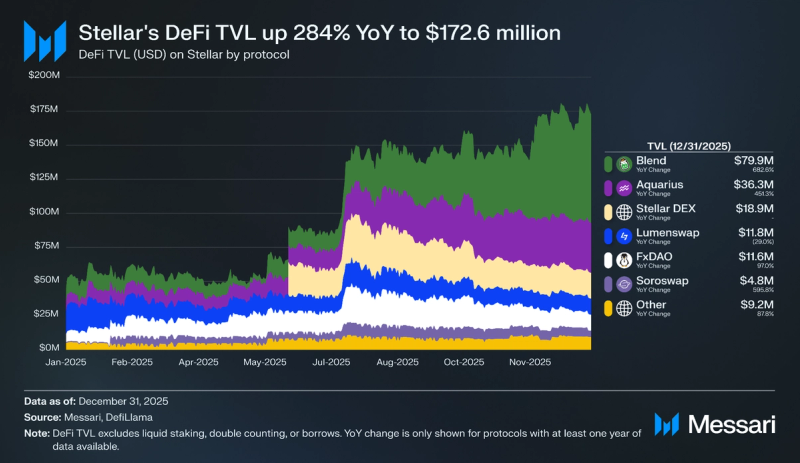
DeFi total-value locked (TVL) on Stellar elevated 284% in 2025 from $44.9 million to $172.6 million. The vast majority of development got here from overcollateralized lending and borrowing protocol Mix, which grew 7.8x YoY from $10.2 million to $79.9 million. APY on USDC deposited on Mix has ranged between 12-18% in current months, a really enticing price in comparison with established overcollateralized lending and borrowing protocols like Aave V3 and SparkLend, which have ranged between 2-7% APY.
Mix has two major lending and borrowing swimming pools: Fastened Pool V2, the place lending and borrowing parameters are immutable after deployment, and Yieldblox V2, which is managed by YBX DAO and permits parameters to be adjusted dynamically and may obtain further yield from BLND rewards, the undertaking’s token. Tokens with notable liquidity on Mix embody XLM, AQUA, stablecoins USDC, EURC, USDGLO, PYUSD, and Etherfuse stablebonds USTRY, CETES, and TESOURO.
Different notable protocols that had excellent TVL development in 2025 embody the DEX Aquarius (+451% YoY to $36.3 million), overcollateralized XLM lending and stablecoin borrowing protocol FxDAO (+97% YoY to $11.6 million), and DEX Soroswap (+86.6% YoY to $4.8 million).
Different DeFi Updates
In October 2025, Stellar joined the Chainlink Scale Program to combine Chainlink’s Knowledge Feeds, Knowledge Streams, and the Cross-Chain Interoperability Protocol (CCIP), increasing the community’s capability to assist RWAs in DeFi. Different notable updates embody:
- SushiSwap Launch: The DEX SushiSwap launched on Stellar on Feb. 10, 2026.
- Rails Vault Storage on Stellar: On Feb. 3, Hybrid perpetual futures platform Rails launched institutional-grade vaults that maintain shopper collateral akin to USDC on Stellar.
- Etherfuse Korean Bond Launch: On Jan. 26, Etherfuse launched Korean authorities bonds (KTB) on Stellar.
- Regular Launch: Regular, an onchain crypto-index funding platform launched on Stellar on Jan. 25, enabling customers to swap XLM or stablecoins for tradable artificial index tokens monitoring diversified baskets like Prime 100 Crypto.
Sensible Contract-based Quantity
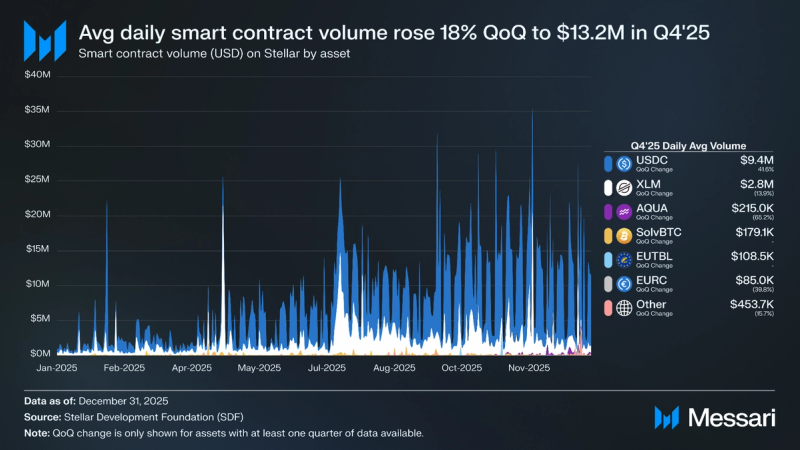
SDF defines good contract quantity as any good contract invocation that causes a token motion (fee, switch, deposit, lend, and so forth.). Common each day good contract quantity rose 18% QoQ from $11.2 million to $13.2 million in This fall 2025. Soroswap and Aquarius are the highest DEXs by quantity, adopted by Phoenix, whereas Mix is the main overcollateralized lending and borrowing protocol. Sensible contracts on Stellar averaged $9.4 million (+42% QoQ) in each day USDC quantity in This fall 2025, adopted by $2.8 million in XLM (-14% QoQ), $215,000 in AQUA (-65.2% QoQ), $179,100 in SolvBTC, $108,500 in EUTBL, and $84,960 in EURC.
Stellar Decentralized Trade (SDEX) and Native AMMs
From its inception, Stellar has had a built-in decentralized alternate referred to as the Stellar DEX or SDEX that makes use of order books for matching purchase and promote orders. In November 2021, community validators upgraded Stellar to Protocol 18, which launched Automated Market Makers (AMMs) inbuilt on the protocol degree. The SDEX’s order books and native AMMs energy Path Funds, which allow sending a distinct asset than that obtained by the recipient. In tandem, Path Funds and Anchors (the community of fiat on/off ramps on Stellar) allow blockchain-based remittances, permitting a consumer in a single nation to ship a given fiat foreign money, which is in the end obtained as a distinct fiat foreign money.
Each of those options have been applied previous to the introduction of Stellar Sensible Contracts (Soroban) in February 2024. For the reason that deployment of good contracts, most initiatives are integrating good contract protocols, and fewer are utilizing the SDEX and native AMMS. For additional particulars, see Genesis of the Stellar Ecosystem in Messari’s Stellar Ecosystem Overview.
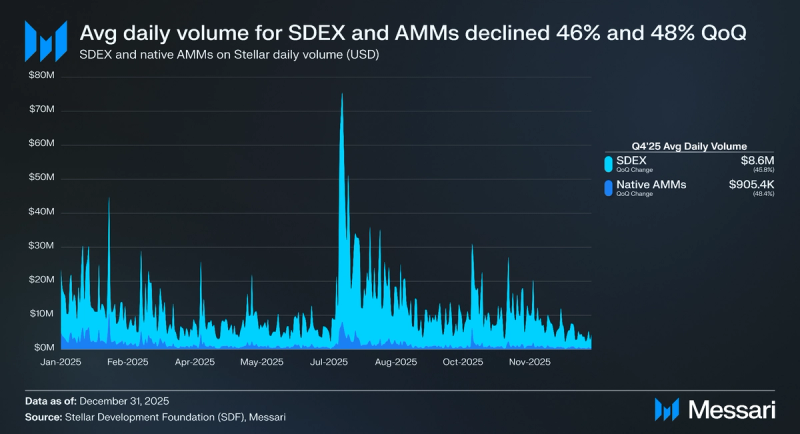
Common each day quantity (USD) for SDEX declined 45.8% QoQ from $15.8 million to $8.6 million, whereas common each day quantity for native AMMs declined 48.4% QoQ from $1.8 million to $905,400. About half of this decline in quantity (USD) might be attributed to the 44.1% QoQ decline within the worth of XLM, as roughly half of quantity on each the SDEX and native AMMs is XLM. The remaining decline is because of decreased quantity, significantly in stablecoins.
Different Ecosystem Utilization Metrics
Past TVL and quantity, month-to-month lively addresses, month-to-month transaction rely, and month-to-month gasoline used are viable metrics for additional evaluating the utilization of good contract-deployed purposes on Stellar.
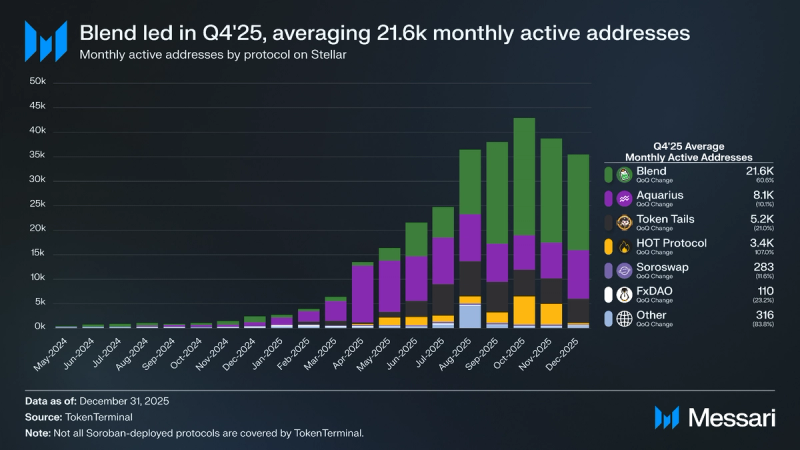
Mix led all protocols in This fall 2025, averaging 21,580 month-to-month lively addresses (+61% QoQ), adopted by Aquarius with 8,080 (-10% QoQ), play-to-save digital cat adoption sport Token Tails with 5,160 (-21% QoQ), and decentralized MPC pockets supplier HOT Protocol with 3,420 (+107% QoQ).
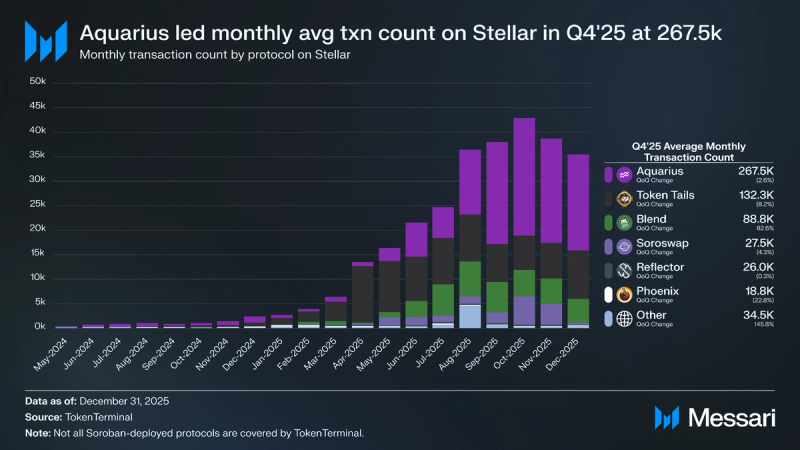
Aquarius led all protocols in This fall 2025, averaging 267,460 month-to-month transactions (-3% QoQ), adopted by Token Tails with 132,320 (-8% QoQ), Mix with 8,830 (+83% QoQ), and Soroswap with 27,510 (-4% QoQ).
Stellar Group Fund (SCF)
The Stellar Group Fund (SCF) is a rounds-based XLM awards program for initiatives constructing on Stellar community. SCF awards observe a quarterly governance course of during which delegate panels evaluation initiatives, and verified members from the Stellar community neighborhood take part in neural quorum governance to award XLM to applicant initiatives.
In January, SDF launched SCF model 7.0, with three software tracks for ecosystem improvement grants. The Integration Monitor is for groups integrating present Stellar ecosystem merchandise, whereas the Open Monitor is for groups constructing monetary protocols, and the RFP Monitor is for developer tooling infrastructure or ecosystem capabilities explicitly requested by a panel of SCF Pilot delegates. Since Q2 2019, there have been 41 rounds, with purposes for SCF #42 due March 15, 2026. Instawards as much as $15,000 per undertaking are additionally accessible to assist early experimentation.
Individually, in January, SCF Development Hack Cohort 1 went reside to assist Stellar Mainnet-launched firms on go-to-market and product-market match by way of consumer acquisition campaigns.
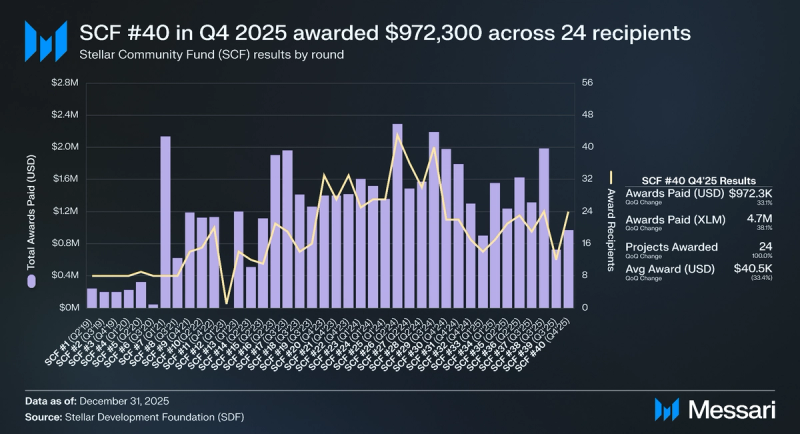
SCF #40 accomplished in December 2025 and has paid $972,300 to this point throughout 24 recipients, with a complete of $2.2 million awarded. Different SDF grants and funding packages embody a bug bounty program, an identical fund whereby SDF matches investments as much as $500,000 for Pre-seed to Collection B firms eager about constructing on the Stellar community, tutorial analysis grants, and advertising and marketing grants for initiatives constructed on Stellar.
Different Notable Updates
- Atomic Pockets added assist for Stellar in January.
- {Hardware} pockets supplier Trezor added assist for all Stellar tokens in December.
- SDF partnered with MIT and different main crypto initiatives, together with Chainlink, Wormhole, and Canton, on a brand new whitepaper addressing interoperability.
Occasions
Introduced occasions in 2026 embody:
- Stellar Home CDMX: April 21-22. Stellar Home is hosted by SDF and brings collectively builders, innovators, builders, entrepreneurs, and thought leaders in blockchain, fintech, DeFi, funds, and digital property to collaborate and share concepts.
- Stellar Meridian 2026 Abu Dhabi: Oct. 21-22. Stellar Meridian is SDF’s annual convention.
A full checklist of neighborhood occasions might be discovered right here.
Funds Evaluation
As a greater than decade-old community constructed for funds, Stellar has realized a strong funds ecosystem throughout its supported wallets, purposes, and customized fee options, just like the Stellar Disbursement Platform (SDP). This contains PayFi, quick for Cost Financing, which makes important monetary use instances, akin to credit score, commerce finance, and remittances, extra accessible, safe, and environment friendly by leveraging blockchain know-how and stablecoins. For a full primer on the funds ecosystem on Stellar, check with the funds part of Messari’s Stellar Ecosystem Overview.
Switch Quantity
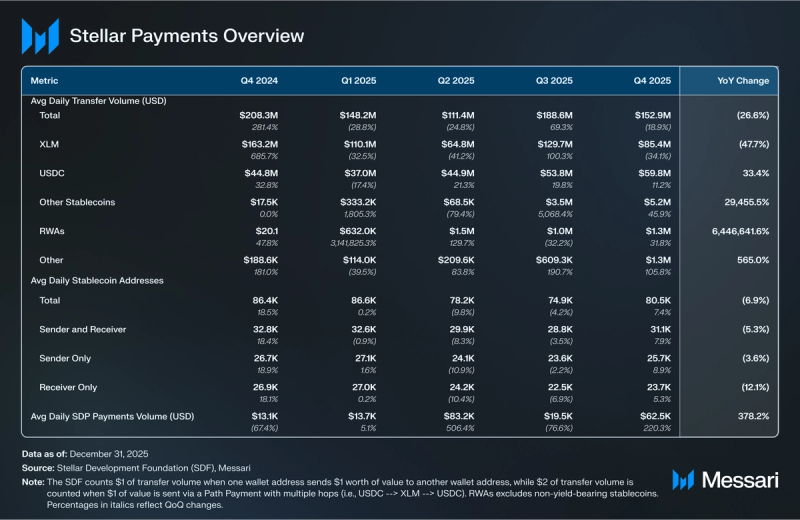
In This fall 2025, Stellar community had a median transaction price of $0.00061, underscoring the community’s affordability for funds. SDF counts $1 of fee quantity when one pockets tackle sends $1 price of worth to a different pockets tackle, whereas $2 of fee quantity is counted when $1 of worth is shipped by way of a Path Cost with a number of hops (i.e., USDC –> XLM –> USDC). Messari counts this exercise as switch quantity.
Common each day switch quantity (USD) on Stellar declined 18.9% QoQ from $188.6 million to $152.9 million. Nevertheless, common each day USDC switch quantity rose 11.2% QoQ to $59.8 million, a 33.4% improve YoY from $44.8 million in This fall 2024. Furthermore, common each day switch quantity of different stablecoins elevated 45.9% QoQ from $3.5 million to $5.2 million, a 300x YoY rise from $17,500 in This fall 2024. Moreover, common each day RWA switch quantity (excluding non-yield-bearing stablecoins) rose 31.8% QoQ to $1.3 million, up dramatically as RWAs have continued to proliferate on Stellar.
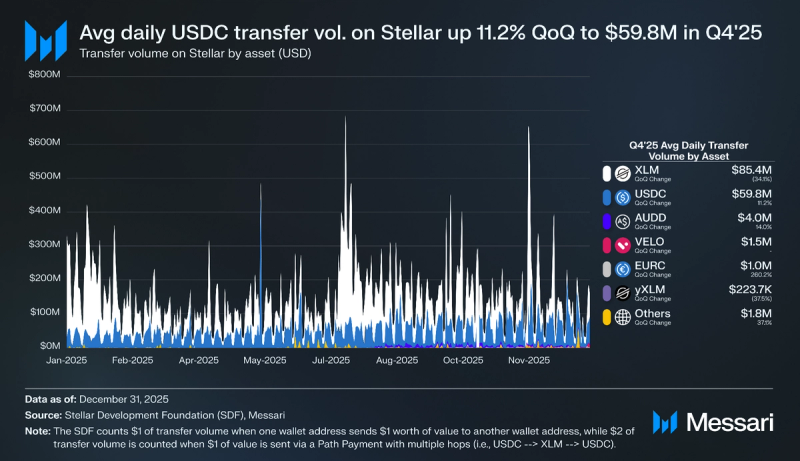
On Stellar, the overwhelming majority of switch quantity is in USDC or XLM. In This fall, common each day XLM switch quantity declined 59.1% QoQ to $85.4 million, whereas common each day USDC switch quantity elevated 11.2% QoQ to $59.8 million. SDF attributes the decline to each decrease XLM worth and lowered microtransactions (~0.0000001 XLM) from bot addresses like GDW…XRP. Past USDC, stablecoins and RWAs with notable switch quantity on Stellar embody Australian Digital Greenback (AUDD), Circle’s tokenized model of the EURO (EURC), and BENJI, every token of which represents one share of Franklin Templeton’s onchain U.S. Authorities Cash Fund (FOBXX).
Stablecoin Addresses
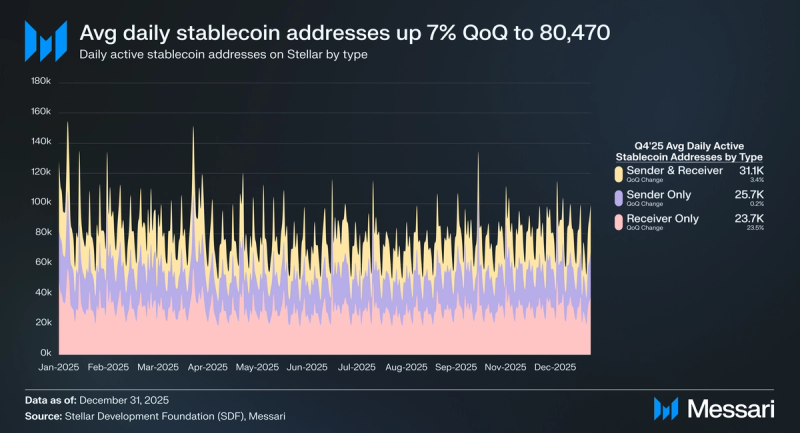
Common each day stablecoin addresses on Stellar elevated 7% QoQ from 74,900 to 80,470. Addresses that despatched and obtained stablecoins on the identical day elevated 8% QoQ from 28,820 to 31,090, whereas addresses that solely despatched elevated 9% from 23,060 to 25,710 and addresses that solely obtained elevated 5.3% from 22,480 to 23,680. This metric counts G-addresses, that are customary Stellar account addresses, whereas C-addresses are used for good contracts. These are the 2 major tackle sorts on the community.
Stablecoin Transfers by Measurement
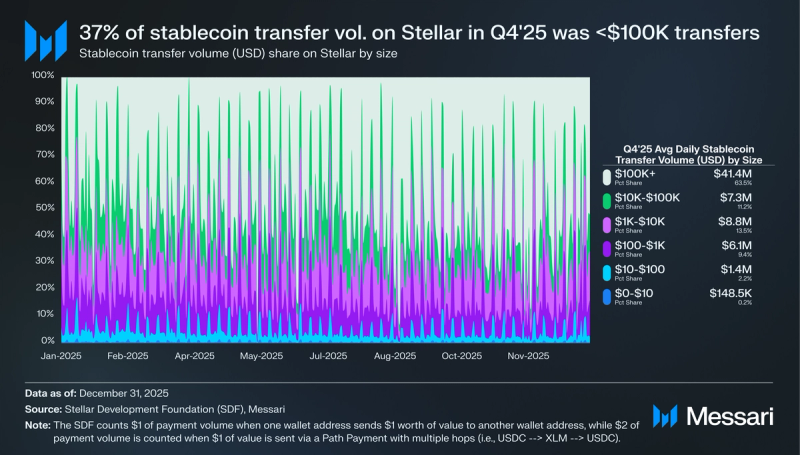
In This fall 2025, 36.5% of stablecoin switch quantity on Stellar was transfers of under $100,000, particularly, 13.5% between $1,000 and $10,000, 11.2% between $10,000 and $100,000, 9.4% between $100 and $1,000, and 0.2% between $0 and $10. Notably, there was outsized quantity within the $1,000 to $10,000 fee band, because it had extra quantity than the $10,000 to $100,000 band.
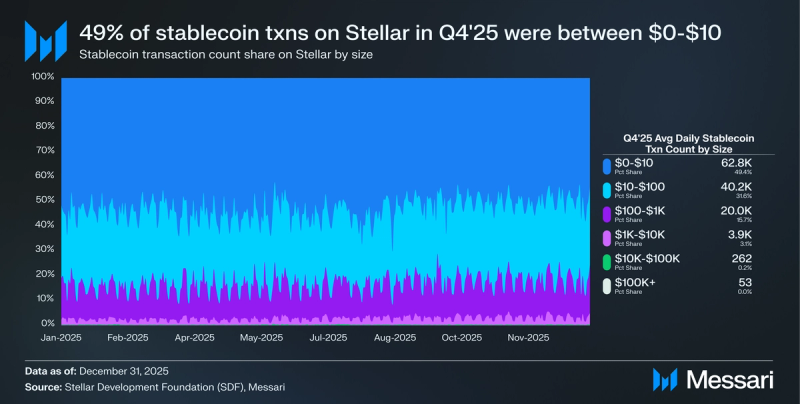
49.4% of stablecoin transactions in This fall 2025 have been between $0 and $10, adopted by 31.6% between $10 and $100, 15.7% between $100 and $1,000, 3.1% between $1,000 and $10,000, and 0.2% between $10,000 and $100,000. Notably, common each day stablecoin transactions between $0 to $10 declined 7.6% QoQ from 68,010 to 62,820, whereas these between $10 to $100 elevated 6.9% QoQ from 37,650 to 40,230, exhibiting elevated transaction exercise at the next fee measurement.
Funds Milestones
There have been quite a lot of fee milestones on Stellar in This fall. Arguably probably the most notable was the Marshall Islands’ onchain common primary revenue disbursement in December 2025 utilizing a tokenized bond (USDM1) on Stellar. This was the primary onchain disbursement of common primary revenue by a nationwide authorities. The initiative is a part of the ENRA program and replaces bodily money deliveries with digital transfers to residents throughout dispersed islands.
Different notable current fee catalysts on Stellar embody:
- Hana: Hana partnered with MoneyGram in November to deliver USDC on Stellar to Southeast Asia.
- SDF x BPC: In November, the Stellar Improvement Basis (SDF) introduced the formation of the Blockchain Funds Consortium (BPC), an initiative to allow frictionless, compliant transactions throughout networks and borders, along with different founding members Fireblocks, Polygon Labs, Mysten Labs, Monad Basis, Solana Basis, and TON Basis. The consortium’s mission is to outline protected, frequent requirements to form higher fee experiences for everybody.
- Crossmint x Stellar: In October, Crossmint launched its Stellar Sensible Wallets V2, enabling simple launch of stablecoin purposes by builders utilizing chain-agnostic web2 APIs. Notably, Crossmint powers MoneyGram’s cross-border stablecoin infrastructure.
- Cartwey: In October, Cartwey, a grocery retailer self-checkout software powered by Stellar and Beans funds SDK, was introduced as a recipient of the Stellar Group Fund (spherical 38, SDF’s awards program for ecosystem improvement.
Stellar Disbursement Platform
The Stellar Disbursements Platform (SDP) is a turnkey resolution for sending digital funds to many people for functions akin to humanitarian assist, international payroll, authorities transfers, and enterprise remittances. SDP implementations have lowered prices by double-digit percentages for disbursers, lots of whom beforehand relied on considerably dearer legacy programs. For additional info on SDP technical specs, case research, and integrations, see Messari’s Stellar Ecosystem Overview report.
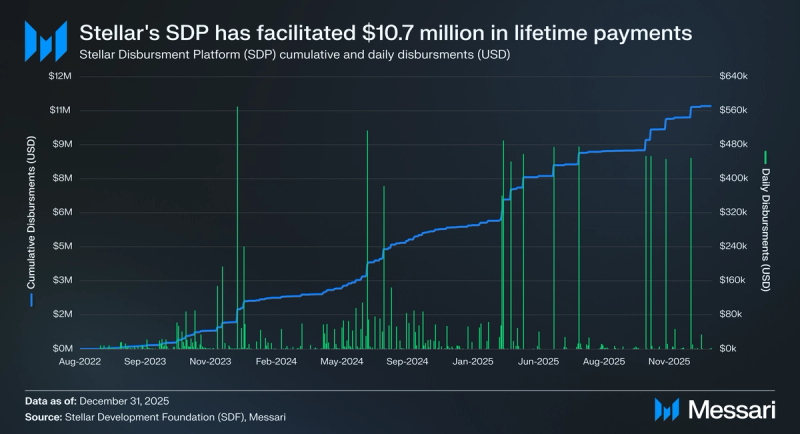
Common each day SDP fee quantity elevated 220.3% QoQ from $19,500 to $62,450. Furthermore, on Nov. 11, 2025, the SDP surpassed $10 million in lifetime disbursements, with $10.7 million distributed lifetime on the finish of 2025. Of this, $4.8 million has been money help, $5.9 million payroll, and the remaining $18,000 disbursed for quite a lot of different functions, together with charitable donations, consumer rewards, international payroll, and money help payroll.
- Hope for Haiti: In December, VIA Science introduced a collaboration with SDF to assist the disbursement of assist by way of the nonprofit Hope for Haiti. The six-month program will distribute greater than $200,000 to 325 moms related with Hope for Haiti’s dietary packages. Every participant will obtain a month-to-month stipend of $100 in USDC.
- Worldwide AIDS Society (IAS): In July 2025, IAS used the SDP and Decaf pockets to interchange cash-based scholarships for its convention, delivering tens of hundreds in USDC throughout 425 funds to convention scholarship recipients, eliminating cash-handling danger and administrative overhead, whereas enabling real-time monitoring and auditability.
Anchors
Since Stellar’s inception, conventional monetary establishments have been important as they supply the on and off-ramps that join Stellar to conventional monetary rails. These entities, referred to as Anchors, embody banks, crypto exchanges, and cash switch operators which have the capability to assist customers ship, deposit, or withdraw fiat for digital property.
As of February 2026, the Stellar Anchor Listing lists 82 Anchor monetary intermediaries that collectively supply providers to greater than 225 jurisdictions (nations, territories, and so forth). Collectively they assist greater than 170 fiat currencies (e.g., USD, ARS, EUR, MXN, BRL, NGN, PHP, RWF, KES, JPY, AUD, SGD, GBP, CLP, KRW, CFA, TWD, and so forth.) and 15 stablecoins backed 1:1 by the underlying fiat asset and yield-bearing equivalents, akin to short-term treasuries, held in reserve (i.e., USDC, EURC, GYEN, ZUSD, UAH, AUDD, EURS, VCHF, VEUR, MXNe, SBC, USDGLO, PYUSD, USDM1, and USD [WisdomTree]) in additional than 170 nations. Moreover, MoneyGram Ramps helps money deposits (on-ramp) from the native foreign money to USDC on Stellar to 40 nations and money withdrawals (off-ramp) from USDC on Stellar to the native foreign money in additional than 170 nations throughout practically 500,000 areas.
Many Anchor organizations additionally assist XLM, the native token of the Stellar community, whereas WisdomTree and Franklin Templeton assist the RWAs they’ve issued on Stellar. SDF presents the Anchor Platform, a set of instruments and APIs for anybody with the supporting conventional monetary system infrastructure to construct their very own on and off-ramp providers for the Stellar community.
In September, Crossmint introduced the combination of its pockets and stablecoin orchestration infrastructure on MoneyGram, enabling customers to immediately obtain USDC in a Crossmint pockets within the MoneyGram software. This USDC can be utilized with MoneyGram’s further monetary providers and cashed out to an area foreign money when wanted.
Community Upgrades
Whisk
In September, Stellar Community upgraded to Protocol 23 (Whisk), key options of which embody:
- Unified Occasions: A brand new single occasion format that permits traditional operations to emit asset occasions in the identical format as good contract transactions.
- Parallel Transaction Processing: Parallel execution of good contract transactions is enabled, sustaining bounded execution time for transaction units, whereas bettering pace and CPU effectivity.
- Price Reductions: Whisk applied price reductions by way of improved WebAssembly caching and extra environment friendly reminiscence utilization for learn operations.
- State Archival Basis: Lays the groundwork for implementation of full state archival of the community in future upgrades.
- Configurable Community Parameters: Elevated flexibility for validators to optimize block timing and cut back latency by way of configurable SCP timing parameters.
Privateness
In September at Meridian 2025 in Rio de Janeiro, SDF’s Chief Product Officer, Tomer Weller, unveiled the group’s roadmap for privateness on Stellar, with the final word purpose of 100% personal settlement for establishments, which are sometimes legally required to maintain shopper positions, buying and selling methods, counterparties, and so forth. confidential.
On Jan. 22, the X-Ray privateness protocol improve went reside on the Stellar community, laying the groundwork for zero-knowledge (ZK) cryptography so builders can construct privacy-preserving, regulatorily compliant purposes on the community. X-Ray launched two necessary primitives:
- BN254: A pairing-friendly elliptic curve for environment friendly zk-SNARK verification. Sensible contracts can now confirm zk-SNRK proofs onchain with BN254, making Stellar interoperable with main networks utilizing ZK know-how, together with Zcash, Ethereum, Sprout, and Starknet.
- Poseidon: Poseidon2 hash permutations are less expensive to characterize inside ZK circuits than conventional hashes like SHA-256.
Following this launch, on Feb. 9, SDF launched a ZK Gaming Hackathon with a $10,000 prize pool for builders to construct video games that forestall dishonest and are trustless.
Then, on Feb. 13, Stellar Personal Funds (SPP) have been open-sourced, introducing a proof-of-concept (not but audited) for a privacy-preserving fee system on Stellar utilizing zero-knowledge proofs (ZKPs). The SPP operates underneath the usual mannequin of offering absolutely personal stability transfers throughout the privateness pool, which don’t reveal transaction quantities, balances, the sender, or the receiver. ZKPs are used to allow privateness within the pool and in order that exterior observers can not hyperlink deposits and withdrawals to particular in‑pool balances or counterparties. Deposit and withdrawal transactions to the privateness pool nonetheless reveal the interacting public account, and the quantity both deposited or withdrawn, however no additional details about inside balances or counterparties.
Constructed by Nethermind, the implementation allows ZKPs utilizing Groth16 proofs by way of Circom circuits. Affiliation Set Suppliers (ASPs) are used as a management mechanism to safeguard in opposition to illicit exercise. ASPs keep membership and non-membership Merkle bushes that enable proving whether or not particular deposits are a part of authorised or blocked units, enabling pool operators to implement administrative controls with out compromising consumer privateness. Importantly, the Widespread Reference String (CRS), which is used to generate and confirm zero‑information proofs for the pool’s transactions, was not generated doing a decentralized ceremony. This implies all customers should absolutely belief that the creators of the CRS didn’t maintain the key used to generate it. In the event that they did, then they’ll mint limitless worth throughout the pool or bypass guidelines, with all ZKPs nonetheless verifying.
Community Evaluation
Lively Addresses
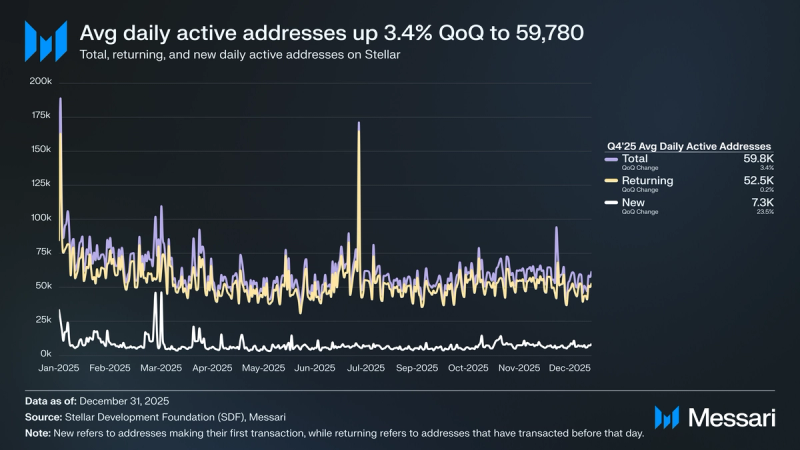
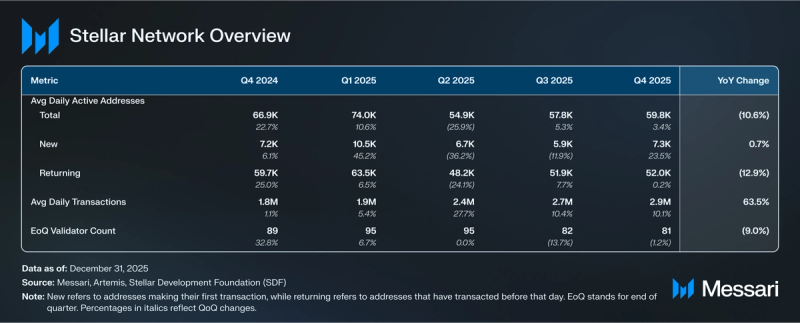
Common each day lively addresses elevated 3.4% QoQ from 57,790 to 59,780. The each day common of latest addresses making their first transaction elevated 23.5% QoQ from 5,880 to 7,260, whereas the each day common of returning addresses having made a transaction earlier than that day elevated 0.2% QoQ from 51,910 to 52,010.
Validators
In contrast to many different blockchain networks, Stellar doesn’t distribute inflationary token rewards or transaction charges to its validators. As such, there isn’t a XLM staking mechanism. Underneath the Stellar Consensus Protocol (SCP), a development of the Federated Byzantine Settlement (FBA) consensus mechanism, every validator maintains a quorum set, an inventory of the nodes it trusts. Core nodes should then set a threshold (minimal variety of nodes that should agree to succeed in consensus), with the mixture of agreeing nodes throughout the quorum set referred to as quorum slices. The validity and order of transactions are then decided by way of a system of federated voting, the place candidate transactions are first nominated to be included within the ledger, adopted by a poll protocol to make sure the unanimous affirmation of nominated transaction units.
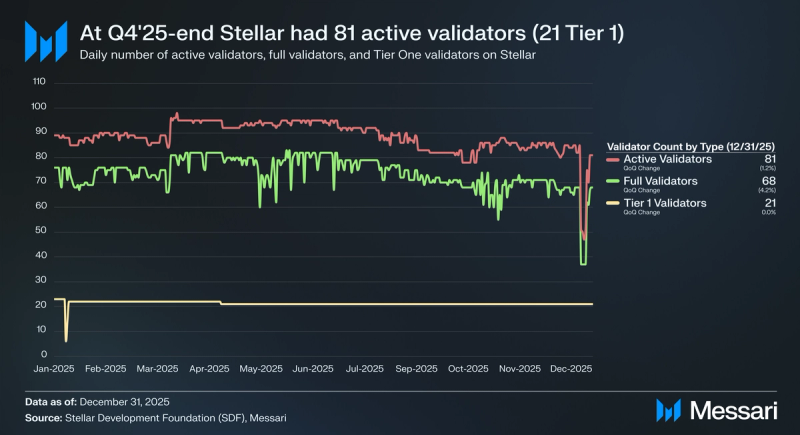
On the finish of 2025, Stellar had 81 lively validators collaborating in SCP, down from 82 lively validators on the finish of Q3 2025. Collectively, these validators maintained a 99.99% uptime for Stellar all through 2025.
The community additionally ended 2025 with 68 full validators (lively validators additionally publishing a public historical past archive), down from 71 on the finish of Q3 2025. The community is successfully run by Tier 1 Organizations, a gaggle of organizations that usually run three validators and coordinate their quorum units with each other. Collectively, Tier 1 Organizations bear the protection and liveness of the community, given that almost all different validators require their settlement underneath the SCP. SDF acts as a coordinator amongst Tier 1 Organizations to make sure community well being, whereas every Tier 1 Group maintains management over its quorum set. Since April 2025, there have been seven Tier 1 organizations, every working three full validators, for a complete of 21 Tier 1 validators. These are Blockdaemon, Creit Applied sciences, Franklin Templeton, LOBSTR, Public Node, SatoshiPay, and SDF.
Monetary Evaluation
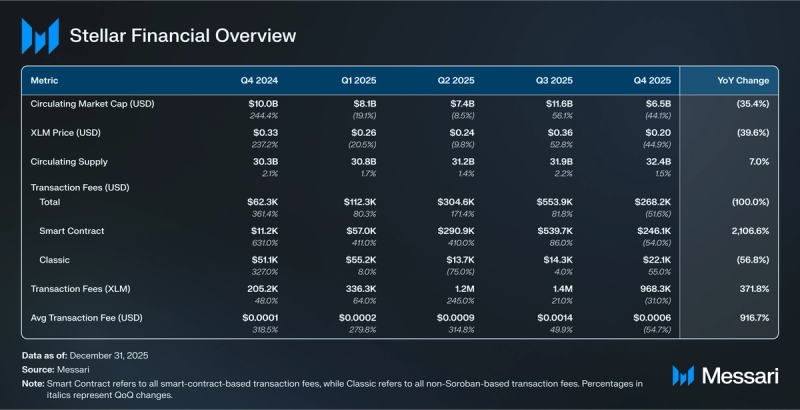
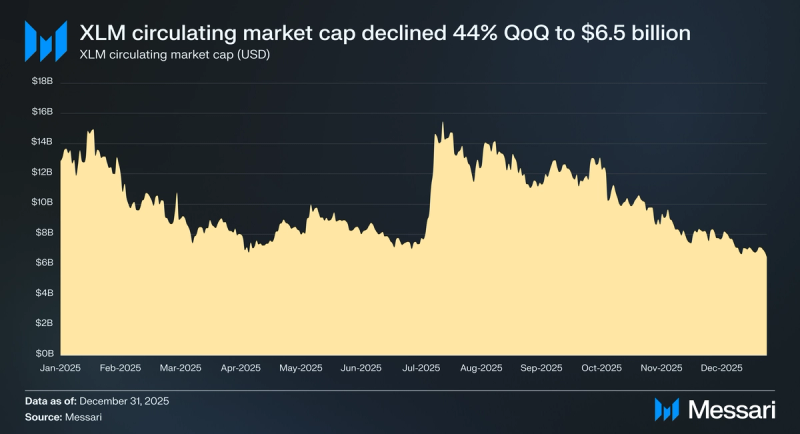
XLM ended This fall 2025 because the Seventeenth-largest crypto asset by market capitalization at $6.49 billion (-44.1% QoQ), underperforming the mixed market capitalization of BTC, ETH, and SOL, which decreased by 24.4% QoQ. XLM’s worth decreased 44.9% QoQ from $0.36 to $0.20, with the 0.8% discrepancy between market cap and worth because of a 1.5% QoQ improve in circulating provide to 32.4 billion XLM. 12 months-over-year (YoY), XLM’s circulating market cap declined 35.4% from $10.05 billion on the shut of This fall 2024.
XLM TradFi Merchandise
In October 2025, WisdomTree launched the WisdomTree Bodily Stellar Lumens ETP (XLMW) with alternate itemizing in Europe.
Moreover, two main U.S.-regulated crypto index funds expanded in 2025 to incorporate XLM:
- In December, Franklin Templeton expanded its Franklin Crypto Index to incorporate spot XLM.
- In September, Hashdex expanded its crypto index U.S. ETF (NCIQ) to incorporate spot XLM.
Circulating Provide + SDF Held XLM
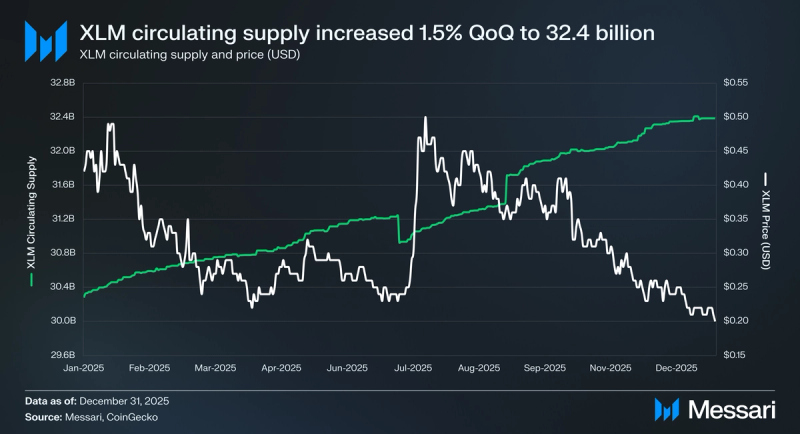
The circulating provide of XLM is the 50 billion complete provide, much less XLM held by SDF, the Improve Reserve, and the Price Pool.
- XLM held by SDF (17.3 billion XLM at This fall-end, 34.6% of the whole provide): SDF’s mandate is to make use of the XLM it holds to construct, promote, and strengthen the Stellar community and ecosystem. SDF sells XLM it holds on public exchanges like Kraken, Coinbase, and Bitstamp, and thru direct gross sales, to pay for SDF’s operational bills and to assist the broader work of its mandate. The XLM is held throughout 4 account sorts:
- SDF Improvement: 2.72 billion XLM (5.4% of the whole token provide). This account covers SDF’s operational bills, together with hire, server prices, network-level advertising and marketing, advocacy and coverage work.
- Stellar Development: 6.29 billion XLM (12.6% of the whole token provide). Makes use of embody funding developer packages, hackathons, and Enterprise Fund Investments that deepen infrastructure throughout wallets, exchanges, DeFi protocols, and fee firms.
- Product and Innovation: 4.49 billion XLM (9% of the whole token provide). Used to determine, fund, and construct Stellar ecosystem instruments.
- Property and Liquidity: 3.5 billion XLM (7% of the whole token provide). Used to assist collaborations for asset issuance with establishments and fintechs, market-making packages, on and off-ramp infrastructure, and integrations with bridges and compliance suppliers.
- Improve Reserve (259.29 million XLM at This fall-end, 0.52% of the whole provide): XLM put aside, to be claimed, one-for-one, by holders of outdated Stellar community tokens, following Stellar community’s relaunch in November 2015 utilizing the Stellar Consensus Protocol (SCP). A declare has not been created from the Improve Reserve since This fall 2021.
- Price Pool (8.97 million XLM at This fall-end, 0.018% of the whole provide): On Stellar, all transaction charges are paid in XLM and despatched to the price pool, making them completely inaccessible.
Transaction Charges
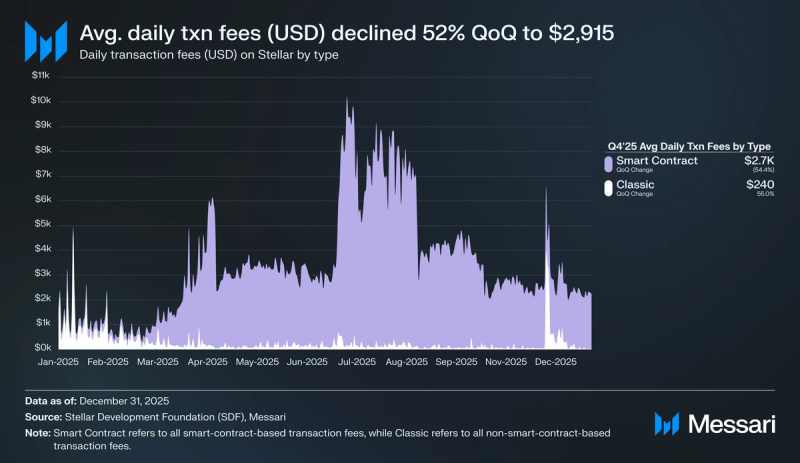
The common transaction price on Stellar fell 54.7% QoQ from $0.0013 to $0.0006. Likewise, common each day transaction charges (USD) declined 52% QoQ from $6,020 in Q3 2025 to $2,915 in This fall 2025. This lower was pushed by the protocol 23 (Whisk) improve in September, which applied price reductions by way of improved WebAssembly caching and extra environment friendly reminiscence utilization for learn operations. Furthermore, the transaction price for good contract transactions (Soroban price) is configurable by way of Stellar Limits Proposals (SLPs) that enable the community to tune efficiency and cut back charges. Rising community capability retains the community out of surge pricing, lowering charges.
Nonetheless, Stellar good contract transaction charges elevated 24x YoY from $11,150 in This fall 2024 to $246,060 in This fall 2025. Because of this, transaction charges (USD) elevated 4.3x YoY from $62,270 in This fall 2024 to $268,160 in This fall 2025, and in XLM phrases elevated 9x YoY from 92,880 XLM to 848,600 XLM. This improve is due Stellar good contracts’ useful resource price, which is required for every transaction based mostly on the useful resource consumption (CPU, storage, bandwidth) declared within the transaction.
Transaction Price Design
The useful resource price exists so the community is just not handled as a free database, which explains Stellar good contract charges are increased than Basic charges. Past this consideration, for each Stellar good contracts and Basic, SDF goals to maintain charges as little as attainable to make sure equitable entry to monetary merchandise, with charges seen as a safety mechanism to stop ledger bloat and spam. For a full primer on price sorts on Stellar, see Stellar’s documentation.
Closing Abstract
This fall 2025 and past have been momentous for Stellar. The RWA market cap on Stellar (excluding stablecoins) surpassed $1 billion on Jan. 21, and elevated 184% in 2025 from $301 million to $855 million. Furthermore, the stablecoin market cap on Stellar elevated 53% year-over-year from $159 million to $244 million, pushed by PayPal’s PYUSD launch on the community in September, and USDC’s 45% YoY improve in market cap to $223 million. This growth is being validated by institutional adoption, as U.S. Financial institution is testing customized issuance of its personal stablecoin on Stellar, underscoring the community’s attraction because of its reliability (>99.99% uptime), affordability (settlement at <1 U.S. cent), and built-in asset controls for regulatory compliance. On high of this, in December, the Marshall Islands accomplished the world’s first onchain common primary revenue disbursement by a nationwide authorities on Stellar.
Stellar additionally moved one step nearer to SDF’s purpose of 100% personal settlement for establishments, which is required for regulatory compliance. With the discharge of Stellar’s X-Ray privateness protocol improve in January, builders can now construct privacy-preserving, regulatorily compliant purposes on the community.
Lastly, Stellar is realizing elevated DeFi composability, thereby reaching larger capital effectivity and DeFi TVL, as extra protocols are launched and issued property are adopted on the community. This contains lending and borrowing protocol Templar, which is able to quickly assist native crypto property, stablecoins, and freely transferable RWAs. With the muse of Stellar’s monetary adoption laid in 2025, Stellar enters 2026 positioned for additional use by establishments and people alike.
