



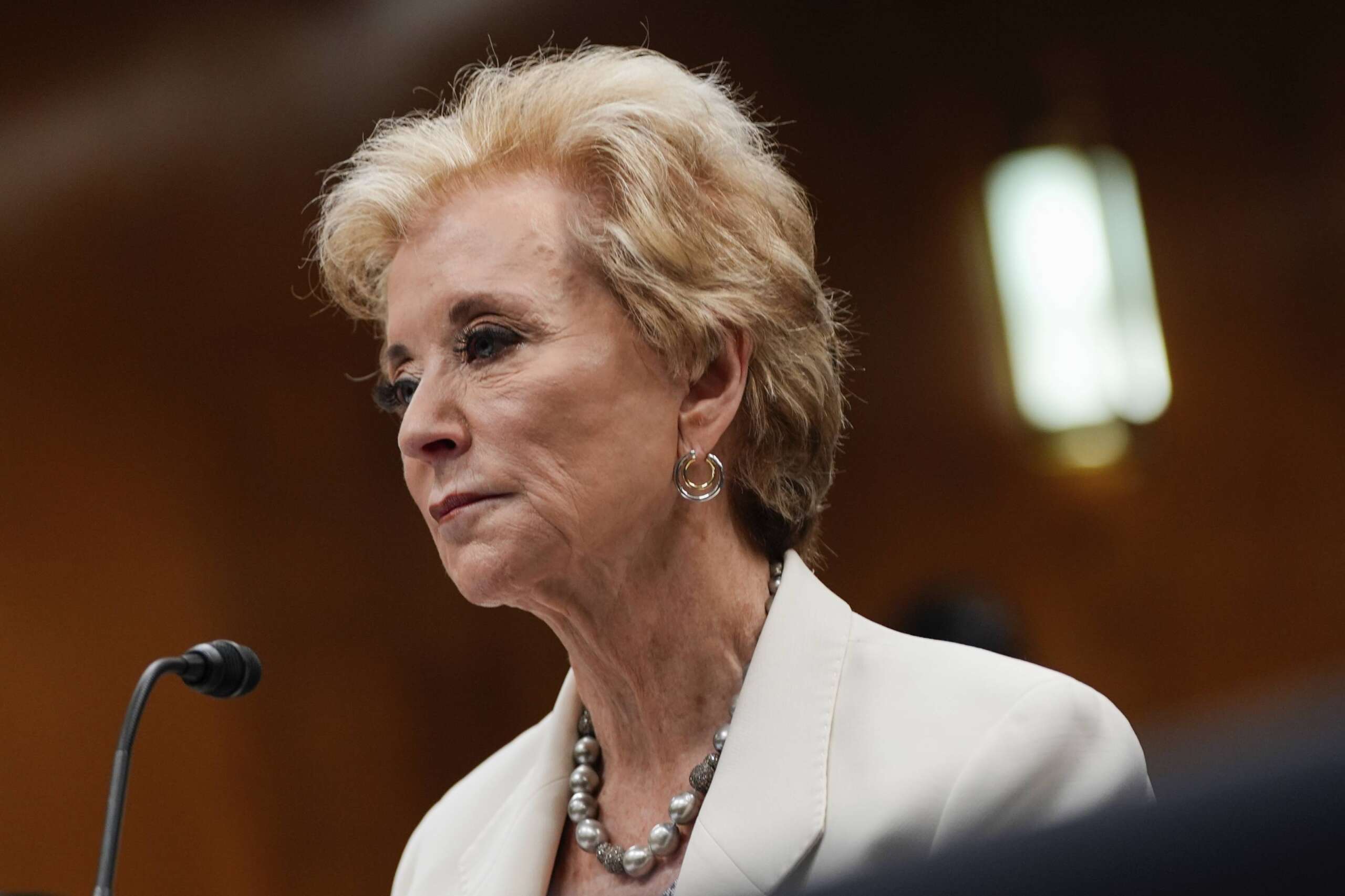
After reversing layoffs for hundreds of its attorneys, the Education Department’s top official says the agency is once again hiring to boost legal staffing and keep pace with its caseload.
The Education Department, as part of long-term efforts to dismantle its operations, continues to shift many of its core functions to other federal agencies.
Education Secretary Linda McMahon told members of the Senate Appropriations Committee that restoring these staff cuts and hiring additional attorneys for its Office of Civil Rights are essential to address a growing backlog of civil rights complaints.
“We are working to resolve as many cases as possible, but we are bringing back many of those lawyers who were part of that reduction in force. There was a time when we were not processing cases as quickly as we should, but we are now focused on doing that and moving forward,” McMahon said.
Last year, the Education Department laid off more than half of its Office of Civil Rights staff and shut down half of its regional offices. When a federal court in Massachusetts blocked the department from finalizing these layoffs, the department placed the employees on paid administrative leave instead of returning them to their positions.
The Government Accountability Office recently found that the department spent up to $38 million keeping these employees on paid administrative leave.
McMahon said the department brought back “all the ones who were fired,” but not those who accepted the deferred resignation program or early retirement offers.
The New York Times recently reported that the Education Department resolved 30% fewer discrimination complaints in 2025 compared to the previous year. Out of a backlog of 12,000 cases, the Education Department’s Office of Civil Rights made 112 resolution agreements last year — less than 1% of investigations. In 15 states, no resolution agreements were reached last year.
Sen. Chris Murphy (D-Conn.) said the Education Department did not resolve any of the 70 cases brought by students and their families in Connecticut last year.
“How do you defend that?” he asked McMahon.
“It is very difficult, when I am trying to address those particular issues, except to acknowledge that those things were happening, and we are looking forward to making sure that they stop happening,” she replied.
McMahon said the department is “moving ahead” to tackle the backlog, and that dwelling on the reversed cuts to the Office of Civil Rights is “hindsight.”
Last year, President Donald Trump nominated Kimberly Richey to be the Education Department’s top civil rights official. The Senate confirmed her nomination last October. Richey served as the acting head of the Education Department’s Office for Civil Rights during the first Trump administration.
“We are bringing back lawyers. We are hiring new lawyers to address this backlog with the person who had been so successful before in getting this done,” McMahon said.
The department has signed 10 interagency agreements to transfer Education personnel and programs to other federal agencies. McMahon said the Education Department, under this plan, will serve as a “pass-through for funding” that it will hand off to other agencies that will “co-administer Department of Education programs.”
“It is not going to various and sundry different agencies. It is dealing with the same people that you have known at the Department of Education who are located somewhere else,” she said.
The Labor Department, under these agreements, will oversee federal funding that goes to K-12 schools, including grants for schools serving low-income communities. Under these changes, the Labor Department will distribute more education funding than it does for its own labor programs.
These interagency agreements have also led to additional costs. According to one interagency agreement obtained by Federal News Network, the Education Department agreed to reimburse the Labor Department for up to $262,000 of expenses in fiscal 2025 and about $807,000 for fiscal 2026.
McMahon said there were “hiccups along the way” with these interagency agreements, but said grant programs that Education has transferred over to the Labor Department are getting the money out to recipients on time.
“We haven’t gotten complaints. You know, I think there were concerns at first — were the grants going to go out on time? Clearly, there were some hiccups at the beginning, which I think would be natural to work out, but we have worked them out.”
Sen. Tammy Baldwin (D-Wis.) said these interagency agreements are “making everything more complicated for states and local school districts.”
“This isn’t reducing bureaucracy, it’s creating more of it, another layer of it. Where states previously primarily dealt with the Department of Education, they will now have to deal with multiple federal agencies,” Baldwin said.
Senate Appropriations Committee Chairwoman Susan Collins (R-Maine) also expressed concern about the department’s plans to consolidate K-12 grants and cut funding for low-income, first-generation, and disabled students.
“In my judgment, the partnership that the Department of Education has entered into with the Department of Labor negatively affects these competitions, and current grantees in my state … are going to be hurt by the change in focus,” Collins said.
Copyright
© 2026 Federal News Network. All rights reserved. This website is not intended for users located within the European Economic Area.
