



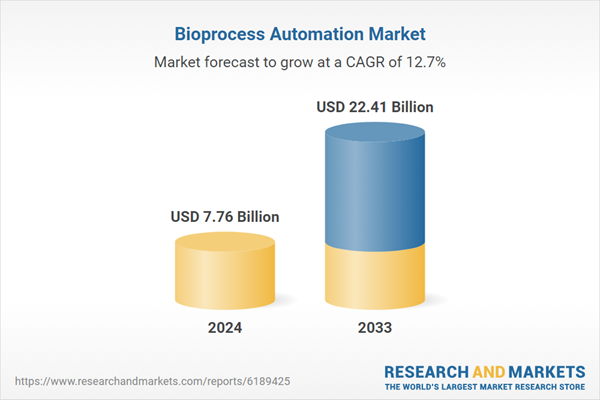
Key market opportunities for bioprocess automation include the growing demand for biologics, driven by advanced treatments like monoclonal antibodies and gene therapies, along with the need for manufacturing efficiency and cost reduction. Integration of AI and robotics enhances production, minimizes errors, and meets rising healthcare demands.
Bioprocess Automation Market

Dublin, Jan. 21, 2026 (GLOBE NEWSWIRE) — The “Bioprocess Automation Market Forecast to 2033” has been added to ResearchAndMarkets.com’s offering.
The global bioprocess automation market is poised for significant growth, with its size estimated at USD 7.76 billion in 2024 and projected to reach USD 22.41 billion by 2033. This expansion reflects a CAGR of 12.67% from 2025 to 2033, primarily driven by the rising demand for biologics, advancements in AI and robotics, and a heightened emphasis on regulatory compliance and operational efficiency.
Rising Demand for Biologics
The increasing demand for biologics is a key driver of the bioprocess automation industry. Over the last decade, the development and use of monoclonal antibodies, vaccines, gene therapies, and other biologic products have surged due to their effectiveness in treating complex diseases. These biologics require controlled, scalable, and precise manufacturing processes to ensure high quality and efficacy. Traditional manual or semi-automated production methods are labor-intensive and prone to errors, unable to meet the expanding market demand. Therefore, the need for fully automated bioprocessing solutions is significant.
Bioprocess automation is anticipated to grow as healthcare increasingly relies on biology for innovative treatments. Automation optimizes production workflows, enhances consistency, and increases throughput without compromising quality. Through the integration of robotics, AI, and advanced monitoring systems, biopharmaceutical companies can produce larger biologics with reduced variability, faster turnaround times, and lowered operational costs.
Need for Efficiency and Cost Reduction
The demand for cost and efficiency improvements also fuels the bioprocess automation market. Biopharmaceutical manufacturing is complex and resource-intensive, often requiring skilled staff and strict protocol adherence. Manual or semi-automated processes can lead to batch failures, inconsistent products, and higher production costs. By adopting automated systems, businesses boost productivity, reduce reliance on manual input, and minimize errors, ensuring more consistent and reliable results across batches.
