



# How Next-Gen Mobile Computers Are Transforming Workplace Efficiency with Embedded RFID
The modern enterprise is witnessing a significant shift in how frontline workers interact with physical inventory and assets. Compact, durable mobile computers—ranging from standard handhelds to ruggedized tablets—are now being manufactured with integrated radio frequency identification capabilities. By merging traditional scanning tools like optical cameras and barcode readers with secure cellular connections and enterprise software, these gadgets empower employees to manage complex workflows right from the palm of their hand. To ensure these tools deliver the necessary performance in fast-paced environments, the underlying communication protocols have undergone major advancements, specifically focusing on faster data exchanges and greater precision.
## Rapid Item Retrieval
Workers spend countless hours searching for specific items throughout their shifts, whether locating a particular clothing size on a store rack, finding expired fresh goods in a grocery aisle, or tracking recalled merchandise in a warehouse. By repeatedly scanning a target product to monitor signal strength fluctuations, these mobile systems can triangulate its exact position on a shelf. The newest protocol updates have drastically accelerated this re-scanning process, allowing staff to find individual items in half the time previously required.
## Continuous Real-Time Stock Monitoring
Older handheld scanners only provided periodic snapshots of inventory, leaving significant gaps in data accuracy. With integrated RFID, the daily movements of employees naturally restocking shelves or processing online orders create a continuous stream of real-time inventory information. This advancement makes passive scanning highly practical, even in difficult environments where tags are placed close to large metal surfaces. Recent benchmarks indicate that micro-sized tags positioned mere millimeters from metallic backgrounds can be detected from distances over a meter and a half, and the volume of items cataloged within a short window has increased dramatically compared to older systems.
## Streamlined Order Fulfillment
The rise of omnichannel retail has intensified the need for rapid, accurate order picking. RFID-enabled mobile devices transform manual selection into guided, automated processes, showing workers exactly what to retrieve and verifying quantities instantly. In notoriously chaotic back rooms and storage facilities, the updated protocol excels at eliminating irrelevant signals and filtering out unnecessary data. This “decluttering” capability allows the device to quickly isolate the target product, improving accuracy and reducing costly fulfillment mistakes.
## Counterfeit Deterrence and Authentication
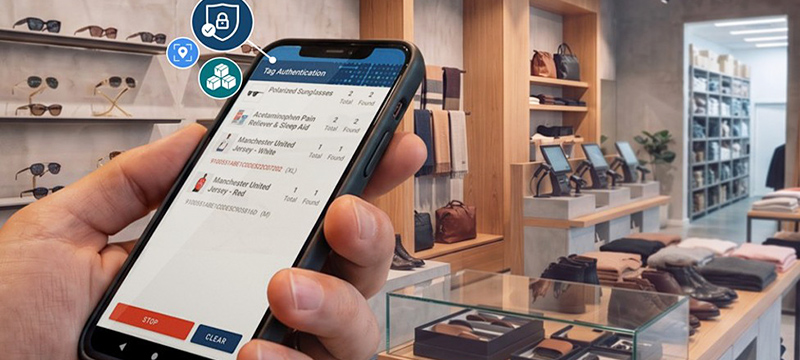
Fake goods cost the global economy billions annually, undermining brand trust and posing serious safety risks. By equipping employees with mobile devices capable of reading RFID tags, companies can verify product authenticity at any stage of the supply chain—from factory floors to distribution centers and retail points of sale. The latest generation of these systems can perform immediate on-the-spot chip verification, confirming an item’s legitimacy with near-total certainty without sacrificing the speed of inventory operations.
## Enterprise Deployment Is Now a Reality
Major semiconductor manufacturers are now embedding RAIN RFID radio capabilities directly into their mobile processing units, eliminating the need for external add-on hardware. This direct integration is sparking the release of a new wave of enterprise-grade mobile computers, readily available for deployment across retail spaces, logistics hubs, manufacturing plants, and healthcare facilities. By incorporating the newest radio standards directly into the mobile chipsets, these devices are paving the way for widespread, seamless adoption of smart inventory management.
—
## Frequently Asked Questions (FAQ)
**Q: What exactly is RFID, and how does it work in mobile devices?**
**A:** Radio Frequency Identification (RFID) uses electromagnetic fields to automatically identify and track tags attached to objects. In mobile devices, an embedded RFID reader allows employees to read and write data to these tags without needing a direct line of sight, unlike traditional barcode scanners that require the code to be visually exposed.
**Q: How does the newer protocol enhance the performance of mobile computers?**
**A:** The newer protocol dramatically improves the speed at which tags can be re-inventoried and the distance over which they can be read. This means mobile devices can locate specific items faster and capture more inventory data in less time, even when tags are placed near challenging materials like metal or liquid.
**Q: Which industries can benefit from using RFID-enabled mobile computers?**
**A:** A wide variety of sectors benefit from this technology, including retail, logistics, manufacturing, and healthcare. Any environment where tracking inventory, verifying assets, or authenticating products is critical can see a significant boost in operational efficiency and accuracy.
**Q: Why is continuous mobile reading better than traditional periodic scanning?**
**A:** Traditional scanning only captures inventory data at specific moments, leaving gaps in visibility. Continuous mobile reading allows the device to update stock levels in real time as employees go about their daily tasks, providing a much more accurate and up-to-the-minute view of inventory.
**Q: Does using RFID in mobile devices slow down other functions like taking pictures or scanning barcodes?**
**A:** No, modern enterprise mobile computers are designed to handle multiple functions simultaneously. The integration of RFID chipsets alongside optical cameras, barcode scanners, and wireless connectivity ensures that workers can switch between tasks seamlessly without experiencing lag or reduced device performance.
—
## Conclusion
The integration of advanced radio frequency identification directly into enterprise mobile computers represents a massive leap forward in operational efficiency. By enabling faster searches, real-time stock visibility, automated picking, and robust counterfeit protection, these devices give organizations the tools they need to thrive in a complex, demand-driven marketplace. As hardware continues to evolve and chipsets become more compact, we can expect even deeper integration of smart tracking into our everyday work tools, fundamentally changing how businesses manage their physical assets.
Thank you for reading
