



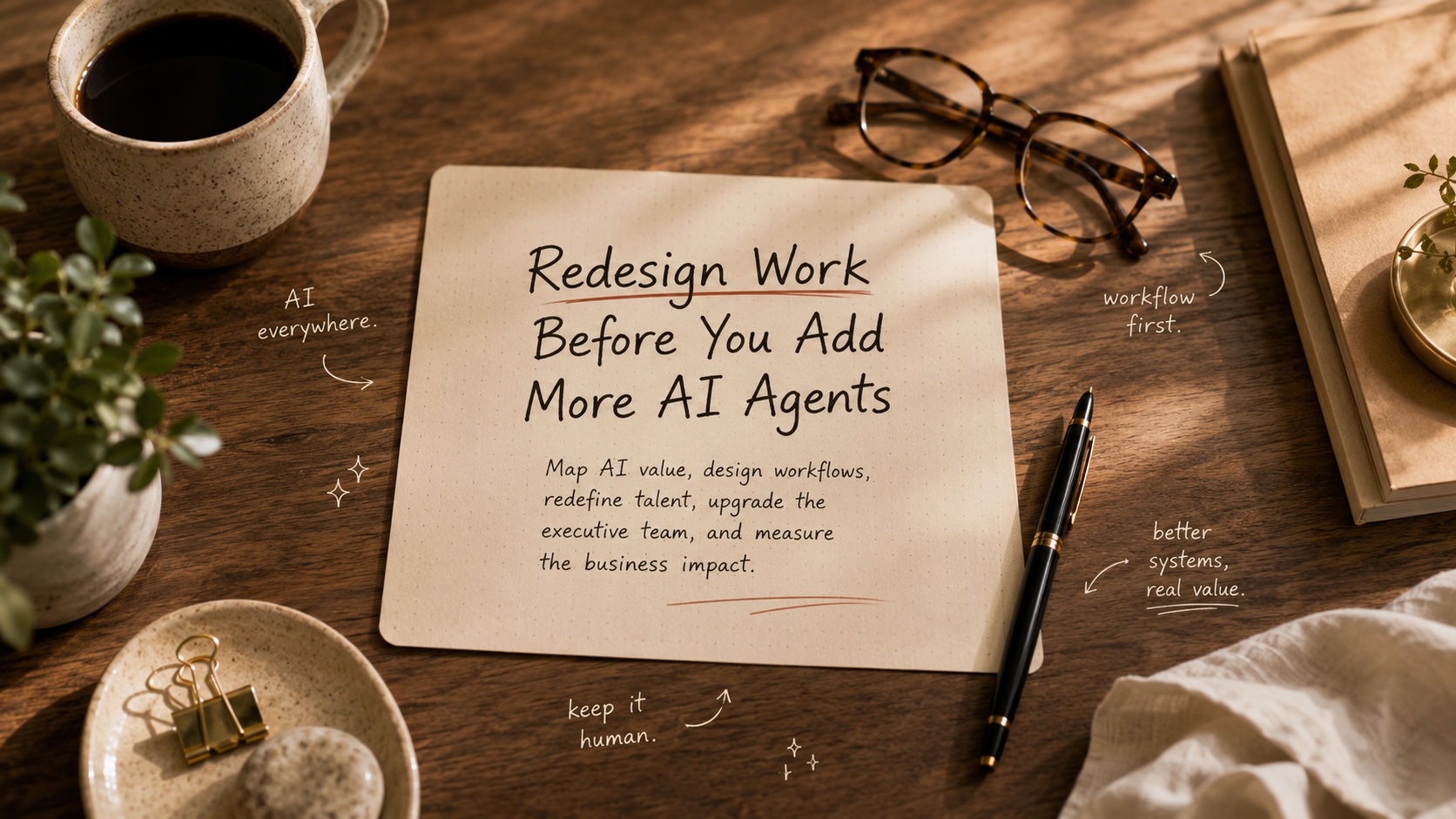
**From AI Hype to Business Value: Redesigning Workflows for Real AI Impact**
The conversation around AI in the enterprise has shifted. Early excitement about generative tools has given way to a more mature—and demanding—question: *Where is the actual business value?* The answer, according to industry research and on-the-ground experience, is not simply in deploying more AI agents or buying the next promising tool. It is in fundamentally rethinking how work gets done.
The core insight is a paradoxical one: **people are using AI, but their workflows remain stubbornly traditional.** Teams celebrate the potential of AI while still relying on manual, multi-step processes that involve copying data between Excel sheets, endless email chains, and fragmented handoffs. The most valuable intelligence often never makes it into a system; it stays trapped in an employee’s head. The solution is not merely to slap a chatbot onto existing inefficiencies. The necessary—and challenging—step is to deeply analyze and then redesign the workflow itself. Only when the process is optimized can AI be injected to deliver tangible returns.
This conclusion is echoed by major industry analyses. McKinsey’s “Talent to Value” research shows that the most significant AI value comes from coordinated systems of humans and agents, with a small percentage of initiatives delivering the majority of the impact. Similarly, BCG’s 2026 AI Radar reveals that CEOs expect AI spending to double and are now the primary decision-makers for AI strategy, believing AI agents will produce measurable returns within the year. The message is clear: value is created not by tools alone, but by how those tools are integrated into the fabric of the business.
So, how do you move from hype to value? The path forward rests on six critical shifts:
### 1. Start with Business Value, Not Tools
Instead of asking “What AI can we try?”, ask “Where can AI create a disproportionate advantage?” The most successful companies, like Johnson & Johnson with its hundreds of GenAI use cases, focus on narrowing resources on the 10% of initiatives that generate 80% of the value. Prioritize areas that reduce costs, boost revenue or customer experience, or enable a new business model.
### 2. Redesign the Work Itself
The goal is to transform the workflow from a series of manual steps into a cohesive human-agent system. This requires deciding which tasks are best for people, which are ideal for agents, and where human judgment must remain in control. A customer service workflow, for example, should evolve from simply helping an employee type faster to a system that predicts issues, triggers proactive outreach, and resolves cases seamlessly.
### 3. Redefine Talent: Become a Workflow Designer
The most valuable employees in the AI era are not just prompt engineers but “workflow designers.” These are the AI super users who understand the current process, can identify broken handoffs, implement and test AI solutions, and make the improved work scalable. With AI-augmented roles growing eight times faster than other jobs, empowering these individuals with a formal workflow mandate is essential.
### 4. Educate and Align Leadership
AI strategy cannot be a scattered portfolio of pilots. It requires executive governance to decide which projects deserve investment, which should be stopped, and which workflows need redesigning before more tools are added. Leadership must own the business outcomes and establish the necessary guardrails for risk and auditability.
### 5. Measure What Matters
AI success is not measured by speed or accuracy alone. True value is determined by its impact on the entire workflow. This requires a three-layer measurement framework:
* **AI Agent Metrics:** Accuracy, reliability, speed, and cost.
* **Human Metrics:** Business judgment, workflow improvement, and ethical use.
* **Business Metrics:** Cycle time, decision quality, customer impact, and cost-to-serve.
### 6. Close the Governance Gap
Currently, most organizations lack mature governance for autonomous agents. Success means ensuring that AI-driven workflows lead to better business outcomes—faster decisions, fewer errors, and improved customer satisfaction—without sacrificing accountability.
In the end, the question for any business is not whether to buy more AI, but whether it is ready to redesign the work that makes the difference. By focusing on value-dense opportunities, reimagining workflows, and measuring business impact, organizations can move beyond experimentation and into sustainable, scalable AI execution.
***
**Original Source:**
*Insight Media Group Contributor. (2026, July 5). [AI Everywhere. Workflows Untouched.](https://contributor.insightmediagroup.io/2026/07/05/ai-everywhere-workflows-untouched/)*
