



Of course. Here is a new article crafted from the provided content, expanded with a detailed FAQ and a conclusion section.
***
## The New Edge: Why Quectel’s FCM665D Signals a Shift to On-Device Intelligence
By Marc Kavinsky, Lead Editor at IoT Business News.
The landscape of the Internet of Things (IoT) is undergoing a fundamental shift. While connectivity and data transmission were once the primary challenges, the next generation of intelligent systems is being defined by what happens at the very edge of the network. In line with this trend, Quectel has announced its new **FCM665D module**, a product explicitly positioned for **edge AI applications**. This launch marks a significant moment, highlighting that the most critical decisions in IoT are increasingly being made not in the cloud, but on the device itself.
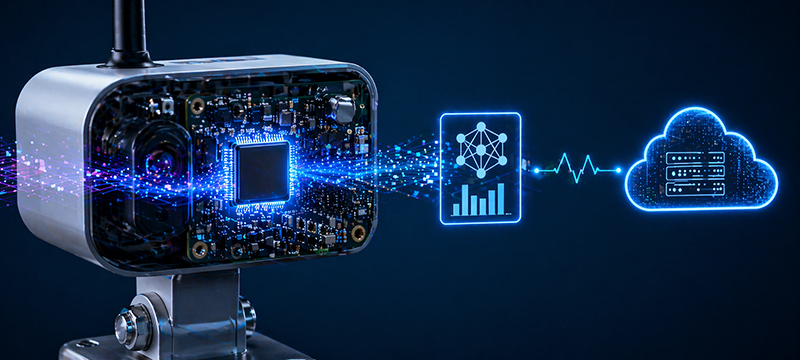
For years, the IoT model was straightforward: sensors collected data, it was transmitted over a network, and powerful cloud servers performed the analysis. However, as deployments have become more data-intensive—think of high-resolution cameras, complex industrial sensors, and fleets of mobile equipment—the limitations of this model have become clear. Transmitting massive volumes of raw data is expensive, slow, and often impractical due to bandwidth constraints or intermittent connectivity. This is where **edge AI** becomes not just an advantage, but a necessity. It enables systems to process data locally, extract insights, and make decisions in real-time, right where the data is generated.
Quectel’s FCM665D is a direct response to this architectural evolution. The company presents it as a high-performance module designed to bring AI inference capabilities to the edge. While specific technical details like processor architecture, AI acceleration benchmarks, and supported interfaces remain under wraps at this stage, the module’s core value proposition is clear: to enable **on-device processing**. This is a move away from a purely connectivity-focused module toward a compute-focused platform that empowers devices to act with intelligence.
This shift in focus changes the conversation for everyone involved. For hardware engineers, the FCM665D is not just another component to solder onto a board; it represents a new set of integration challenges around thermal management, power consumption, and physical space. For software teams, it introduces the complexity of deploying and managing AI models directly on embedded systems. For operations and procurement teams, the module’s ability to reduce cloud dependency and bandwidth usage becomes a key factor in its evaluation.
Ultimately, the FCM665D is more than a product launch; it is a statement about the future of IoT hardware. The industry is moving beyond simple connectivity and towards intelligent endpoints. The true measure of the FCM665D’s success will lie in its detailed technical specifications and real-world performance, but its very positioning points to a future where intelligence is built-in, making the endpoint the new smartest layer in the IoT ecosystem.
### FAQ: Understanding the FCM665D and Edge AI Modules
**Q1: What does “edge AI” mean in the context of the FCM665D module?**
Edge AI refers to the capability of processing data and running artificial intelligence (AI) algorithms directly on a device (the “edge” of the network), rather than sending all data to a remote cloud server for processing. For the FCM665D, this means it can analyze sensor data or camera feeds locally and trigger actions or send only relevant results back to the cloud.
**Q2: Why is sending all data to the cloud a problem?**
Transmitting large amounts of data, especially high-bandwidth data like video streams, is costly in terms of network bandwidth and cloud computing fees. It also creates latency, which is unsuitable for real-time applications like autonomous vehicles or industrial safety monitoring. Furthermore, if an internet connection is lost, a cloud-dependent system becomes non-functional.
**Q3: What kind of applications would use a module like the FCM665D?**
Edge AI modules are ideal for applications requiring real-time insights, enhanced security, or operation in low-bandwidth environments. Potential use cases include industrial automation (predictive maintenance, quality control), smart cities (traffic monitoring, surveillance), logistics (package sorting, fleet tracking), and robotics (obstacle detection, navigation).
**Q4: What information is still missing about the FCM665D?**
At the time of its announcement, key technical specifications are not public. These would typically include its processor type and speed, AI inference performance (e.g., TOPS), memory capacity, supported wireless protocols (e.g., 4G, 5G), camera/sensor interfaces, and power requirements.
**Q5: How will this module affect the software development process?**
Deploying AI on an edge device is more complex than running an application in the cloud. Developers will need to work with tools for model optimization (like quantization and pruning), firmware integration, and real-time operating systems. The success of the FCM665D will depend heavily on how accessible and well-documented its software development kit (SDK) and support are.
**Q6: For connectivity providers, why is an edge AI module relevant?**
Even though it’s a compute-focused product, the FCM665D impacts network traffic. By processing data locally, the module can drastically reduce the amount of raw data that needs to be sent over the network. This alleviates network congestion and allows connectivity providers to offer more value-added services focused on data analysis and system management rather than just data transport.
### Conclusion
Quectel’s announcement of the FCM665D module is a clear indicator that the IoT industry is maturing beyond its connectivity roots. The push for edge AI represents a fundamental re-architecting of how we handle data, shifting the intelligence from the cloud to the device. While the complete technical picture of the FCM665D is still emerging, its very existence underscores a critical trend: the future of intelligent IoT systems is being built into the hardware at the edge. Success for this module, and others like it, will ultimately be determined by their ability to deliver on the promise of reliable, powerful, and seamless on-device intelligence.
