



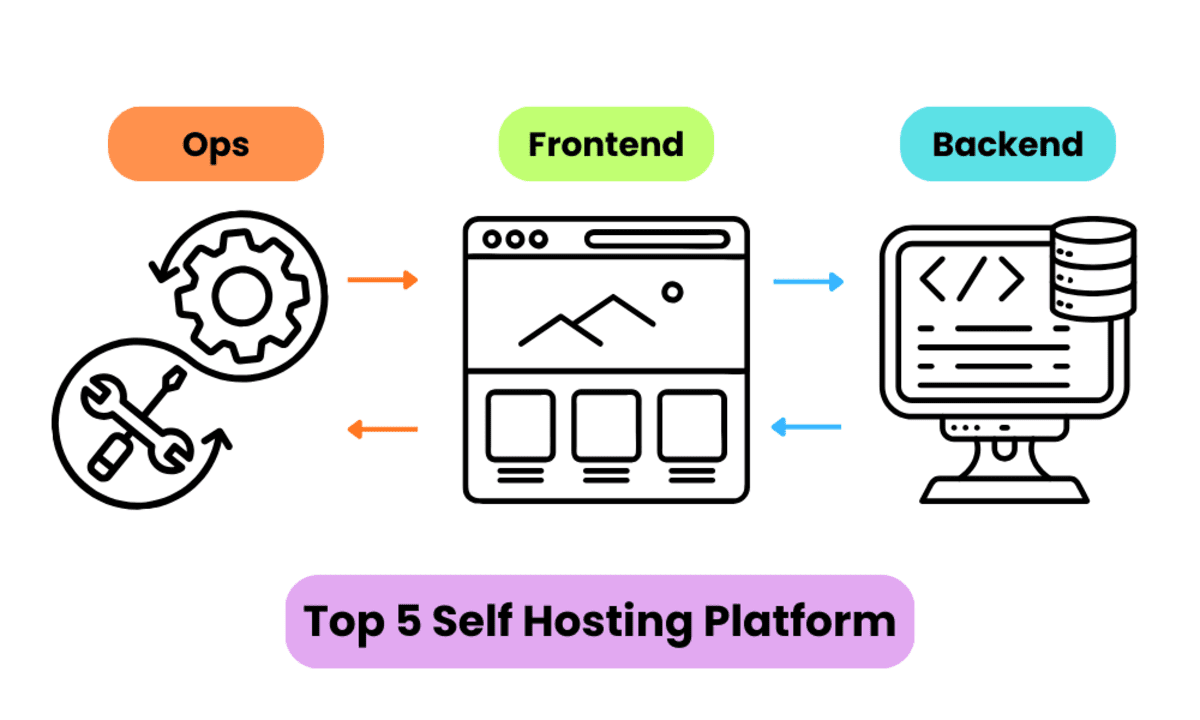
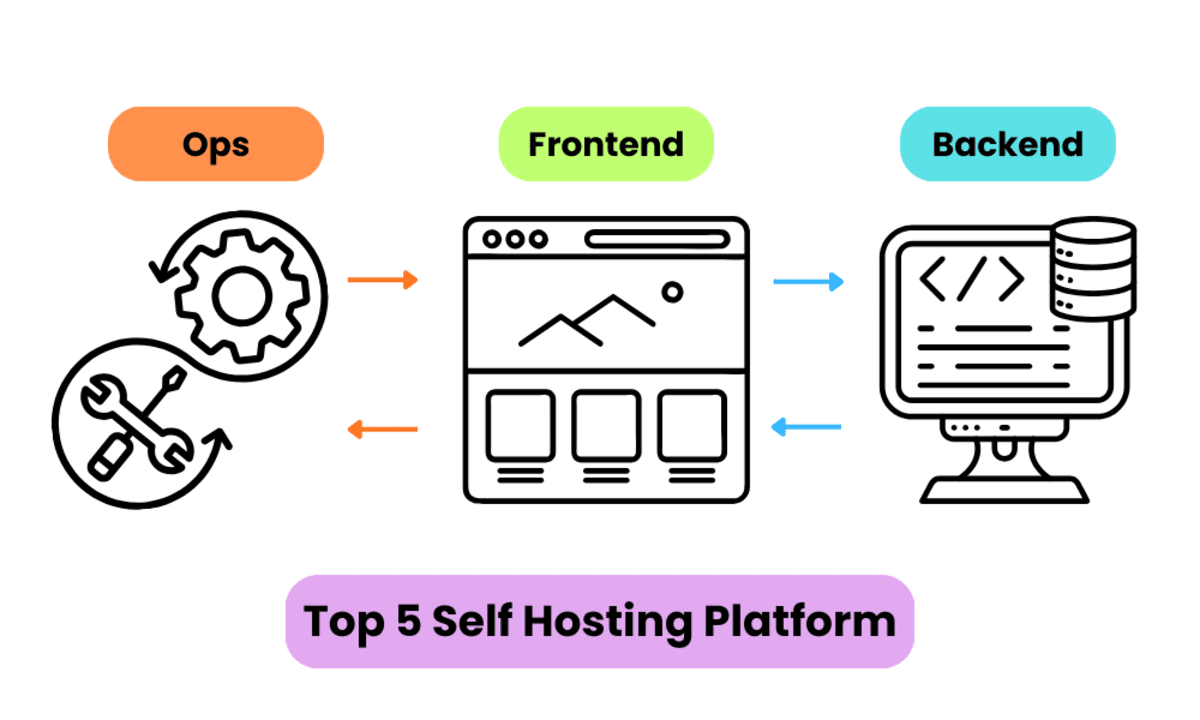
Picture by Writer
# Introduction
I’ve been vibe coding my Steady Coin Cost platform, operating every part regionally with my very own server setup utilizing Docker Compose.
However sooner or later, I spotted one thing vital: there actually just isn’t a easy self hosted platform that may deal with scaling, deployment, and multi service Docker administration with out turning right into a full time DevOps job.
This pushed me to begin trying to find Vercel model alternate options which can be simple to make use of whereas nonetheless giving me the liberty and management I would like.
The self internet hosting platforms I’m going to share come straight from my very own expertise and the struggles of looking for instruments that really work for vibe coders.
In order for you higher pricing, extra management, robust safety, and actual scalability, these platforms can assist you are taking your aspect undertaking and switch it into one thing that feels a lot nearer to an actual startup.
The most effective half is that getting began doesn’t require something difficult. All you actually need is an affordable Hetzner server. Set up one in all these platforms, lots of that are designed to simplify deployments so you possibly can give attention to constructing as an alternative of managing infrastructure, and you may be able to deploy manufacturing prepared purposes with confidence.
# 1. Dokploy
Dokploy is a steady, easy-to-use deployment resolution designed to simplify software administration. It serves as a free, self‑hostable various to platforms like Heroku, Vercel, and Netlify, whereas leveraging the ability of Docker and the pliability of Traefik to make deployments clean and environment friendly.
Key options:
- Simplicity: Straightforward setup and intuitive administration of deployments.
- Flexibility: Helps a variety of purposes and databases.
- Open Supply: Fully free and open-source for anybody to make use of.
# 2. Coolify
Coolify is an open‑supply, self‑hostable PaaS that allows you to deploy purposes, databases, and providers, resembling WordPress, Ghost, and Believable Analytics, by yourself infrastructure with ease.
It acts as a DIY various to platforms like Heroku, Vercel, and Netlify, enabling you to run static websites, full‑stack apps, and one‑click on providers throughout any server utilizing easy, automated tooling.
Key options:
- Deploy Wherever: Helps deployment to any server, together with VPS, Raspberry Pi, EC2, Hetzner, and extra by way of SSH, giving full flexibility over infrastructure.
- Broad Expertise Help: Works with nearly any language or framework, enabling deployment of static websites, APIs, backends, databases, and lots of standard app stacks like Subsequent.js, Nuxt.js, and SvelteKit.
- Built-in Git & Automation: Provides push‑to‑deploy with GitHub, GitLab, Bitbucket, and Gitea, plus computerized SSL, server setup automation, and pull request deployments for clean CI/CD workflows.
# 3. Appwrite
Appwrite is an open‑supply backend‑as‑a‑service platform that now presents full‑stack capabilities due to its Websites function, which helps you to deploy web sites straight alongside your backend providers.
Since full‑stack growth means dealing with each frontend and backend elements and Appwrite now helps web site internet hosting plus APIs, auth, databases, storage, messaging, and features, it gives every part wanted to construct, deploy, and scale full purposes inside a single platform.
Key options:
- Finish‑to‑Finish Full‑Stack Platform: With Websites for frontend internet hosting and sturdy backend instruments like Auth, Databases, Capabilities, Storage, Messaging, and Realtime, Appwrite covers your entire net stack.
- Versatile Integration Strategies: Helps SDKs, REST, GraphQL, and Realtime APIs, permitting seamless integration from any language or framework.
- Knowledge Possession & Straightforward Migration: Provides migration instruments from Firebase, Supabase, Nhost, and self‑hosted setups so builders can simply transfer initiatives whereas conserving full management of their information.
# 4. Dokku
Dokku is an extensible, open‑supply Platform‑as‑a‑Service that runs on a single server of your alternative, functioning very like a self‑hosted mini‑Heroku. It builds purposes routinely from a easy git push utilizing both Dockerfiles or language autodetection by way of Buildpacks, then runs them inside remoted containers.
Dokku additionally integrates applied sciences like nginx and cron to route net visitors and handle background processes, giving builders a light-weight however highly effective method to deploy and function apps on their very own infrastructure.
Key options:
- Git‑Powered Deployments: Push code by way of Git to construct apps on the fly utilizing Dockerfiles or Buildpacks, just like Heroku’s workflow.
- Light-weight Single‑Server PaaS: Runs on any Ubuntu/Debian server and makes use of Docker to handle app lifecycles, making it simple to self‑host a Heroku‑like setting on minimal {hardware}.
- Extensible & Plugin‑Pleasant: Helps a large ecosystem of neighborhood and official plugins, permitting builders so as to add databases, storage, monitoring, and extra to their deployments.
# 5. Juno
Juno is an open‑supply serverless platform that allows you to construct, deploy, and run purposes in safe WASM containers whereas sustaining full self‑internet hosting management and 0 DevOps. It gives an entire backend stack, together with key‑worth information storage, authentication, file storage, analytics, and serverless features, so builders can create trendy apps with out managing infrastructure.
Juno additionally helps internet hosting static websites, constructing full net apps, and operating features with the privateness and sovereignty of self‑internet hosting, all whereas providing a well-recognized, cloud‑like developer expertise.
Key options:
- Full Serverless Stack with Self‑Internet hosting Management: Contains datastore, storage, auth, analytics, and serverless features operating in safe WASM containers, supplying you with full possession of your apps and information.
- Zero‑Setup Developer Expertise: Use native emulation for growth and deploy to remoted containers (“Satellites”) with no DevOps required and a workflow just like trendy cloud platforms.
- Constructed for Internet Builders: Use your favourite frontend frameworks and write serverless features in Rust or TypeScript, with templates and instruments that simplify constructing full‑stack apps.
# Comparability Desk
This comparability desk highlights what every platform is finest for, the way you deploy to it, and the sorts of purposes it may possibly run so you possibly can shortly choose the suitable self-hosted various on your workflow.
| Platform | Greatest for | Deploy workflow | What it runs |
|---|---|---|---|
| Dokploy | Easy “Heroku-style” self-hosting with robust Docker Compose help | UI-driven deploys + Docker Compose | Containers, Compose apps |
| Coolify | Closest really feel to a self-hosted Vercel/Netlify, plus a number of prebuilt providers | Git push to deploy (GitHub/GitLab/Bitbucket/Gitea) + automation | Static websites, full-stack apps, providers |
| Appwrite (with Websites) | One platform for backend (Auth/DB/Storage/Capabilities) plus frontend internet hosting | Join Git repo or use templates for Websites | Frontends + backend providers |
| Dokku | Light-weight “mini-Heroku” on a single server | git push deploys by way of Buildpacks or Dockerfile | Containerized apps |
| Juno | Serverless-style apps with self-hosting management and minimal ops | CLI or GitHub Actions deploy to “Satellites” | Static websites, net apps, WASM-based serverless features |
Abid Ali Awan (@1abidaliawan) is an authorized information scientist skilled who loves constructing machine studying fashions. At present, he’s specializing in content material creation and writing technical blogs on machine studying and information science applied sciences. Abid holds a Grasp’s diploma in expertise administration and a bachelor’s diploma in telecommunication engineering. His imaginative and prescient is to construct an AI product utilizing a graph neural community for college students scuffling with psychological sickness.
