



# How Cybercriminals Are Using Invisible Unicode Characters to Bypass Email Security Filters
A massive phishing campaign has recently drawn widespread attention from cybersecurity researchers after it was discovered that attackers are weaponizing invisible Unicode characters to slip malicious emails past automated security filters undetected. The operation, which unfolded over the course of several months in early 2026, represents a significant evolution in traditional phishing tactics by incorporating techniques originally associated with AI-era evasion methods.
## Understanding the Technique: ASCII Smuggling Through Unicode
The method at the center of this campaign is known as ASCII smuggling. It involves embedding invisible or non-rendering Unicode characters within otherwise normal-looking text. To the human eye, the content appears completely standard and harmless. However, beneath the surface, these hidden characters can fundamentally alter how machines — including email filters and AI language models — interpret the message.
The specific Unicode block being exploited is the Tags block, which spans the range from U+E0000 to U+E007F. This block contains a hidden parallel set of printable ASCII characters. For example, the character U+E0041 visually mirrors the letter “A,” and U+E0061 mirrors the lowercase “a.” Originally designed for language tagging purposes, this block has since been largely deprecated but remains functional in many text processing systems.
## How the Attack Works in Practice
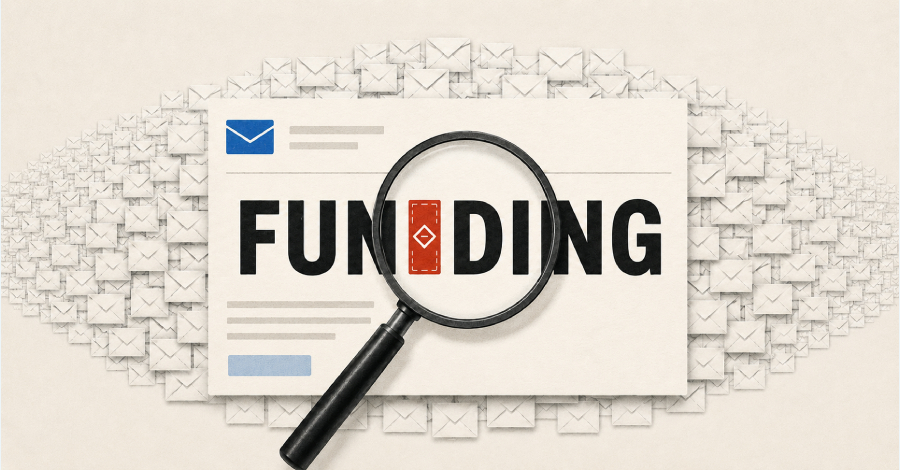
Rather than hiding instructions for AI systems, the attackers in this campaign used invisible tag characters to fragment financial keywords that email filters rely on to detect phishing attempts. By inserting these invisible characters inside common terms related to finance, the attackers effectively split the words apart so that signature-based detection engines fail to recognize them.
A practical example illustrates the technique clearly. A lure term like “funding” is transformed into something like “fun⟨invisible character⟩ding.” To a human recipient reading the email, the word still appears as “funding” and reads naturally. However, to an email filter or a regular expression engine that searches for the exact contiguous string “funding,” the hidden byte sequence breaks the match entirely. The filter sees something that no longer resembles the target keyword, allowing the malicious email to pass through unchecked.
Email parsing pipelines that strip or normalize these invisible characters also fail to catch the obfuscation, because the damage to the keyword signature has already been done at the detection layer.
## Scale and Timing of the Campaign
The sheer volume of this phishing operation is what makes it particularly alarming. The campaign entered a high-volume phase that lasted approximately three months before activity dropped off sharply after May 15, 2026. During its peak, the operation was estimated to send between one million and 2.37 million messages per day. The highest single-day volume was recorded on February 26, 2026.
The campaign followed a remarkably consistent weekly pattern, with activity surging during weekdays and nearly shutting down on weekends before resuming with full force on Mondays. This schedule suggests a coordinated, possibly automated operation running on a structured timeline.
## Connection to a Broader Phishing Ecosystem
Investigators have linked this Unicode-based obfuscation campaign to a larger phishing operation that targeted applicants for Small Business Administration loans. Earlier disclosures from threat intelligence teams revealed that the attackers exploited the ActiveCampaign marketing and automation platform to distribute thousands of AI-generated phishing emails at scale.
The broader operation was notable for its ability to mass-produce convincing, tailored phishing websites that adapted dynamically to different impersonated domains. By leveraging ActiveCampaign’s AI-powered automation features, the attackers were able to vary the design, content, and user flow of each phishing site, making the campaigns more persuasive and harder to detect.
In the latest wave of emails using Unicode obfuscation, the attackers routed messages through hundreds of disposable, finance-themed sender domains. Common lure themes included business loans, lines of credit, and advance funding — all designed to attract small business owners and entrepreneurs seeking financial assistance.
## Notable Sender Domains
The top sender domains identified in the campaign included finance-themed names such as guardiangrowthfunding[.]com, digitalcapitalboost[.]com, thebusinessloanexpress[.]com, advancefundingboost[.]com, and unitedfundingwave[.]com, among others. Each domain was crafted to appear legitimate and trustworthy to recipients.
Additionally, every outbound link embedded in the phishing emails was routed through ActiveCampaign’s own click-tracking infrastructure, using domains like acemlnd[.]com and activehosted[.]com. This added another layer of obfuscation, making it harder for security analysts to trace the ultimate destination of malicious links.
## Platform Response and Implications
ActiveCampaign has acknowledged testing its content-moderation systems against messages containing invisible Unicode characters. The company reported that emails with such obfuscation receive the same moderation verdict as their unobfuscated counterparts, and that heavy use of invisible characters is flagged as a suspicious signal.
However, experts warn that the use of a reputable marketing platform as a relay point gives the malicious emails an advantage. Because ActiveCampaign has established IP reputation and proper authentication protocols, emails sent through its infrastructure may resemble legitimate marketing traffic, further complicating reputation-based email filtering systems.
## Why This Matters
This campaign marks a notable shift in how cybercriminals approach email-based attacks. While invisible or look-alike characters have been used in homoglyph phishing attacks before, the combination of the Unicode Tags block with large-scale mass mailing represents a new frontier. It demonstrates that AI-era evasion techniques, once thought to be relevant primarily to attacks targeting language models, can be effectively repurposed for traditional phishing and spam campaigns.
For organizations and individuals alike, the lesson is clear: email security must evolve beyond simple keyword matching and signature-based detection. As attackers continue to find creative ways to obfuscate malicious content, a multi-layered defense strategy that includes behavioral analysis, URL rewriting, and sender reputation verification becomes essential.
—
## Frequently Asked Questions (FAQ)
**What is ASCII smuggling?**
ASCII smuggling is a technique in which invisible or non-rendering Unicode characters are embedded within text to conceal content from automated detection systems. While the text appears normal to human readers, the hidden characters can disrupt how email filters and other machine-based systems parse and analyze the message.
**Which Unicode block is being exploited in this campaign?**
The Unicode Tags block (U+E0000 to U+E007F) is being exploited. This block contains a shadow set of printable ASCII characters and was originally intended for language tagging purposes.
**How do invisible characters help attackers bypass email filters?**
By inserting invisible characters inside financial keywords like “funding,” attackers split the words apart so that signature-based detection engines can no longer match them. The email appears harmless to both the recipient and the filtering system, allowing the phishing message to reach the inbox.
**What was the scale of this phishing campaign?**
The campaign generated between one million and 2.37 million messages per day during its peak, with the highest daily volume recorded on February 26, 2026.
**Who was targeted by this campaign?**
The campaign primarily targeted Small Business Administration loan applicants, using financial lures related to business loans, lines of credit, and advance funding.
**Is this technique new?**
The use of invisible characters is not entirely new, but the choice of the Unicode Tags block and the massive scale of the campaign are what make this operation particularly notable.
**What can individuals and organizations do to protect themselves?**
Users should remain vigilant with unsolicited emails, especially those requesting financial information or urging immediate action. Organizations should invest in multi-layered email security that goes beyond keyword matching, including URL rewriting, behavioral analysis, and robust sender authentication protocols.
—
## Conclusion
The discovery of this high-volume phishing campaign underscores a growing trend in cybercrime: the adaptation of advanced AI-era obfuscation techniques for use in traditional email-based attacks. By exploiting invisible Unicode characters to fracture financial keywords and evade detection, attackers have demonstrated that even well-established filtering systems can be circumvented at scale. As email threats continue to grow in sophistication, staying informed and adopting comprehensive, layered security measures will be critical for both individuals and organizations. The industry must continue to innovate its defenses in lockstep with the evolving tactics of threat actors.
Thank you for reading
