



In my final article, I shared easy methods to use MCP to combine LLMs into your full knowledge science workflow. I additionally briefly talked about one other .
A ability is a reusable package deal of directions and optionally available supporting recordsdata. It helps AI deal with a recurring workflow extra reliably and constantly. At a minimal, it wants a SKILL.md file containing metadata (title and outline) and detailed directions for the way the ability ought to work. Folks typically bundle it with scripts, templates, and examples for standardization and accuracy.
At this level, you is perhaps questioning why we use expertise as a substitute of simply writing the entire thing instantly into the Claude Code or Codex context. One benefit is that expertise assist hold the principle context shorter. AI solely must load the light-weight metadata at first—it may well learn the remaining directions and bundled assets when it decides that the ability is related. You will discover an excellent public assortment of expertise at expertise.sh.
Let me make the thought extra concrete with a easy instance.
My Instance — Weekly Visualization Talent
Context
I’ve been making one visualization each week since 2018 — in case you are curious, I wrote about my journey on this article. This course of is very repetitive and often takes me about one hour each week. Subsequently, I discovered it an excellent candidate for automation with expertise.
Workflow with out AI
Right here is my weekly routine:
- Discover a dataset that pursuits me. Web sites I often go for inspiration embody Tableau Viz of the Day, Voronoi, the Economics Every day by BLS, r/dataisbeautiful, and many others.
- Open Tableau, play with the info, discover insights, and construct one visualization that tells the story intuitively.
- Publish it to my private web site.
AI workflow
Whereas the dataset search step continues to be guide, I created two expertise to automate steps 2 and three:
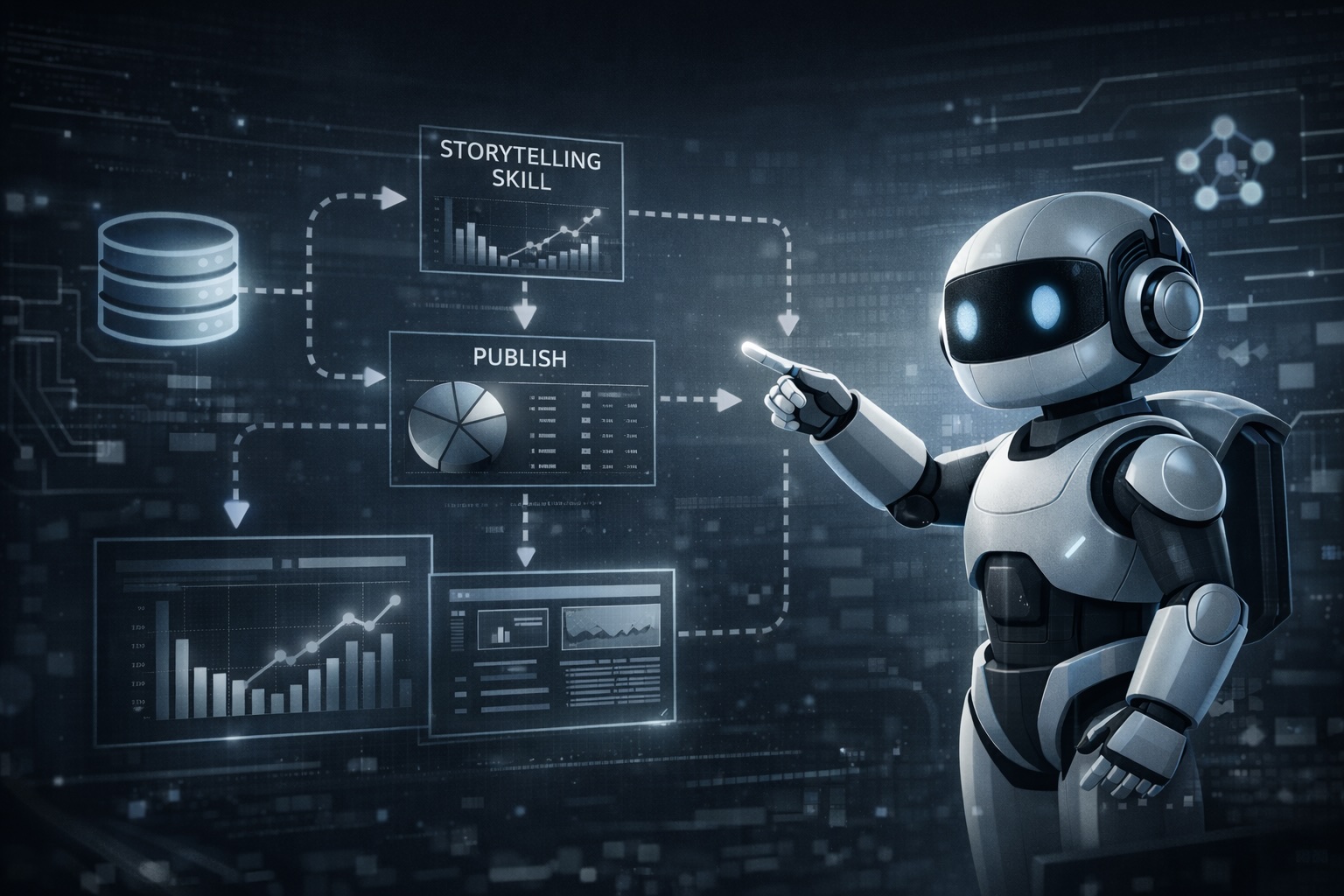
- A storytelling-viz ability that analyzes the dataset, identifies insights, suggests visualization varieties, and generates an interactive visualization that’s intuitive, concise, and storytelling-oriented.
- A viz-publish ability that publishes the visualization to my web site as embedded HTML — I’m not going to share this one, as it is vitally particular to my web site repo construction.
Beneath is an instance the place I triggered the storytelling-viz ability in Codex Desktop. I used the identical Apple Well being dataset as final time, asking Codex to question the info from the Google BigQuery database, then use the ability to generate a visualization. It was capable of floor an perception round annual train time vs. energy burned, and advocate a chart kind with reasoning and tradeoffs.


The entire course of took lower than 10 minutes, and right here is the output — it leads with an insight-driven headline, adopted by a clear interactive visualization, caveats, and the info supply. I’ve been testing the ability with my previous few weekly visualizations, and yow will discover extra visualization examples within the ability repo.

How I Really Constructed It
Now that we now have regarded on the output, let me stroll you thru how I constructed the ability.
Step 1: Begin with a plan
As I shared in my final article, I prefer to decide on a plan with AI first earlier than implementation. Right here, I began by describing my weekly visualization workflow and my aim of automating it. We mentioned the tech stack, necessities, and what “good” output ought to seem like. This results in my very first model of the ability.
The great half is that you just don’t have to create the SKILL.md file manually — merely ask Claude Code or Codex to create a ability in your use case, and it may well bootstrap the preliminary model for you (it is going to set off a ability to create a ability).


Step 2: Take a look at and iterate
Nevertheless, that first model solely obtained me 10% of my ideally suited visualization workflow — it may generate visualizations, however the chart varieties have been typically suboptimal, the visible kinds have been inconsistent, and the principle takeaway was not all the time highlighted, and many others.
These remaining 90% required iterative enhancements. Listed here are some methods that helped.
1. Share my very own data
Over the previous eight years, I’ve established my very own visualization finest practices and preferences. I needed AI to observe these patterns as a substitute of inventing a distinct fashion every time. Subsequently, I shared my visualization screenshots together with my fashion steering. AI was capable of summarize the frequent rules and replace the ability directions accordingly.

2. Analysis exterior assets
There are such a lot of assets on-line about good knowledge visualization design. One other helpful step I took was to ask AI to analysis higher visualization methods from well-known sources and comparable public expertise. This added views that I had not explicitly documented myself, and made the ability extra scalable and strong.


3. Be taught from testing
Testing is important to determine enchancment areas. I examined this ability with 15+ numerous datasets to look at the way it behaved and the way its output in contrast with my very own visualizations. That course of helped me recommend concrete updates, resembling:
- Standardizing the font selections and structure
- Checking desktop and cellular previews to keep away from overlapping labels and annotations
- Making charts comprehensible even with out tooltips
- At all times asking for the info supply and linking it within the visualization
- …


You will discover the newest model of the storytelling-viz ability right here. Please be at liberty to play with it and let me know the way you prefer it 🙂
Takeaways for Knowledge Scientists
When expertise are helpful
My weekly visualization challenge is only one instance, however expertise may be helpful in lots of recurring knowledge science workflows. They’re particularly priceless when you might have a job that comes up repeatedly, follows a semi-structured course of, is dependent upon area data, and is troublesome to deal with with a single immediate.
- For instance, investigating the motion of metric X. You most likely already know the frequent drivers of X, so that you all the time begin with slicing by segments A/B/C and checking upfunnel metrics D and E. That is precisely the method that you would be able to package deal right into a ability, so AI follows the identical analytical playbook and identifies the foundation trigger for you.
- One other instance: suppose you intend to run an experiment in area A, and also you wish to verify different experiments working in the identical space. Up to now, you’ll search key phrases in Slack, dig via Google Docs, and open the inner experimentation platform to assessment experiments tagged with the area. Now, you possibly can summarize these frequent steps right into a ability and ask LLMs to conduct complete analysis and generate a report of related experiments with their objectives, durations, visitors, statuses, and docs.
In case your workflow consists of a number of impartial and reusable parts, you must break up them into separate expertise. In my case, I created two expertise — one for producing the visualization, and one other for publishing it to my weblog. That makes the items extra modular and simpler to reuse in different workflows later.
Expertise and MCP work effectively collectively. I used BigQuery MCP and the visualization ability in a single command, and it efficiently generated a visualization based mostly on my datasets in BigQuery. MCP helps the mannequin entry the exterior instruments easily, and ability helps it observe the best course of for a given job. Subsequently, this mixture is highly effective and enhances one another.
A ultimate word on my weekly visualization challenge
Now that I can automate 80% of my weekly visualization course of, why am I nonetheless doing it?
After I first began this behavior in 2018, the aim was to apply Tableau, which was the principle BI instrument utilized by my employer. Nevertheless, the aim has modified over time — now I take advantage of this weekly ritual to discover completely different datasets that I might by no means encounter at work, sharpen my knowledge instinct and storytelling, and see the world via the lens of information. So for me, it isn’t actually concerning the instrument, however the technique of discovery. And that’s the reason I plan to maintain doing it, even within the AI period.
