



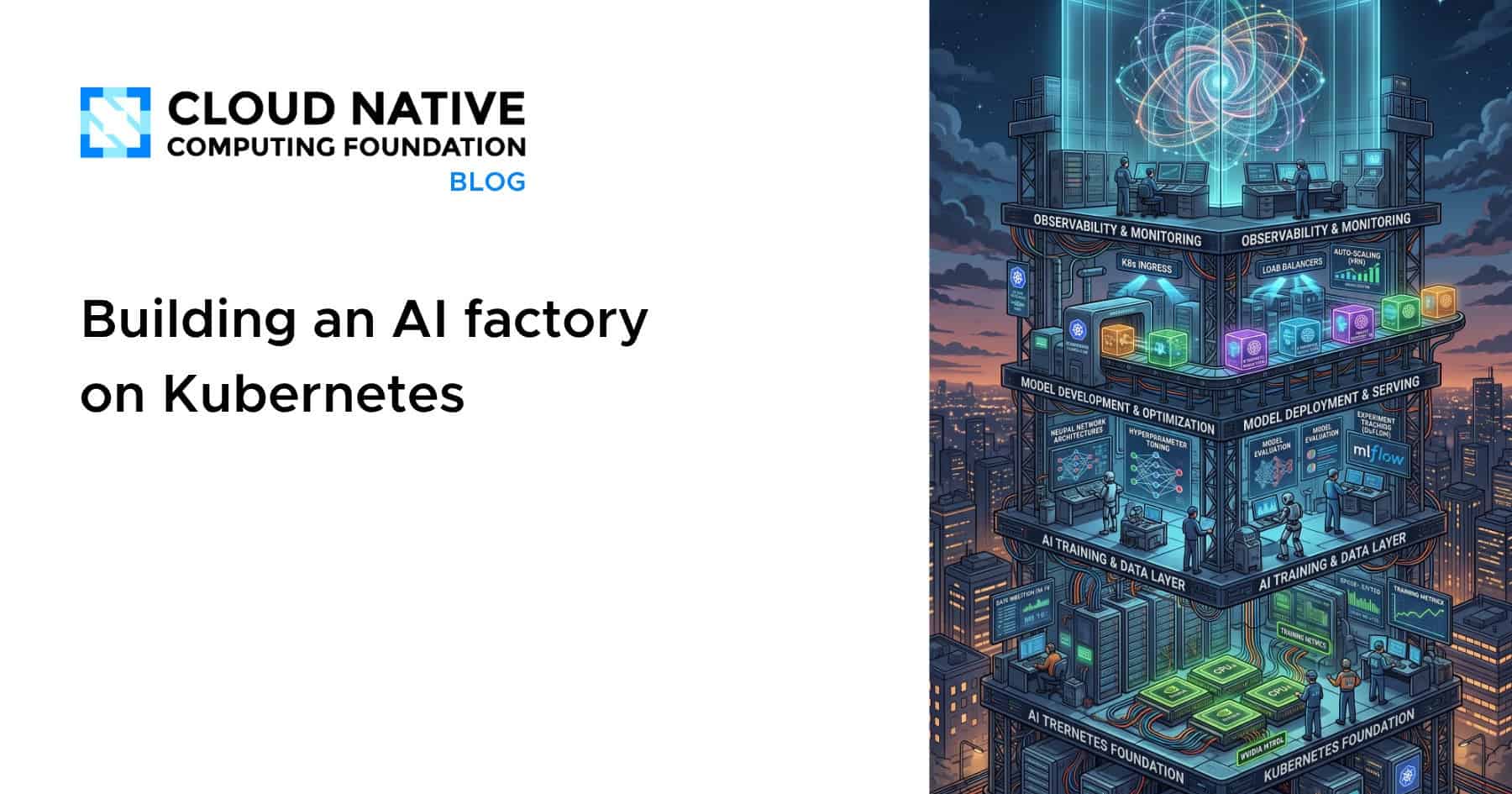
# Building an AI Factory on Kubernetes: A Cloud Native Blueprint for Shared GPU Infrastructure
## Why the AI Factory Model Matters
Modern enterprises no longer treat artificial intelligence as a single-model project. They operate as factories — shared pools of GPU accelerators where multiple teams coexist simultaneously. One team fine-tunes a model, another serves inference traffic, and a third runs evaluation benchmarks, all drawing from the same hardware fleet. The challenge is no longer about training a better model; it is about giving every team safe, isolated access to expensive accelerators without interference or wasted capacity.
NVIDIA describes this vision as “infrastructure for the full AI lifecycle,” spanning data preparation, training, fine-tuning, and high-volume inference. In an enterprise setting, this translates into a single fleet of GPUs serving many tenants, each governed by distinct quotas, policies, and trust boundaries.
## The Platform Gap That Started Everything
A couple of years ago, every platform engineering team was building internal developer platforms. Kubernetes offered mature primitives for container orchestration, role-based access control, autoscaling, and policy enforcement. What it lacked was a clean answer for accelerators and for keeping tenants properly separated on the same physical nodes.
That gap is precisely what an AI factory needs to close. The cloud native ecosystem has now matured enough to supply most of the components required — from bare metal provisioning to GPU scheduling, tenant isolation, and metered billing.
## Why Utilization Is the Real Metric
Accelerators represent the largest capital expense in any AI infrastructure deployment, and the metric that ultimately determines whether that investment pays off is utilization — not a peak throughput number from a single benchmark run. Independent rating organizations evaluate GPU cloud providers on security, networking, storage, reliability, and support, with hard per-tenant isolation being a key differentiator.
Two systemic problems keep GPU utilization low. The first is the resource model: traditional device-plugin approaches assign an entire accelerator to a pod even when the workload only uses ten percent of it. Dynamic Resource Allocation, now generally available in Kubernetes 1.34, improves this by treating accelerators as rich devices with attributes, memory characteristics, and topology information, though it does not itself split a GPU into smaller fractions — that granularity comes from the device layer below.
The second problem is the isolation model. Platforms typically default to giving each team a dedicated cluster or a dedicated set of GPUs, which is the safest approach when trust boundaries are strict but results in massive hardware waste. The real solution is a stack that allocates accelerators efficiently so capacity is neither stranded nor unsafe while isolating tenants firmly enough to allow dense packing.
## The Layered Stack: From Rack to Revenue
An AI factory is fundamentally an assembly problem. Most layers are Kubernetes native or originate from CNCF projects, supplemented by a few open source tools and vendor-specific technologies.
### Provisioning and Hardware Lifecycle
Everything begins at the rack. Raw servers must be turned into a validated pool of compute capacity before any GPU can run a workload. This provisioning layer performs discovery — inventorying GPUs, checking memory health, and recording network interface identities — then network-boots nodes with operating system images that include GPU drivers and communication libraries. BIOS configurations are applied according to the node’s intended role: baseline, performance-optimized, or confidential-compute mode.
Each node undergoes a burn-in test under load to surface early hardware failures, along with an interconnect validation that confirms GPUs can communicate at full bandwidth. Results are recorded in a source of truth system that also manages IP address assignments. When a node is retired, the reverse process wipes disks and resets management credentials before returning the hardware to the available pool.
### Cluster Lifecycle and Node Inventory
Cluster creation, versioning, and GitOps-driven configuration management form the next layer. Node discovery tools label GPUs, network interfaces, and topology details so the scheduler understands what hardware is available and where it sits physically.
### GPU Allocation and Scheduling
This is the layer that makes the economics work. Dynamic Resource Allocation provides a richer model for claiming devices, while hardware partitioning technologies enable multiple workloads to share a single accelerator with software-enforced guardrails. Topology-aware schedulers handle placement decisions accounting for NVLink domains, NVSwitches, and NUMA relationships, while queue management systems handle admission control and quota enforcement.
The guiding principle is simple: whole-GPU allocation for tenant isolation across trust boundaries, and partitioning for density within a single trust domain.
### Workload Execution
Teams run different types of workloads on the same infrastructure. Model serving engines wrapped in autoscaling platforms handle inference traffic, with API gateways providing routing and compatibility layers. Traditional training workloads often run through Slurm, now implemented on Kubernetes as native workloads with GPU-aware scheduling. Some tenants require full virtual machines rather than containers, which Kubernetes-native VM runtimes can provide from the same pooled fleet.
### Networking, Storage, and Observability
High-bandwidth GPU-to-GPU communication demands purpose-built networking with hardware offloading for isolation and encryption. Per-tenant persistent storage backed by distributed storage systems ensures datasets, checkpoints, and models remain isolated and durable. Observability stacks collect metrics, logs, and traces with GPU-specific telemetry feeds that feed into per-tenant cost allocation pipelines.
### Reliability, Security, and Identity
At scale, GPUs fail constantly — ECC errors, bus disconnections, thermal faults, and NVLink degradation. Health monitoring, automated node cordoning, and workload migration form a remediation loop that catches problems before tenants experience them. Identity management through standard protocols, policy enforcement engines, runtime security monitoring, and supply chain scanning round out the protection layer.
### Self-Service and Billing
The line between a pile of GPUs and a real cloud is whether customers can provision resources themselves and receive meaningful bills. API-first provisioning through declarative configurations, tenant-scoped metering based on GPU-seconds, and cost allocation engines transform raw hardware into a service.
## The Tenant Isolation Problem
Every layer above assumes one critical capability: safely running multiple teams on the same hardware. This has two distinct halves.
The control plane side is addressed through the tenant-cluster pattern, where each team receives a full Kubernetes API server with its own resources, admission policies, and access controls, all running as workloads on a shared underlying cluster. This gives teams a clean, familiar experience with standard tooling while maintaining strict boundaries.
The data plane requires additional isolation at the network and storage levels, often enforced by the fabric itself through per-tenant virtual networks and partition keys. Increasingly, hardware accelerators called Data Processing Units handle this enforcement, moving isolation and encryption work off the host CPU and enabling confidential computing postures.
In practice, operators run two tiers: high-trust enterprise tenants may receive dedicated clusters or hardware with physical boundaries, while smaller or cost-sensitive tenants share pooled capacity through virtual clusters. The same control plane manages both tiers uniformly.
## From Lab to Production
Turning a working demo into production requires two things. The first is conformance — validation tooling that checks cluster configurations against actual hardware and produces reproducible deployment artifacts. The second is scale — ensuring the design holds across hundreds of GPU nodes across multiple data centers, which is why GitOps workflows, declarative tenant management, and a single source of truth form the foundation.
## The Strategic Choice
Hardware vendors are increasingly moving into the platform layer with integrated operating systems for AI infrastructure. Operators face a deliberate choice at every layer: adopt the vendor’s integrated suite, assemble equivalent functionality from cloud native open source projects, or compose both approaches together. The build-versus-assemble decision recurs at every level of the stack, and the right answer depends on trust models, team expertise, and long-term operational requirements.
## Conclusion
An AI factory is not another AI platform or model serving product. It is an operating model for running GPU infrastructure at scale on Kubernetes. Just as Kubernetes became the operating system for cloud native applications, it is becoming the foundation for AI infrastructure — making GPUs schedulable resources, providing isolated environments for tenants, and enabling on-demand compute.
The challenge is not deploying individual technologies like hardware partitioning, dynamic resource allocation, or inference servers. It is combining them into a cohesive platform that balances utilization, isolation, and cost while allowing multiple teams to safely share expensive GPU infrastructure without compromising performance or security. Software is only half the equation — the hardware topology, networking fabric, and physical reliability form an equally hard problem that the platform must account for.
## Frequently Asked Questions
**What exactly is an AI factory?**
An AI factory is a shared GPU infrastructure model where multiple teams draw compute resources from a common pool for different phases of the AI lifecycle — training, fine-tuning, evaluation, and inference — all governed by separate quotas, policies, and trust boundaries.
**Why not just give each team its own GPU cluster?**
Dedicated clusters are the safest option but waste the majority of hardware. Most workloads do not saturate GPUs continuously, so sharing hardware with proper isolation dramatically improves utilization and reduces cost per workload.
**What is Dynamic Resource Allocation in Kubernetes?**
Dynamic Resource Allocation is a Kubernetes feature that allows the scheduler to treat accelerators as rich devices with detailed attributes, memory configurations, and topology information, enabling more intelligent placement decisions than traditional device-plugin models.
**How does tenant isolation work on shared GPUs?**
Isolation operates at multiple levels: virtual clusters provide separate control planes, network fabrics enforce per-tenant traffic separation, storage backends maintain per-tenant persistence, and hardware partitioning technologies allow safe sharing of a single GPU within a trust domain.
**Why is topology awareness important for GPU scheduling?**
GPU performance depends heavily on physical relationships — which GPUs share NVLink domains, how nodes connect through InfiniBand or RoCE fabrics, and whether components sit on the same NUMA node. Ignoring topology causes collective operations to bottleneck on the slowest connection.
**What role do Data Processing Units play in AI factories?**
DPUs offload network isolation, encryption, and security enforcement from the host CPU onto dedicated hardware, enabling confidential computing and reducing overhead on the main compute path.
**How is GPU usage measured and billed?**
GPU telemetry collected through monitoring exporters tracks seconds of usage per tenant, and cost allocation tools translate these metrics into chargeback figures that are reported per team or per project.
**Can AI factories support both containers and virtual machines?**
Yes. Kubernetes-native VM runtimes allow the same pooled GPU fleet to serve both container-based and VM-based workloads under unified access controls and resource quotas.
**What is the difference between whole-GPU allocation and GPU partitioning?**
Whole-GPU allocation assigns an entire accelerator to a single tenant for strict isolation across trust boundaries. Partitioning splits a GPU into smaller segments for multiple workloads within the same trust domain, trading some isolation for higher density.
**How do operators handle GPU failures at scale?**
Continuous health monitoring detects degradation early, automated remediation loops cordon and drain affected nodes, and Kubernetes reschedules workloads onto healthy hardware — all before tenants notice any disruption.
Thank you for reading
