



**Webmail Security Breaches: When Email Content Breaks Boundaries**
*By Swati Khandelwal, August 8, 2026*
*Tags: Email Security / Vulnerability*
—
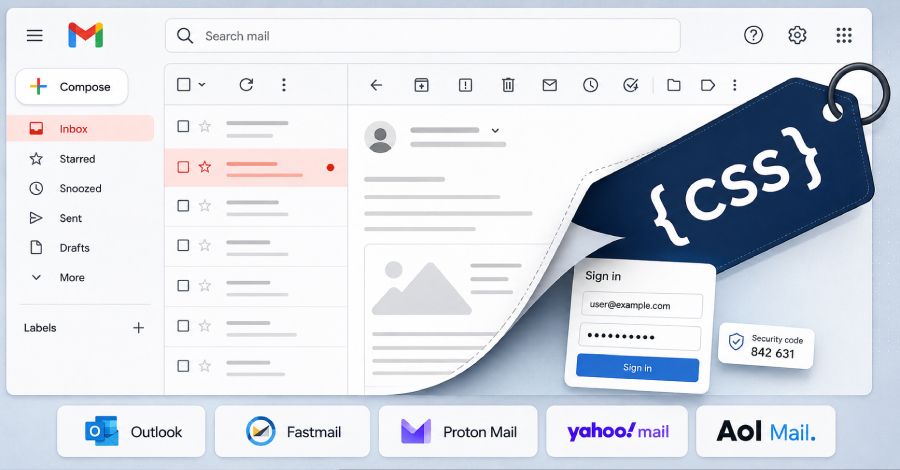
A new frontier in webmail exploitation has been revealed by PortSwigger researcher Gareth Heyes, whose presentation at Black Hat USA 2026 details how malicious content embedded within an email can escape its designated boundary and manipulate the very interface of the webmail service itself. Moving beyond traditional phishing, this research demonstrates that by abusing allowed HTML and CSS features, attackers can hijack trusted user interfaces, steal credentials, and compromise linked AI tools.
The scope of this research is vast, with successful attack chains demonstrated across major platforms including Microsoft Outlook, Gmail, Yahoo Mail, AOL Mail, Fastmail, and Proton Mail. While the presented findings are proof-of-concept and not attributed to active malicious campaigns, the public availability of these Proofs of Concept (PoCs) underscores a systemic weakness in how webmail platforms handle untrusted content.
### The Core Vulnerability: Crossing the Trust Boundary
The fundamental issue lies in the discrepancy between what sanitization filters allow and what the browser ultimately renders. Attackers are leveraging two primary strategies:
1. **Abusing Allowed Features:** Using legitimate web technologies like CSS and HTML elements that webmail providers intentionally permit.
2. **Triggering Side-Effects:** Manipulating the browser or application into creating DOM nodes or rendering states that the sanitizer did not anticipate.
This can lead to a terrifying array of exploits, ranging from password capture and token theft to the hijacking of artificial intelligence tools.
### Notable Attack Chains
* **The Outlook/Firefox Password Capture:** By combining allowed “label” elements with custom attributes and specific CSS media queries, an attacker can spoof a Microsoft sign-in screen directly within the email client. The select element is disguised as a password field, and a timing quirk in Firefox resets its selection timer when moved, enabling real-time password capture.
* **The Yahoo/AOL “Paste Race”:** This technique exploits the handling of pasted HTML. An attacker can initiate a login flow for a service like Medium; the victim copies attacker-provided CSS to their clipboard, pastes it into a draft, and the resulting requests leak a portion of their login token, which can be reconstructed by the attacker.
* **The Gmail/Cowork Prompt Injection:** By chaining Gmail’s `image-set()` CSS function with an indirect prompt injection attack on an AI tool like Anthropic’s Claude (via a connected Gmail connector), an attacker can trick the AI into retrieving sensitive tokens from an email draft and exfiltrating them.
* **AI-Specific Exploits:** In a separate finding targeting OpenAI’s now-deprecated Atlas browser, hidden instructions were embedded using CSS pseudo-elements and opacity. When a user asked Atlas to translate visible text, the hidden prompt instructed it to open tabs and leak the victim’s name in URL fragments.
### Mitigation and Recommendations
The research concludes with a call for drastic defensive measures. Webmail providers are urged to move beyond simple sanitization and implement strict isolation of emails within sandboxed iframes. Further recommendations include tightly restricting CSS custom properties, attribute allow-lists, blocking dangerous selectors like `select` menus, and preventing attacker-controlled image requests.
—
### FAQ Section
**Q1: Is this vulnerability being actively exploited in the wild?**
**A:** No. The research is presented as proof-of-concept, and the author has not reported any confirmed cases of malicious exploitation at this time. The public PoCs serve as a warning of potential attack vectors.
**Q2: Which email providers have acknowledged or fixed these issues?**
**A:** Fastmail has fixed two specific CSS mutation bugs mentioned in the research. Proton Mail fixed a proxy bypass issue, although the researcher noted it was no longer effective upon retesting. The status of fixes for the Outlook password-capture chain and Gmail’s `image-set()` bypass was not confirmed at the time of publication.
**Q3: As a regular email user, what can I do to protect myself?**
**A:** While the onus is largely on email providers to implement robust defenses, users can adopt a cautious mindset. Be wary of unexpected emails, especially those asking you to interact with embedded elements or click suspicious links. Keep your web browser and email client updated to the latest versions.
**Q4: What is the “CSS hotwiring” and “image-proxy bypass” found in Fastmail?**
**A:** “CSS hotwiring” refers to a technique where CSS can redirect mouse clicks to unintended locations or trigger multi-step UI actions. The “image-proxy bypass” is a method that exploits an allowed domain to reveal when a specific email is being viewed by the recipient.
**Q5: What is the primary goal of these attacks?**
**A:** The primary goals are credential theft (passwords, tokens) and account takeover. By breaking out of the email sandbox, attackers can hijack user sessions, steal authentication tokens for linked services (like Slack), and even manipulate integrated AI tools to perform actions on the user’s behalf.
—
### Conclusion
The boundary between an email’s content and its rendering interface is proving to be more porous than previously assumed. This research highlights a critical class of vulnerabilities where the trusted environment of a webmail interface can be weaponized using the very features designed to enrich user experience. As the sophistication of email-based attacks evolves, the responsibility falls on service providers to implement more robust, architecture-level defenses. For now, the public PoCs stand as a stark reminder that in the digital world, no content should be considered truly “inside” a message if it can escape its container.
