ByteDance Seed not too long ago dropped a analysis which may change how we construct reasoning AI. For years, devs and AI researchers have struggled to ‘cold-start’ Massive Language Fashions (LLMs) into Lengthy Chain-of-Thought (Lengthy CoT) fashions. Most fashions lose their manner or fail to switch patterns throughout multi-step reasoning.
The ByteDance staff found the issue: we have now been taking a look at reasoning the fallacious manner. As an alternative of simply phrases or nodes, efficient AI reasoning has a steady, molecular-like construction.
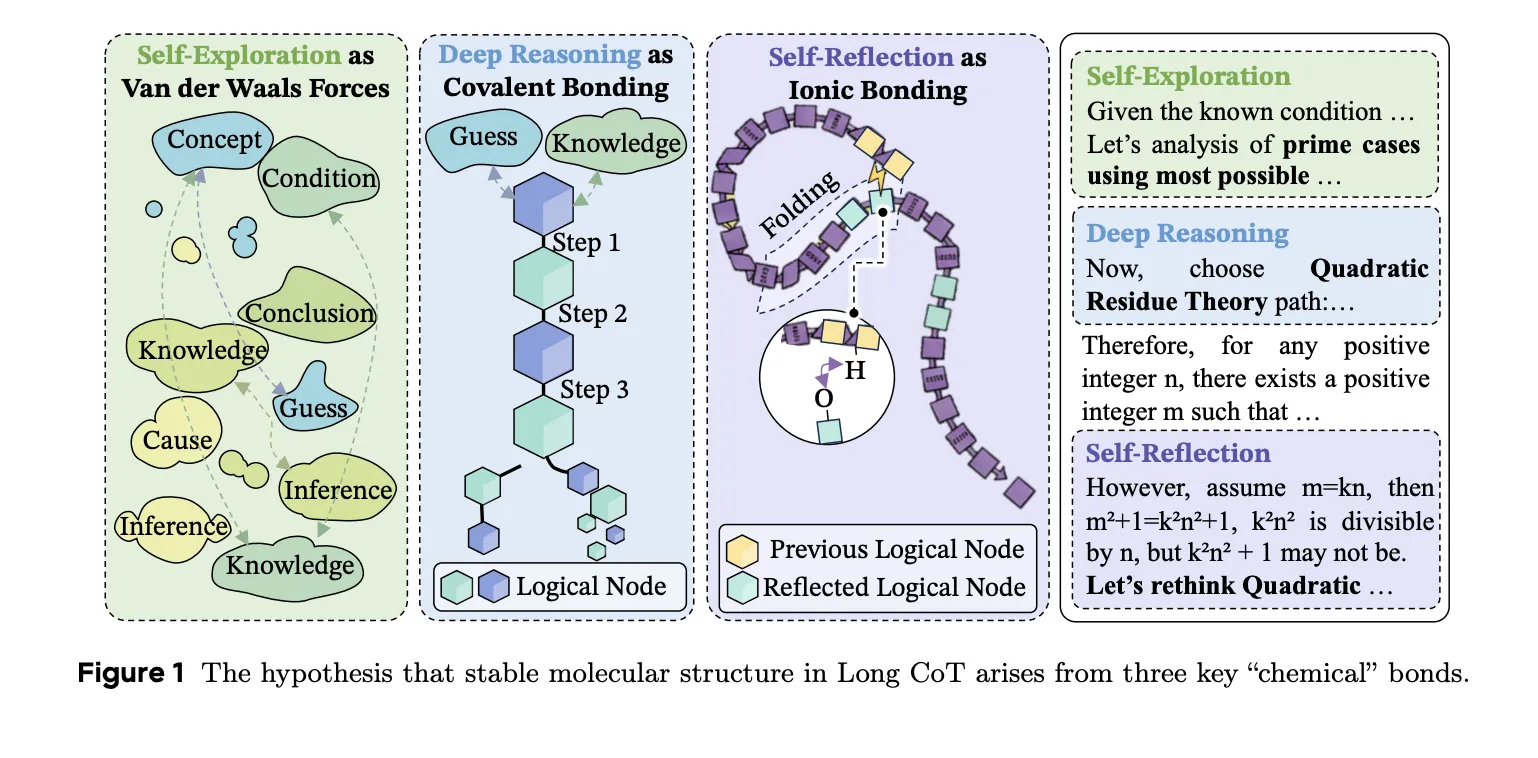
The three ‘Chemical Bonds’ of Thought
The researchers posit that high-quality reasoning trajectories are held collectively by 3 interplay sorts. These mirror the forces present in natural chemistry:
- Deep Reasoning as Covalent Bonds: This varieties the first ‘bone’ of the thought course of. It encodes sturdy logical dependencies the place Step A should justify Step B. Breaking this bond destabilizes all the reply.
- Self-Reflection as Hydrogen Bonds: This acts as a stabilizer. Simply as proteins achieve stability when chains fold, reasoning stabilizes when later steps (like Step 100) revise or reinforce earlier premises (like Step 10). Of their checks, 81.72% of reflection steps efficiently reconnected to beforehand shaped clusters.
- Self-Exploration as Van der Waals Forces: These are weak bridges between distant clusters of logic. They permit the mannequin to probe new potentialities or different hypotheses earlier than implementing stronger logical constraints.
Why ‘Wait, Let Me Think’ Isn’t Sufficient
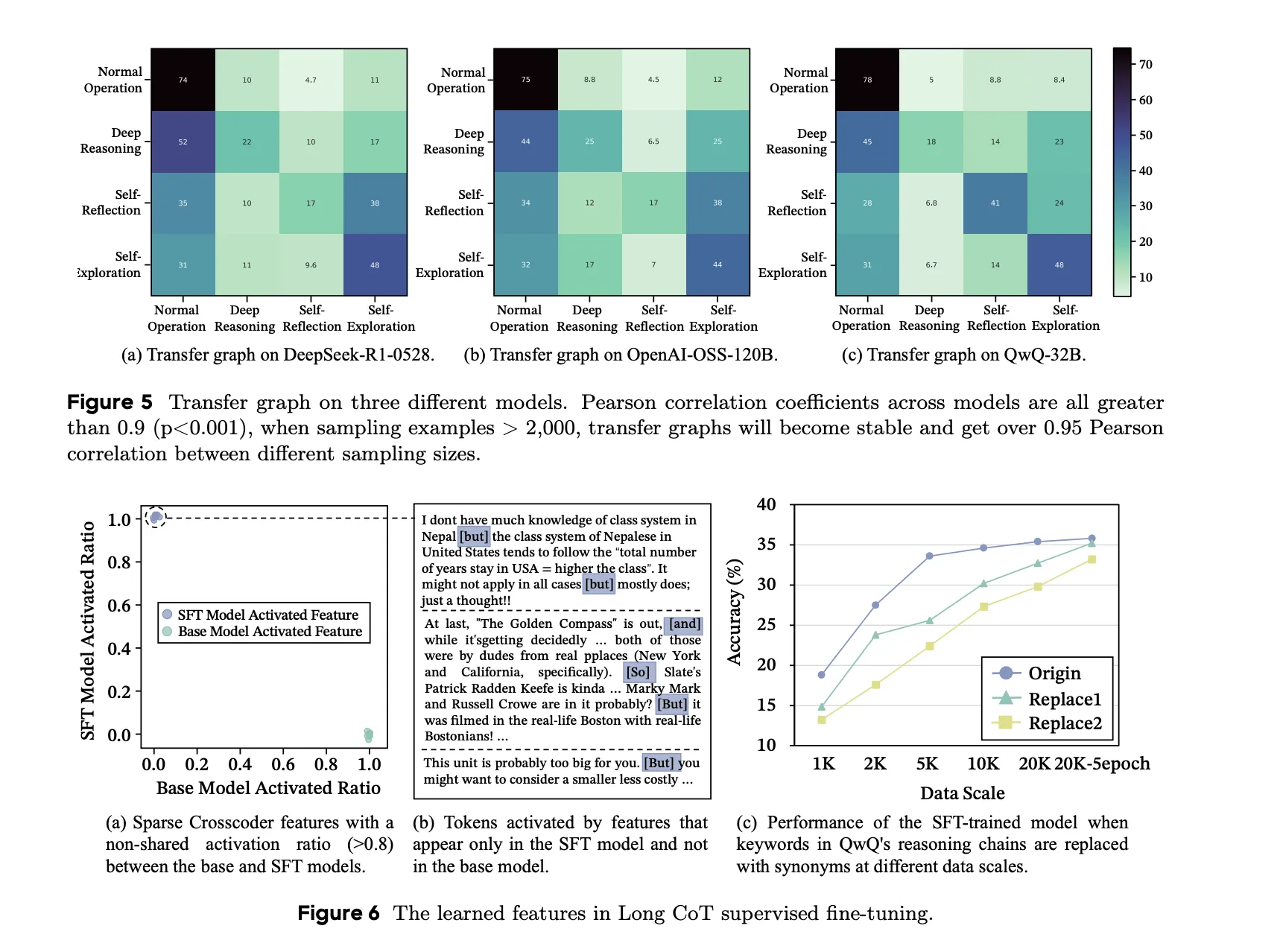
Most AI devs/researchers attempt to repair reasoning by coaching fashions to mimic key phrases like ‘wait’ or ‘maybe’. ByteDance staff proved that fashions truly study the underlying reasoning conduct, not the floor phrases.
The analysis staff identifies a phenomenon referred to as Semantic Isomers. These are reasoning chains that resolve the identical activity and use the identical ideas however differ in how their logical ‘bonds’ are distributed.
Key findings embrace:
- Imitation Fails: Positive-tuning on human-annotated traces or utilizing In-Context Studying (ICL) from weak fashions fails to construct steady Lengthy CoT constructions.
- Structural Battle: Mixing reasoning information from totally different sturdy lecturers (like DeepSeek-R1 and OpenAI-OSS) truly destabilizes the mannequin. Even when the information is comparable, the totally different “molecular” constructions trigger structural chaos and drop efficiency.
- Info Stream: In contrast to people, who’ve uniform info achieve, sturdy reasoning fashions exhibit metacognitive oscillation. They alternate between high-entropy exploration and steady convergent validation.
MOLE-SYN: The Synthesis Methodology
To repair these points, ByteDance staff launched MOLE-SYN. It is a ‘distribution-transfer-graph’ technique. As an alternative of instantly copying a instructor’s textual content, it transfers the behavioral construction to the scholar mannequin.
It really works by estimating a conduct transition graph from sturdy fashions and guiding a less expensive mannequin to synthesize its personal efficient Lengthy CoT constructions. This decoupling of construction from floor textual content yields constant features throughout 6 main benchmarks, together with GSM8K, MATH-500, and OlymBench.
Defending the ‘Thought Molecule‘
This analysis additionally sheds mild on how non-public AI firms shield their fashions. Exposing full reasoning traces permits others to clone the mannequin’s inner procedures.
ByteDance staff discovered that summarization and reasoning compression are efficient defenses. By lowering the token rely—usually by greater than 45%—firms disrupt the reasoning bond distributions. This creates a niche between what the mannequin outputs and its inner ‘error-bounded transitions,’ making it a lot tougher to distill the mannequin’s capabilities.
Key Takeaways
- Reasoning as ‘Molecular’ Bonds: Efficient Lengthy Chain-of-Thought (Lengthy CoT) is outlined by three particular ‘chemical’ bonds: Deep Reasoning (covalent-like) varieties the logical spine, Self-Reflection (hydrogen-bond-like) supplies world stability via logical folding, and Self-Exploration (van der Waals-like) bridges distant semantic ideas.
- Habits Over Key phrases: Fashions internalize underlying reasoning constructions and transition distributions fairly than simply surface-level lexical cues like ‘wait’ or ‘maybe’. Changing key phrases with synonyms doesn’t considerably affect efficiency, proving that true reasoning depth comes from realized behavioral motifs.
- The ‘Semantic Isomer’ Battle: Combining heterogeneous reasoning information from totally different sturdy fashions (e.g., DeepSeek-R1 and OpenAI-OSS) can set off ‘structural chaos’. Even when information sources are statistically related, incompatible behavioral distributions can break logical coherence and degrade mannequin efficiency.
- MOLE-SYN Methodology: This ‘distribution-transfer-graph’ framework permits fashions to synthesize efficient Lengthy CoT constructions from scratch utilizing cheaper instruction LLMs. By transferring the behavioral transition graph as a substitute of direct textual content, MOLE-SYN achieves efficiency near costly distillation whereas stabilizing Reinforcement Studying (RL).
- Safety through Structural Disruption: Personal LLMs can shield their inner reasoning processes via summarization and compression. Lowering token rely by roughly 45% or extra successfully ‘breaks’ the bond distributions, making it considerably tougher for unauthorized fashions to clone inner reasoning procedures through distillation.
Take a look at the Paper. Additionally, be happy to comply with us on Twitter and don’t overlook to hitch our 100k+ ML SubReddit and Subscribe to our E-newsletter. Wait! are you on telegram? now you may be a part of us on telegram as properly.