



# Meet Microduck: Pollen Robotics’ Open-Source Bipedal Robot That Learns to Walk, Fall, and Get Back Up
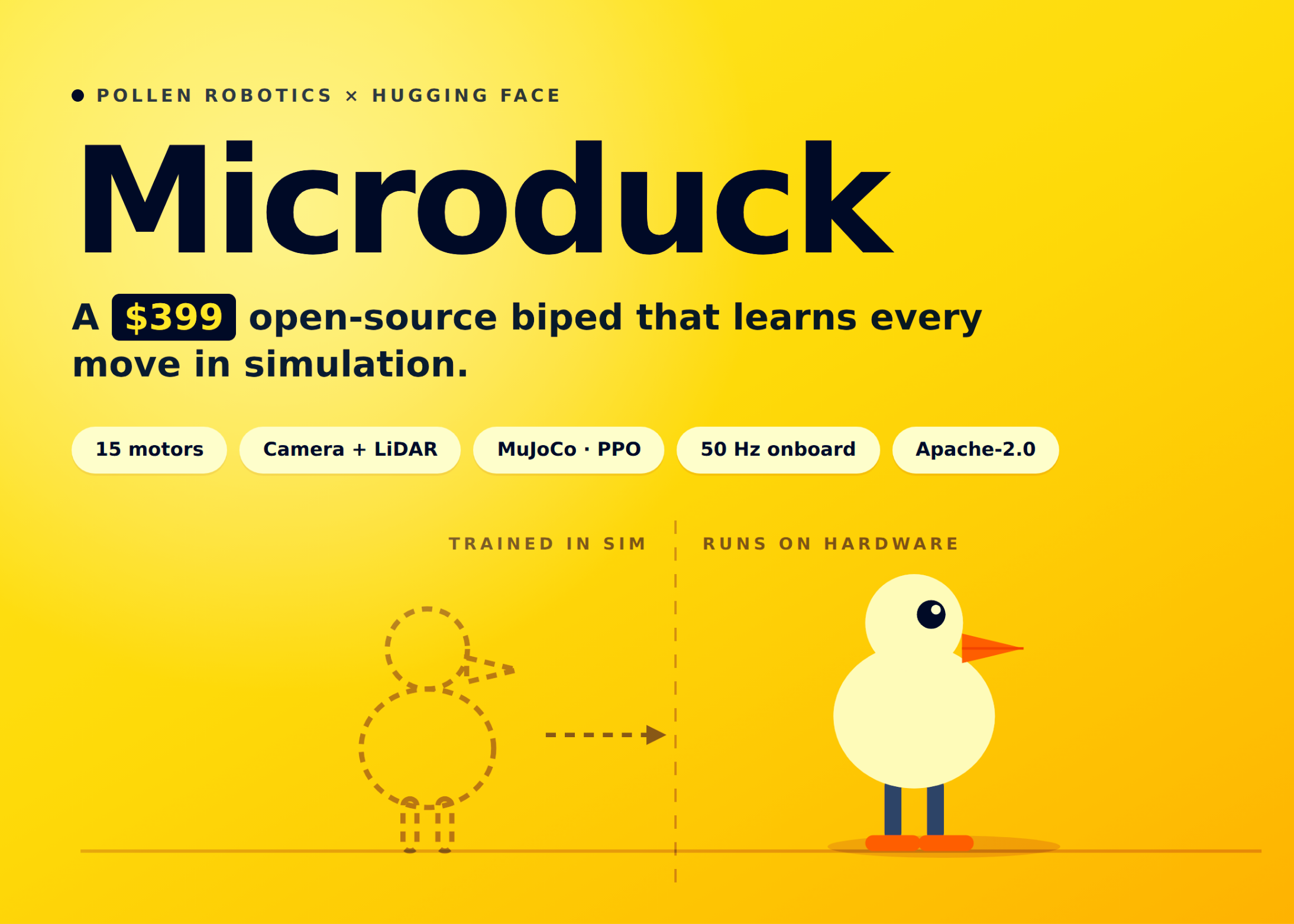
The robotics industry has long relied on flashy demo videos to convince people that walking machines are ready for the real world. A French robotics team out of Bordeaux, working under the Pollen Robotics banner at Hugging Face, is taking a fundamentally different approach — one that emphasizes transparency, reproducibility, and open science over polished presentations. Their latest creation, the Microduck, is a 25-centimeter-tall bipedal robot that costs just $399 and arrives with something most robots of this class never do: the complete training loop, publicly available.
## A New Philosophy in Consumer Robotics
What sets Microduck apart is not just its price point or its compact size. It is the philosophy baked into every layer of the project. While many robotics companies gate their software behind proprietary walls and ask buyers to simply trust that the demo video is representative of real-world performance, Pollen Robotics has chosen to ship everything — the neural policies, the simulation environments, the reward functions, the domain-randomization configurations, and the full sim-to-real transfer recipe — as open-source repositories on GitHub.
The robot is the physical manifestation of a training pipeline that begins entirely in simulation. Every behavior Microduck performs — walking, sitting, standing back up after a fall, kicking a ball, roller-skating, and picking objects off the ground with its beak — was first learned by a neural network inside a physics simulator. That learned policy was then exported to the actual hardware, running at 50 Hz on a Rockchip RK3566 processor with an AI accelerator. There are no teleoperation tricks, no hidden human controllers, and no hand-tuned locomotion scripts. What you see the robot do is what the neural network learned through trial and error in a simulated world.
## Hardware Specifications at a Glance
Despite its small form factor, Microduck packs a remarkably complete sensor and actuator suite. Standing at 25 cm tall and 14 cm wide while weighing under 800 grams, the robot is lightweight enough to be handled easily but sturdy enough to endure repeated falls and recoveries.
The actuation system relies on 15 servo motors distributed across the legs, neck, and head, plus an articulated beak mechanism capable of grasping small objects from the floor. These motors are driven by a custom control loop running on the onboard Rockchip RK3566 system-on-chip, which also provides 1 GB of RAM and 32 GB of onboard storage for storing policies and recorded data.
The sensor stack is unusually thorough for a device in this price range. A front-facing camera is mounted behind a dedicated indicator light that signals when the camera is active. Two inertial measurement units provide spatial orientation data — one embedded in the body and one in the head. Range sensing is handled by a compact LiDAR unit and an 8×8 time-of-flight matrix, giving the robot a surprisingly detailed picture of its immediate surroundings. Audio input and output are covered by a microphone array and a speaker, while two NFC antennas enable proximity-based interactions. Wireless communication is supported through both Wi-Fi and Bluetooth. Power comes from a removable NP-F550 battery with a 2600 mAh capacity, providing roughly one hour of continuous operation.
## Seven Behaviors Out of the Box
When you unbox a Microduck, it is not a blank slate. Seven distinct trained behaviors are pre-loaded and can be triggered using a bundled game controller before any programming is required. These include walking forward and turning, sitting down and standing back up, kicking a ball, picking objects up with the beak, roller-skating on passive wheels clipped beneath the feet, and the most impressive of all — self-recovery from a fall.
The robot does not use text-to-speech or pre-recorded audio. Instead, each unit generates a unique audio identity the first time it powers on, and that voice remains permanently tied to that specific robot. It is a small detail, but one that reinforces the sense of personality and ownership that Pollen Robotics seems to be designing for.
## The Training Pipeline: From Simulation to Silicon
The technical architecture behind Microduck is where the project becomes genuinely fascinating for researchers and hobbyists alike. The entire training pipeline is built on MuJoCo, the widely used physics engine, configured through MJCF (MuJoCo XML) files that model every joint, actuator, and contact surface in precise detail. Rather than using idealized PD controllers to simulate the servo motors, the simulation models the actual Dynamixel XL330 actuators with their voltage control laws, back-electromotive force characteristics, Coulomb friction, Stribeck friction, and load-dependent friction profiles.
Domain randomization is applied aggressively during training. Each parallel simulation environment receives different values for battery voltage, voltage sag under load, communication latency, and surface friction. A backlash twin — simulating ±1 degree of gear play — is added in series with each of the 14 joints used in the reinforcement learning layout. The purpose is to ensure that the policies learn robust behaviors that do not rely on perfect hardware alignment or idealized conditions.
Training is conducted using the Proximal Policy Optimization algorithm, running thousands of simulated ducks simultaneously on GPU hardware through the mjlab framework built on MuJoCo and NVIDIA’s Warp libraries. Pollen Robotics reports that a usable walking gait can be produced in roughly one to two hours when training with 4,096 parallel environments. For users who lack a local GPU, the training commands can be executed on Hugging Face Jobs, making the entire pipeline accessible without expensive hardware investments.
The final step is exporting the trained policy to the ONNX format, which includes the observation normalizer baked directly into the computational graph. This design choice is deliberate — hand-converted checkpoints that skip this step would receive unnormalized observations, leading to catastrophic failures when deployed on the real robot.
## Why Openness Matters
Pollen Robotics has a track record with its previous product, the Reachy Mini humanoid, which has moved more than 10,000 units into the hands of researchers, educators, and robotics enthusiasts worldwide. Microduck represents a conceptual inversion of that earlier product. Where the Reachy Mini was designed to sit on a desk and interact with its environment in a controlled setting, Microduck is explicitly built to be unstable, to fall down, and to learn how to recover.
The decision to make the entire training loop public is a statement of intent. By sharing the environments, reward functions, randomization settings, and export procedures, Pollen Robotics is inviting the community not just to use the robot but to understand how it works, improve upon it, and contribute back. This open approach has the potential to accelerate progress in sim-to-real transfer for legged locomotion, a field that has traditionally been opaque and difficult for newcomers to enter.
At $399, Microduck occupies a unique niche — affordable enough for independent researchers, students, and hobbyists, yet sophisticated enough to serve as a genuine platform for reinforcement learning research and experimentation.
—
## Frequently Asked Questions
**What is the Microduck robot?**
The Microduck is a 25 cm tall, 800 g bipedal robot developed by Pollen Robotics that walks, sits, stands, kicks, roller-skates, and recovers from falls using neural policies trained entirely in simulation and deployed on real hardware.
**How much does the Microduck cost?**
The Microduck is priced at $399, making it one of the most affordable fully-capable bipedal robots available for purchase.
**What is the robot’s onboard compute?**
It runs on a Rockchip RK3566 system-on-chip with an AI accelerator, 1 GB of RAM, and 32 GB of storage.
**How many motors does it have?**
Microduck carries 15 servo motors distributed across its legs, neck, and head, plus an additional actuator for the articulated beak.
**What sensors are included?**
The robot features a front camera, two IMUs (body and head), a LiDAR unit, an 8×8 time-of-flight matrix, microphones, a speaker, two NFC antennas, and wireless connectivity via Wi-Fi and Bluetooth.
**Are the training environments and code open source?**
Yes. The complete training loop — including simulation environments, reward functions, domain-randomization settings, and the sim-to-real export recipe — is publicly available on GitHub.
**What behaviors come pre-loaded on the robot?**
Seven trained behaviors ship out of the box: walking, sitting and standing, kicking a ball, ground object pickup, roller-skating, self-recovery from a fall, and a forward roll (roulade).
**How is the robot controlled?**
Behaviors can be triggered via a bundled game controller for beginners, or through code for researchers and developers who want to build custom applications.
**What framework is used for training?**
Training uses MuJoCo with the MJCF XML format, leveraging the mjlab framework and the PPO reinforcement learning algorithm on CUDA GPUs.
**Can the training be done without a local GPU?**
Yes. The training commands support execution on Hugging Face Jobs, removing the barrier of needing expensive GPU hardware.
**Does the robot have a voice?**
The robot does not use text-to-speech or pre-recorded audio. Each unit generates a unique audio identity upon first boot, which remains permanently associated with that specific robot.
**What is the battery life?**
The removable NP-F550 battery (2600 mAh) provides approximately one hour of runtime per charge.
—
## Conclusion
Microduck represents more than just another small bipedal robot entering the market. It is a proof of concept for a fundamentally different way of building and selling robots — one rooted in openness, reproducibility, and community collaboration. By placing the entire training pipeline in the public domain alongside the physical hardware, Pollen Robotics has created a platform that invites scrutiny, experimentation, and improvement from anyone with an interest in legged locomotion and reinforcement learning.
The fact that this level of sophistication is available at a $399 price point is significant. It lowers the barrier to entry for students, independent researchers, and educators who have historically been priced out of the robotics research space. In a field where many companies treat their software stacks as closely guarded competitive advantages, Pollen Robotics has chosen a path of radical transparency that could benefit the entire robotics community.
As bipedal robotics continues to advance, projects like Microduck that prioritize education, openness, and real-world robustness over marketing spectacle will play a crucial role in shaping the next generation of roboticists. Whether you are a seasoned researcher looking for a cheap platform to test new policies or a curious beginner wanting to see machine learning in action on a physical machine, Microduck offers a compelling and accessible entry point.
Thank you for reading
