



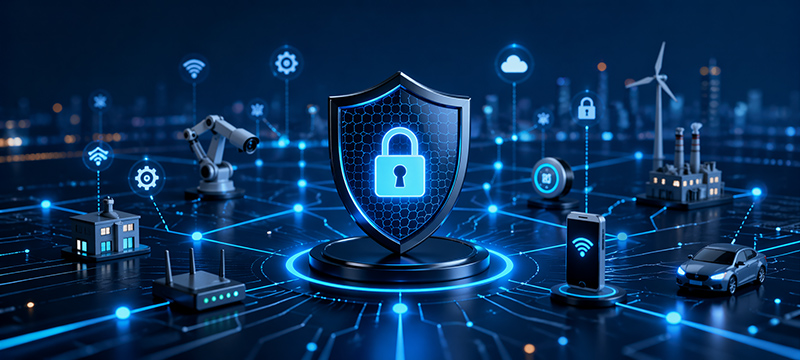
Securing linked gadgets has turn out to be a central concern as deployments scale from pilot initiatives to vital infrastructure. IoT Safety is not a distinct segment technical subject however a foundational requirement shaping how techniques are designed, deployed and operated throughout industries. The enlargement of linked endpoints—typically distributed, resource-constrained and remotely managed—has widened the potential assault floor in ways in which conventional IT safety fashions weren’t constructed to deal with.
For organizations constructing or working linked techniques, the problem shouldn’t be solely to mitigate identified dangers however to anticipate how evolving threats work together with heterogeneous gadgets, networks and cloud platforms. Understanding IoT Safety requires trying past particular person elements to the complete lifecycle of linked techniques, from {hardware} design to knowledge processing and long-term upkeep.
Key Takeaways
- IoT Safety addresses dangers throughout your entire lifecycle of linked gadgets, from manufacturing to decommissioning.
- The distributed nature of IoT techniques expands the assault floor, requiring layered and architecture-level protections.
- Safe-by-design ideas are more and more changing reactive safety approaches in fashionable deployments.
- Requirements, id administration and encryption are core constructing blocks of resilient IoT environments.
- Balancing safety with value, energy consumption and scalability stays a key engineering problem.
What’s IoT Safety?
IoT Safety refers back to the set of applied sciences, processes and design ideas used to guard linked gadgets, networks and knowledge in Web of Issues environments from unauthorized entry, manipulation or disruption. It encompasses {hardware}, software program and network-level protections utilized all through the lifecycle of IoT techniques.
Throughout the broader IoT ecosystem, safety acts as an enabling layer that ensures belief between gadgets, platforms and customers. With out sufficient safeguards, linked techniques turn out to be weak to assaults that may compromise knowledge integrity, disrupt operations or create bodily security dangers—notably in industrial, healthcare or infrastructure functions.
In contrast to conventional IT environments, IoT deployments typically contain constrained gadgets, lengthy operational lifecycles and restricted bodily entry. These traits require tailor-made approaches to IoT Safety that account for gadget heterogeneity, intermittent connectivity and large-scale gadget administration.
How IoT Safety works
IoT Safety operates throughout a number of layers of the structure, from embedded {hardware} to cloud providers. Every layer introduces particular vulnerabilities and requires devoted safety mechanisms.
On the gadget degree, safety begins with hardware-based belief anchors akin to safe parts or trusted execution environments. These elements allow safe boot processes, making certain that solely authenticated firmware can run on the gadget. Firmware integrity checks and over-the-air (OTA) replace mechanisms are vital to sustaining safety over time.
On the community degree, communication between gadgets and backend techniques is secured via encryption protocols. Applied sciences akin to TLS or DTLS present confidentiality and integrity for knowledge in transit. Authentication mechanisms be certain that gadgets join solely to trusted endpoints, decreasing the chance of man-in-the-middle assaults.
On the platform degree, id and entry administration techniques management how gadgets, customers and functions work together. This contains provisioning, credential administration and coverage enforcement. Monitoring and anomaly detection techniques analyze gadget conduct to determine potential threats in actual time.
From an operational perspective, IoT Safety additionally entails lifecycle administration, together with safe onboarding, configuration, patching and decommissioning. Every part presents potential entry factors for attackers if not correctly managed.
Key applied sciences and requirements
A spread of applied sciences and requirements underpin IoT Safety implementations, reflecting the range of IoT use circumstances and architectures.
- Encryption protocols: TLS, DTLS and IPsec safe knowledge transmission throughout networks.
- System id and authentication: X.509 certificates, SIM-based authentication and hardware-rooted identities.
- Safe boot and firmware validation: Ensures solely trusted code runs on gadgets.
- Light-weight safety protocols: Designed for constrained gadgets, together with CoAP with DTLS.
- {Hardware} safety modules: Safe parts and TPMs present tamper-resistant storage of cryptographic keys.
- Zero Belief architectures: Steady verification of gadgets and customers relatively than implicit belief.
Trade frameworks and requirements our bodies additionally play a key function. Organizations akin to ETSI, NIST and the GSMA have developed pointers and specs for IoT Safety, masking areas akin to gadget provisioning, lifecycle administration and knowledge safety.
Major IoT use circumstances
Safety necessities fluctuate considerably relying on the appliance area, however sure patterns emerge throughout industries.
Industrial IoT: Manufacturing techniques depend on safe connectivity between sensors, controllers and cloud platforms. Assaults can result in manufacturing downtime or security incidents, making community segmentation and real-time monitoring vital.
Logistics and asset monitoring: Gadgets utilized in provide chains should guarantee knowledge integrity and site accuracy. Tampering or spoofing assaults can disrupt operations or allow fraud.
Sensible cities: City infrastructure akin to visitors techniques, lighting and surveillance networks requires strong IoT Safety to forestall unauthorized management or knowledge breaches affecting public providers.
Power and utilities: Sensible meters and grid administration techniques should defend towards each cyber and bodily threats. Compromised gadgets can affect billing accuracy or grid stability.
Healthcare: Related medical gadgets deal with delicate affected person knowledge and, in some circumstances, straight have an effect on affected person security. Regulatory necessities add a further layer of complexity to IoT Safety methods.
Fleet administration and telematics: Car monitoring techniques should safe communication channels and forestall unauthorized entry to operational knowledge or management techniques.
Advantages and limitations
Implementing strong IoT Safety supplies clear operational and strategic benefits. It reduces the chance of knowledge breaches, ensures system availability and helps compliance with regulatory necessities. Sturdy safety practices additionally construct belief amongst customers and companions, which is important for large-scale IoT adoption.
Nonetheless, these advantages include trade-offs. Safety mechanisms typically enhance gadget complexity, value and energy consumption—notably in battery-powered or resource-constrained environments. Light-weight encryption and optimized protocols are essential however could not present the identical degree of safety as extra strong approaches.
Scalability is one other problem. Managing identities, credentials and updates throughout thousands and thousands of gadgets requires automated and extremely dependable techniques. As well as, lengthy gadget lifecycles imply that safety options should stay efficient over a few years, whilst threats evolve.
Interoperability will also be a limitation. The shortage of universally adopted requirements can result in fragmented safety implementations, complicating integration throughout totally different distributors and platforms.
Market panorama and ecosystem
The IoT Safety ecosystem spans a number of layers of the worth chain, reflecting the complexity of linked techniques.
System producers are more and more integrating security measures on the {hardware} degree, embedding safe parts and enabling safe boot capabilities. Connectivity suppliers, together with mobile and LPWAN operators, contribute by providing safe communication channels and network-level protections.
Platform suppliers ship gadget administration, authentication and monitoring capabilities, typically integrating security measures into broader IoT platforms. Cloud suppliers play a big function in securing knowledge storage and processing environments, in addition to offering id and entry administration providers.
Specialised cybersecurity companies deal with menace detection, vulnerability administration and compliance. On the similar time, system integrators and OEMs are accountable for implementing end-to-end IoT Safety methods tailor-made to particular use circumstances.
This multi-layered ecosystem requires coordination between stakeholders. Safety gaps typically come up on the interfaces between elements, making integration and governance vital elements of any deployment.
Future outlook
IoT Safety is evolving towards extra proactive and built-in approaches. Safe-by-design ideas are gaining traction, encouraging organizations to embed safety concerns from the earliest levels of product improvement relatively than including them later.
Advances in hardware-based safety, together with extra environment friendly safe parts and embedded SIM applied sciences, are enabling stronger device-level safety with out considerably growing value or energy consumption. On the similar time, AI-driven menace detection is enhancing the power to determine anomalies throughout massive fleets of gadgets.
Regulatory frameworks are additionally turning into extra stringent, notably in areas specializing in vital infrastructure and shopper gadget safety. Compliance necessities are prone to drive extra standardized approaches to IoT Safety throughout industries.
Trying forward, the convergence of edge computing, 5G and distributed architectures will introduce new safety challenges, notably round knowledge processing exterior centralized environments. Addressing these challenges would require continued innovation in each know-how and governance fashions.
Often Requested Questions
What are the primary threats in IoT Safety?
Widespread threats embrace gadget hijacking, knowledge interception, unauthorized entry, firmware tampering and distributed denial-of-service (DDoS) assaults utilizing compromised gadgets.
Why is IoT Safety extra complicated than conventional IT safety?
IoT techniques contain a variety of gadgets with various capabilities, typically deployed in distant environments with restricted assets and lengthy lifecycles, making constant safety implementation harder.
What’s secure-by-design in IoT?
Safe-by-design refers to integrating safety measures into the design and improvement of gadgets and techniques from the outset, relatively than including protections after deployment.
How are IoT gadgets authenticated?
Gadgets are sometimes authenticated utilizing digital certificates, SIM-based credentials or hardware-rooted identities saved in safe parts.
What function does encryption play in IoT Safety?
Encryption protects knowledge in transit and at relaxation, making certain confidentiality and integrity of communications between gadgets and backend techniques.
Can IoT gadgets be up to date securely?
Sure, safe over-the-air replace mechanisms enable gadgets to obtain authenticated firmware updates, which is important for patching vulnerabilities over time.
