



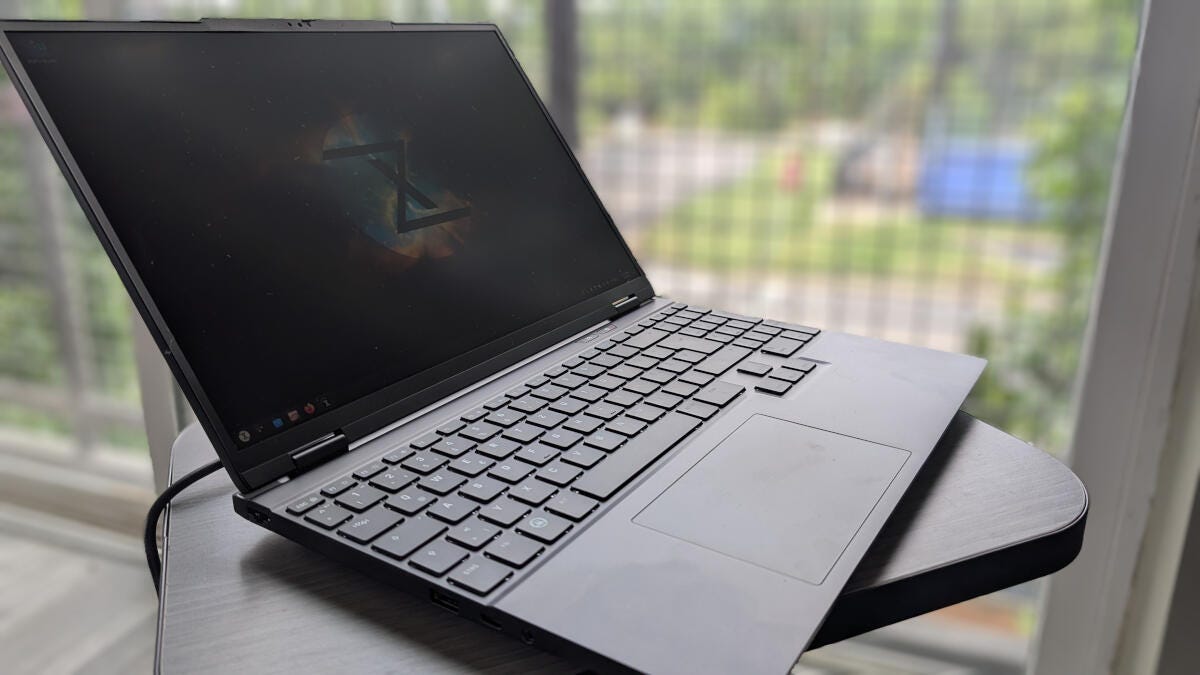
Tuxedo InfinityBook Max 15
pros and cons
- Durable aluminum body
- Stunning 300Hz display
- Reliable everyday performance
- Inconsistent battery duration
- Can become expensive
Double-check your keyboard layout before purchasing
Follow ZDNET: Add us as a preferred source on Google.
Tuxedo Computers, a German firm with over 20 years of experience building Linux-based systems, recently sent me their newest model—the InfinityBook Max 15—for review. Starting at $1,800, it was an opportunity I couldn’t turn down.
Also: Ready for a Linux laptop? I recommend a Tuxedo to beginners and pro users alike
Right away, this machine stood out. It feels solidly built, features a gorgeous display, and includes a charming Tux penguin icon replacing the traditional Windows key.
While it has a few minor drawbacks, the laptop strikes a great balance between design and usability. It’s not a performance monster, but if you’re after a well-made aluminum laptop that handles daily tasks efficiently—and you run Linux—this could be a perfect fit.
Best laptop deals of the week
Deals are selected by the CNET Group commerce team, and may be unrelated to this article.
What stood out
The first thing I noticed was the matte black aluminum chassis. The moment you pick it up, you can tell it’s built to last. The hinge is firm yet smooth, and at 4.1 pounds, it’s manageable—though heavier than my 13-inch MacBook Pro, it’s far from the heaviest laptop I’ve used.
The screen is impressive: a 15.5-inch panel with 500 nits of brightness and a 300Hz refresh rate. In my experience, it matches my MacBook Pro in clarity—especially at max brightness—and produces less glare, which is a real advantage.
Also: These are the absolute best Linux distros for programming
Performance-wise, the InfinityBook Max didn’t wow me, but it didn’t disappoint either. I set up Ollama AI, loaded a few models, and ran standard benchmarks. Honestly, my reaction was lukewarm. I’d hoped for faster speeds, but the mid-tier GPU struggled with AI workloads. It’s usable, but doesn’t compete with high-end GPU machines I’ve tested.
You can even create your own power profile.
Jack WallenZDNET
However, when I switched to everyday productivity tasks, the laptop really shone. I installed DaVinci Resolve 20, and it performed flawlessly—actually better than on my MacBook Pro. While it can’t match my iMac M3 Ultra with 96GB RAM, it held its own. Just don’t expect to render anything longer than 15 minutes; shorter projects work perfectly.
A few things to keep in mind
My biggest issue was battery life—it fell short of my expectations. During early testing, I used the “Default” performance mode, which prioritizes power over efficiency.
Switching to “Cool and Breezy” improved things noticeably. But when I enabled “Powersave extreme,” battery life stopped being a concern altogether.
On Default mode, I barely got six hours. With Cool and Breezy, I gained an extra four. On Powersave extreme, I used the laptop for nearly 12 hours before it finally died—my brain gave out before the battery did!
Also: This simple Linux tweak fixes crashes automatically – and it costs me nothing
Sound quality was another letdown. While not as thin-sounding as some laptops, it lacked depth and impact. Listening to Rush’s “Tom Sawyer” on YouTube felt flat. That said, for casual video watching in a quiet space, it’s perfectly adequate.
The trackpad, while not quite as buttery-smooth as the MacBook Pro’s, worked very well. I appreciated that Tuxedo included gesture support—a thoughtful addition.
My only real complaint about the keyboard isn’t about how it feels—the key travel is excellent, with a satisfying, sturdy press. In fact, it’s far better than my MacBook Pro’s keyboard.
The issue is that Tuxedo consistently sends me non-US layouts, forcing me to hunt for certain symbols. I understand the company is German-based, but buyers should be aware. Once I adapted, though, I grew to like it.
ZDNET’s buying advice
Would I recommend the Tuxedo Computer InfinityBook Max 15? It depends on your priorities. If you need a hardcore gaming rig or a local AI workstation, this could work—but I’d suggest upgrading the RAM and opting for the strongest GPU your budget allows (the Nvidia GeForce RTX 5070 is the top choice).
With those upgrades, you’d have a powerhouse capable of handling almost anything. Of course, maxing out both RAM and GPU brings the total to $3,605 USD—a steep price for any laptop, no matter the OS.
Also: 8 things you can do with Linux that you can’t do with MacOS or Windows
I genuinely enjoyed using the InfinityBook Max 15. Would I trade my MacBook Pro 13 for it? Probably not—but that’s mostly because I prefer a more compact device.
Tuxedo InfinityBook Max 15 tech specs
- Processor: Intel Core Ultra 7 255H (16 cores, 22 threads, up to 5.1 GHz).
- Graphics: NVIDIA GeForce RTX 5060 or RTX 5070 (8GB GDDR7).
- Display: 15.3-inch “Omnia” display, 2560 x 1600 (16:10), 300Hz, 500 nits, 100% sRGB.
- Memory: Up to 128GB DDR5 5600MHz/6400MHz (two slots).
- Storage: 2x M.2 NVMe PCIe 4.0 SSDs for up to 8TB.
- Weight: 4.1 pounds
- Ports: 2x HDMI, 3x DisplayPort and 5x USB
- Battery: 99Wh Battery and USB-C Charging With 140 Watts
- Cooling: Low-profile cooling system that keeps laptop quiet and cool under light tasks and dissipates up to 165 watts from the two processors at full fan speed.
- Base price: $1,801.07
