



**Avoiding Redundant Tokenization in Multi‑Agent Pipelines: A Pragmatic Approach to Token Hand‑Offs**
—
### Introduction
When orchestrating multiple LLM agents from the same model family, it is tempting to treat tokenization as a free, stateless step. In practice, each agent independently running its own tokenizer means the same characters are tokenized over and over. This article presents a small but intentional pipeline built around a shared‑memory token hand‑off and a strict runtime vocabulary equality check, enabling significant latency reductions while preserving correctness.
—
### The Core Idea
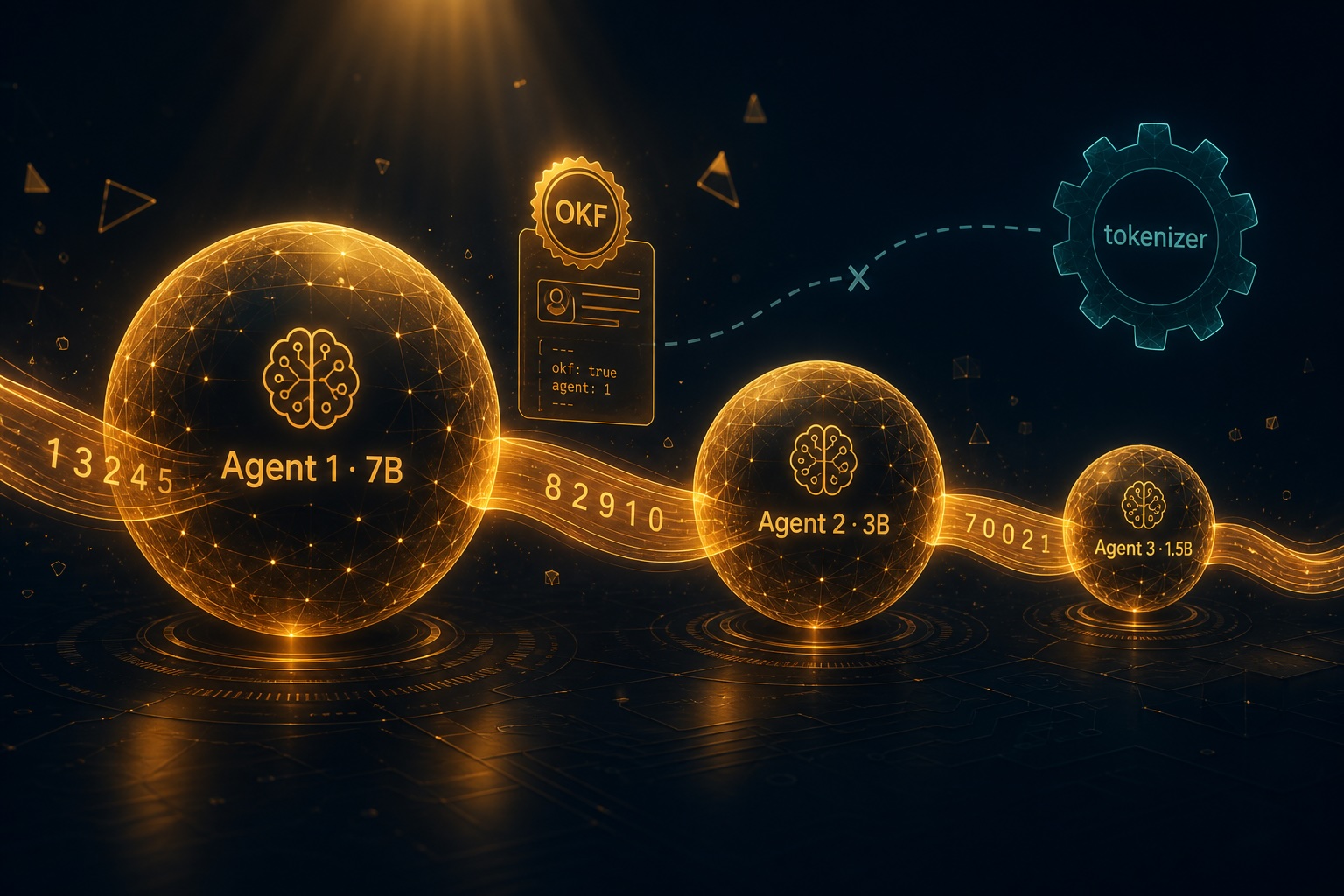
The repository demonstrates a three‑agent Qwen2.5‑Coder pipeline (7B → 3B → 1.5B) where:
– The upstream agent tokenizes once.
– Token IDs are stored as a NumPy `int64` array in `/dev/shm/qwen_tokens/` (a RAM‑backed tmpfs).
– A Markdown file with YAML frontmatter (inspired by Open Knowledge Format) carries a `token_pointer` absolute path and metadata.
– Downstream agents load the array directly and call `model.generate(input_ids=…)`, skipping tokenization entirely.
– Before trusting the shared integers, each downstream agent validates that all models agree on the exact vocabulary mapping.
This approach turns what would be redundant BPE work into a one‑time cost, while guarding against the silent correctness risks that arise when vocabularies diverge.
—
### Why This Matters
Tokenizers are fast, but they are not free. More importantly, they are not harmless either. A vocabulary mismatch does not crash a pipeline; it produces fluent, coherent, and completely wrong output. The key insight is:
> **Skipping the tokenizer is safe only when you actively guarantee that all models interpret the integers identically.**
The repository’s value lies not in clever orchestration alone, but in the guardrail that makes that orchestration trustworthy.
—
### Model Design and Vocabulary Sharing
All three models share the same BPE vocabulary, but:
– KV caches cannot be shared due to differing `hidden_size` (3584 / 2048 / 1536).
– Token IDs can be shared because Qwen2.5‑Coder maintains a single, consistent vocabulary across sizes.
– The design assumes vocabulary equality, then verifies it byte‑for‑byte at runtime.
This distinction—shared mapping but separate activation shapes—drives the entire architecture.
—
### Performance Results
Using median measurements over seven trials, 64 new tokens, and greedy decoding:
| Model | Baseline TTFT (ms) | Optimized TTFT (ms) | Reduction |
|—————————|——————–|———————|———–|
| Qwen2.5‑Coder‑3B‑Instruct | 69.3 | 49.9 | 28.0% |
| Qwen2.5‑Coder‑1.5B‑Instruct| 49.6 | 30.9 | 37.8% |
– Semantic fidelity checks passed for all samples.
– The larger relative gain for the 1.5B model reflects its smaller GPU workload, making the fixed tokenizer cost a larger fraction of total latency.
—
### Key Components
#### 1. Token Save / Load (utils/token_manager.py)
“`python
def save_token_array(token_ids: torch.Tensor, block_name: str) -> Path:
tensor = token_ids.detach().cpu().numpy().astype(np.int64)
path = Path(“/dev/shm/qwen_tokens/”) / f”{block_name}.npy”
np.save(path, tensor, allow_pickle=False)
return path
def load_token_array(pointer_path: Path) -> torch.Tensor:
arr = np.load(pointer_path, allow_pickle=False)
if arr.dtype != np.int64:
raise TypeError(“Unexpected dtype in token array”)
return torch.from_numpy(arr)
“`
– `.npy` format embeds dtype and shape.
– `allow_pickle=False` prevents unintended code execution.
– `int64` matches PyTorch’s default `torch.long`.
#### 2. Vocabulary Equality Guard (utils/env_checks.py)
“`python
def verify_tokenizer_equivalence(model_ids):
tokenizers = {mid: AutoTokenizer.from_pretrained(mid) for mid in model_ids}
ref_vocab = tokenizers[model_ids[0]].get_vocab()
for mid in model_ids[1:]:
t = tokenizers[mid]
if t.vocab_size != len(ref_vocab):
raise RuntimeError(“Vocabulary size mismatch”)
if t.get_vocab() != ref_vocab:
raise RuntimeError(“Vocabulary content mismatch”)
if t.special_tokens_map != tokenizers[model_ids[0]].special_tokens_map:
raise RuntimeError(“Special token mismatch”)
“`
This check ensures byte‑for‑byte agreement before any downstream agent trusts shared integers.
#### 3. Isolated Process Execution
Each agent runs in a separate OS process, guaranteeing VRAM release between stages and avoiding costly manual cleanup.
—
### Frequently Asked Questions
**Q: Is this approach limited to Qwen models?**
A: In principle, any model family with a shared BPE vocabulary can use this pattern. The repository pins specific checkpoints and verifies compatibility explicitly.
**Q: What happens if two agents use different tokenizers?**
A: The `verify_tokenizer_equivalence` step will raise a runtime error, preventing silent corruption of downstream output.
**Q: Does this actually reduce latency?**
A: Yes. Measurements show 28–38% reductions in time‑to‑first‑token for the optimized path, with semantic correctness preserved.
**Q: Is this just about skipping tokenization speed?**
A: The latency improvement is real but modest. The main benefit is eliminating redundant work and the correctness guarantees that make the optimization safe.
**Q: Does this scale to larger documents or more agents?**
A: Yes. The cost savings scale with document size and the number of downstream consumers, subject to GPU compute dominance at larger input lengths.
—
### Conclusion
The most valuable insight from this work is not that tokenization is fast, but that correctness in multi‑agent pipelines requires explicit guarantees. By combining shared‑memory token hand‑offs with a rigorous vocabulary equality check, this repository transforms a potential footgun into a reliable optimization. For anyone wiring multiple agents from the same model family, the lesson is clear: find the assumption your system is making—and verify it explicitly.
