



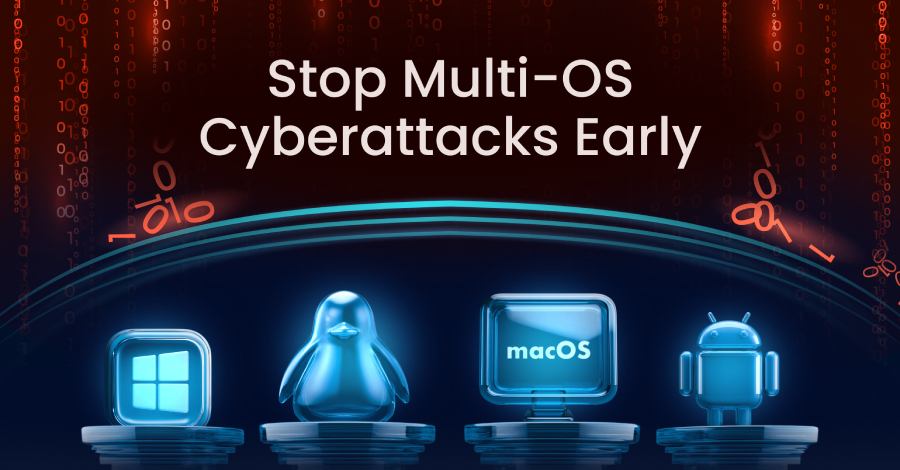
Your assault floor no longer lives on one working system, and neither do the campaigns concentrating on it. In enterprise environments, attackers transfer throughout Home windows endpoints, govt MacBooks, Linux infrastructure, and cell gadgets, profiting from the truth that many SOC workflows are nonetheless fragmented by platform.
For safety leaders, this creates a expensive operational hole: slower validation, restricted early-stage visibility, extra escalations, and extra time for attackers to steal credentials, set up persistence, or transfer deeper earlier than the response totally begins.
The Multi-OS Assault Downside SOCs Aren’t Prepared For
A multi-OS assault can flip one menace into a number of totally different investigations at as soon as. The marketing campaign might observe a special path relying on the system it reaches, which breaks the pace and consistency SOC groups depend on throughout early triage.
As a substitute of transferring via one clear validation course of, the group finally ends up leaping between instruments, reconstructing habits throughout environments, and making an attempt to catch up whereas the assault retains transferring.
That rapidly results in acquainted issues contained in the SOC:
- Validation delays enhance enterprise publicity by slowing the second when the group can verify threat and comprise it.
- Fragmented proof reduces incident readability when quick selections are wanted on scope, precedence, and impression.
- Escalation quantity grows as a result of too many instances can’t be closed confidently on the earliest stage.
- Response consistency breaks down throughout groups and environments, making investigations tougher to handle at scale.
- Attackers get extra time to maneuver earlier than the group has a transparent image of what’s unfolding.
- SOC effectivity drops as time is misplaced to tool-switching, duplicated effort, and slower decision-making.
How High SOCs Flip Multi-OS Complexity into Sooner Response
The groups that deal with this properly normally do one factor in another way: they make cross-platform investigation sooner, clearer, and extra constant from the beginning. With options like ANY.RUN Sandbox, that turns into a lot simpler to do throughout enterprise working methods.
Listed below are three sensible steps to make that occur:
Step 1: Make Cross-Platform Evaluation A part of Early Triage
Early triage will get slower the second groups assume the identical menace will behave the identical approach in every single place. It typically does not. A suspicious file, script, or hyperlink that reveals one sample in Home windows might take a special path on macOS, depend on totally different native parts, and create a special stage of threat. That makes cross-platform validation important from the begin.
For occasion, macOS is typically handled because the safer facet of the enterprise setting, which might make it an simpler place for threats to go unnoticed early. As adoption grows amongst executives, builders, and different high-value customers, attackers have extra cause to tailor campaigns for that setting.
A current ClickFix marketing campaign was analyzed by ANY.RUN specialists is an efficient instance. Verify its full assault chain under:
See the recent attack targeting Claude Code users.

Attackers exploited a Google ad redirect to lure victims to a fake Claude Code documentation page, then used a ClickFix flow to push a malicious Terminal command. That command downloaded an encoded script, installed AMOS Stealer, collected browser data, credentials, Keychain contents, and sensitive files, then deployed a backdoor for persistent access.
Give your team a faster way to detect multi-OS threat behavior before hidden execution paths turn into credential theft, persistence, and deeper compromise.
Close Multi-OS Security Gaps
When cross-platform analysis starts early, teams can:
- Recognize how one campaign changes across operating systems before the investigation splits
- Validate suspicious activity earlier in the environment actually being targeted
- Reduce the chance of missing platform-specific behavior during early triage
Step 2: Keep Cross-Platform Investigations in One Workflow
Multi-OS attacks become harder to contain when one case forces the team into several disconnected workflows.A suspicious link on one system, a script on another, and a different execution path somewhere else can quickly turn a single incident into a messy investigation spread across multiple tools. That slows down validation, makes evidence harder to follow, and creates more room for the threat to keep moving.
ClickFix campaigns, for instance, show why this matters. The same technique has been used to target different operating systems, from Windows to macOS, while following different execution paths depending on the environment.

If each version has tobe analyzed in a separate tool, the investigation takes longer, requires more effort, and becomes much harder to keep consistent. WithANY.RUN Sandbox, teams can investigate these threats within a single workflow across major enterprise operating systems, making it easier to compare behavior, follow the attack chain, and understand how the campaign changes from one environment to another without constantly switching context.

When investigations stay in one workflow, teams:
- Cut the operational overhead that multi-OS investigations create
- Keep one connected view of campaign activity instead of managing separate case fragments
- Support a more standardized response process as the attack scope expands across the enterprise
Step 3: Turn Cross-Platform Visibility into Faster Response
Seeing activity across operating systems only helps if the team can quickly understand what matters and act on it. In multi-OS attacks, that is often where the response starts to slow down. One behavior appears in one environment, other artifacts show up somewhere else, and the team is left trying to piece everything together before it can make a confident decision.
What helps is having the right information presented in a way that is easier to work through under pressure. With ANY.RUN Sandbox, teams can review auto-generated reports, follow attacker behavior, examine IOCs in dedicated tabs, and use the built-in AI Assistant to speed up analysis and understand suspicious activity faster.
That makes it easier to move from raw activity to a clearer view of what the threat is doing, how serious it is, and what needs to happen next.

When cross-platform visibility is easier to work through, teams can:
- Make faster decisions with evidence that is easier to review and act on
- Reduce delays caused by scattered findings and manual reconstruction
- Move into containment with more confidence even when the attack behaves differently across environments
Stop Giving Multi-OS Attacks Room to Move
Multi-OS attacks win when defenders lose time. Every extra workflow, every delayed validation, and every missing piece of context gives the threat more room to spread before the team can contain it.
With ANY.RUN’s cloud-based sandbox, teams can reduce that delay by bringing cross-platform analysis into a more consistent workflow across major enterprise operating systems. That gives SOC teams clearer context, faster decisions, and measurable operational gains:
- Up to 3× stronger SOC efficiency across investigation workflows
- 21 minutes less MTTR per case when threats are validated faster
- 94% of users reporting faster triage in daily operations
- Up to 20% lower Tier 1 workload from reduced manual effort
- 30% fewer escalations from Tier 1 to Tier 2 during early analysis
- Lower breach exposure through earlier detection and response
- Less alert fatigue with faster access to threat insights
Expand cross-platform visibility to reduce investigation delays, limit business exposure, and give your SOC more control over multi-OS threats.
