



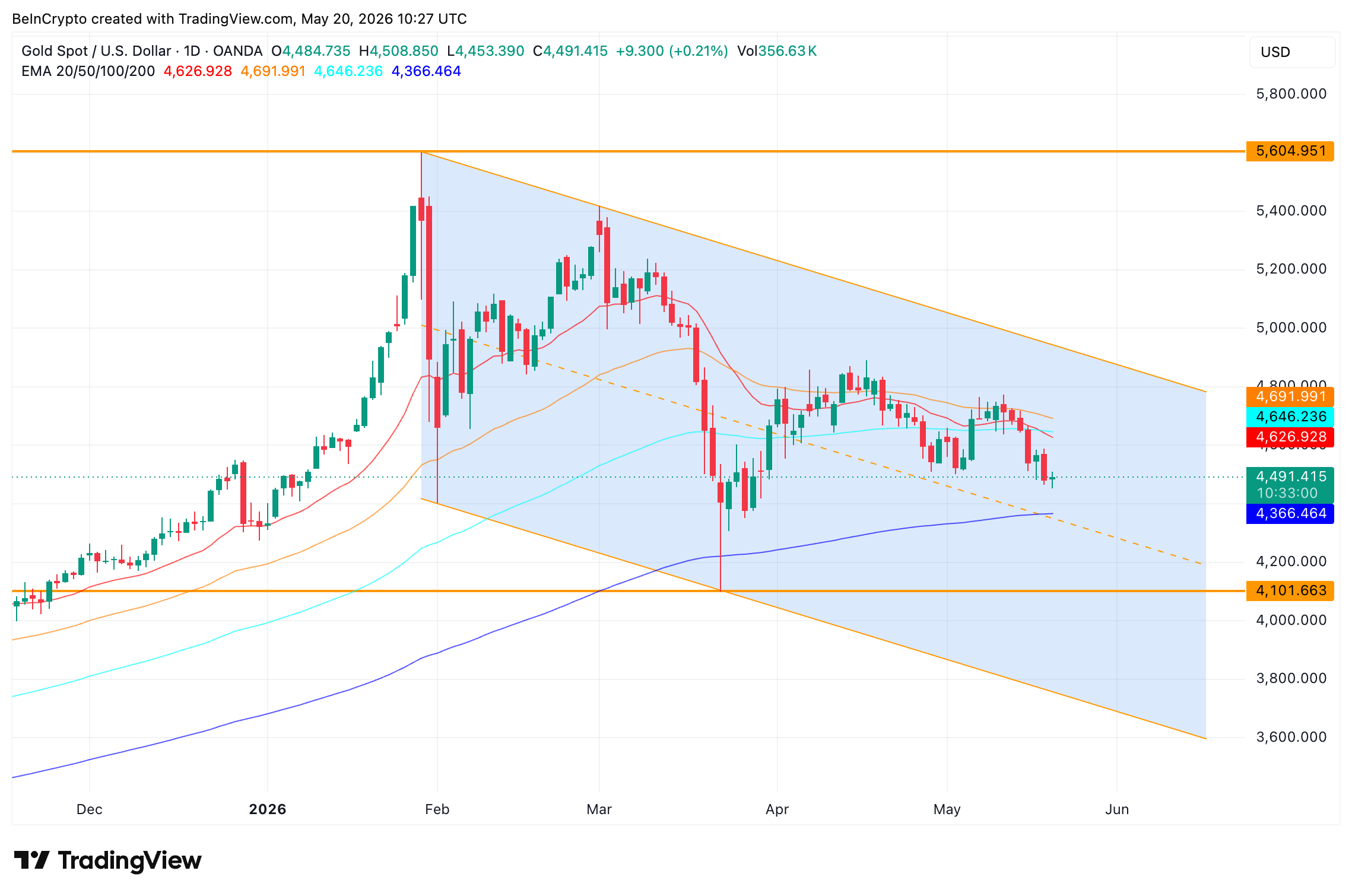
Gold is trading at $4,491, sitting below most of its short-term moving averages. Meanwhile, commercial hedgers are aggressively shorting near the top, while speculators continue adding long positions.
This decline is taking place within a five-month falling channel that has been in place since January. On top of that, options positioning and tensions involving Iran and oil — which influence the dollar — are adding further complexity to the bearish outlook.
Gold Falls Below Three Short-Term EMAs Within the Falling Channel
Gold (XAU/USD) has been moving inside a descending channel since January. The metal bounced off the lower boundary on March 23 and staged a recovery. The channel’s downward slope confirms that the broader trend has been losing momentum, even though buyers have repeatedly defended the floor.
Looking for more analysis like this? Sign up for Editor Harsh Notariya’s Daily Newsletter here.
The structure has deteriorated further in recent weeks. Gold has dropped below its 20-day, 50-day, and 100-day exponential moving averages (EMAs) — trend-following indicators that assign greater weight to more recent price action compared to older data. The 200-day EMA is the only one still holding, at $4,366, representing the critical line that defines whether the broader uptrend remains intact.
The fact that gold has lost three short-term EMAs without reclaiming them cleanly indicates that sellers are in control of the near-term trend. Whether the 200-day EMA holds or breaks becomes the next key factor, but positioning data provides an additional layer of insight.
Commercial Hedgers Short the Top as Speculators Build Long Positions
The latest Commitments of Traders (COT) report from the CFTC, published on May 12, reveals a sharp divergence in gold futures positioning. The COT report separates commercial hedgers — physical-market participants such as miners, refiners, and jewelers — from non-commercial speculators, which are typically managed money funds and large traders.
Commercial hedgers added 10,818 short contracts during the week ending May 12 (the same week the right shoulder top formed), marking a significant increase in bearish hedge positioning. Commercial shorts now account for 71.2% of open interest, making them the dominant force in the market.
Non-commercial speculators, on the other hand, added 7,979 long contracts during the same period. Their net long exposure grew even as commercials were hedging aggressively.

Commercials are widely regarded as the “smart money” in gold futures because they have direct exposure to the physical gold supply chain. Their tendency to hedge at price peaks has historically served as a contrarian bearish signal, and this divergence carries even greater significance when options positioning also shows hedging building on the other side.
GLD Put Hedges Rise While Call-Heavy Open Interest Persists
The options market on the SPDR Gold Shares ETF (GLD) shows hedging activity that aligns with the COT divergence. The GLD put-call ratio by open interest stands at 0.58, meaning calls still outnumber puts among total open contracts.
However, the open interest ratio has climbed from lows of 0.47 in early February to 0.58 as of May 19, indicating that put accumulation has been accelerating. The volume ratio has also tightened to 0.97, meaning daily put and call trading volumes are now nearly equal.

Implied volatility (IV) sits at 23.22% with an IV percentile of 62%, which measures the percentage of trading days over the past year that IV has been at or below its current level. A percentile above 60% suggests options pricing is somewhat elevated.
The pattern across both markets is consistent. The call-heavy open interest and bullish speculator longs reflect retail and managed money sentiment, while the rising put hedges and aggressive commercial shorts reflect institutional caution. Both markets are telling the same story from different perspectives.
Iran-Oil Tension Weighs on the Dollar and Adds to Gold’s Decline
The macro environment has been contributing to gold’s price swings. Iran-related geopolitical tensions have kept oil markets volatile throughout May, feeding into the dollar through the petrodollar feedback loop.
Rising oil prices push inflation expectations higher, which can weaken the dollar but also strengthen it when safe-haven flows take precedence. Gold typically benefits from a weaker dollar and rising inflation, but it has failed to gain cleanly because the dollar has not moved decisively in either direction.
The metal is down approximately 6.83% over the past month while still up 36% compared to a year ago.

The recent month’s drift mirrors the indecision in the macro picture, where conflicting forces have prevented a clear directional move. With macro forces locked in equilibrium, the gold price chart itself becomes the ultimate deciding factor.
Gold Price Levels That Determine Whether the Pattern Confirms
Gold’s price action across April and May has carved out a head-and-shoulders pattern inside the descending channel. The left shoulder formed in early April. The head peaked near $4,890 in late April. And the right shoulder topped around $4,775 in mid-May. The neckline slopes downward and sits near $4,308.
For gold to show strength, it needs to hold above $4,539, the 0.618 Fibonacci retracement level of the recent swing. Below that, the chart shows weakening support at $4,474 (the nearest support), $4,393, and the $4,308 neckline.
A confirmed break below $4,308 projects a 6.35% measured move toward $4,038. The $4,308 level also aligns closely with the 200-day EMA highlighted earlier.
Bullish invalidation begins at $4,775 and completes at $4,890. A decisive move above $4,890 would invalidate the pattern and re-engage the speculator long positioning from the COT report.

The key nuance worth noting is that a head-and-shoulders setup only confirms after a decisive neckline break accompanied by volume. Until $4,308 cracks convincingly, the structure remains a forming pattern rather than a confirmed bearish signal.
The $4,308 neckline separates a controlled hold above $4,539 from a 6.35% slide toward $4,038.
The post Gold Price Risks 6% Drop as Smart Money Quietly Sells the Top appeared first on BeInCrypto.
