



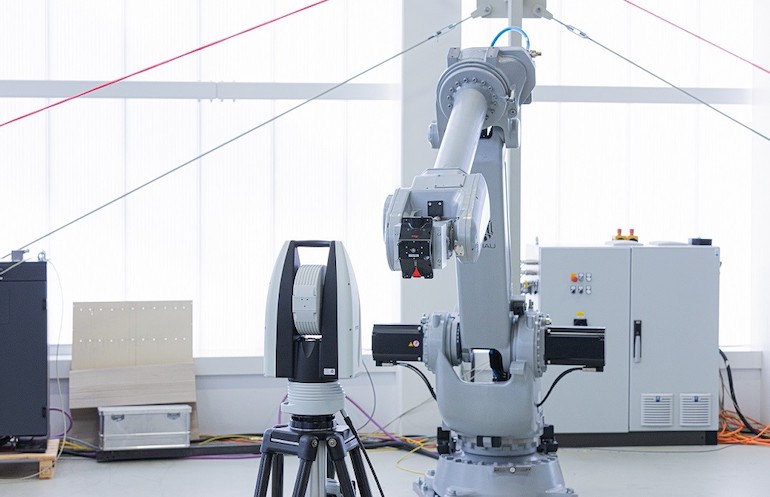
With prime gear and years of expertise, Fraunhofer IPA will get to the basis causes of inaccurate robotic operation. Supply: Rainer Bez, Fraunhofer IPA
Robots are virtually at all times extremely repeatable. Absolute accuracy, however, typically leaves one thing to be desired. A group on the Fraunhofer Institute for Manufacturing Engineering and Automation IPA is uncovering the explanations for this and serving to firms to attain extra environment friendly robotic methods.
Repeatability and absolute accuracy are established parameters for assessing the standard and precision with which a robotic performs a selected job. If a robotic performs a selected job many occasions with virtually equivalent outcomes, this demonstrates superb repeatability. Many industrial robots obtain values within the vary of 0.1 mm or higher.
In distinction, absolute accuracy describes how precisely a robotic’s spatial coordinates are achieved in relation to its base system, no matter earlier actions. And right here, there may be typically nonetheless room for enchancment. Sometimes, values between 0.5 and 1.5 mm are achieved. This tendency towards inaccuracy isn’t an issue for some functions, however it’s for others.
Disadvantages of inaccurate robots
It’s tough to make use of robots with low absolute accuracy in processes that aren’t repeated identically, equivalent to within the manufacturing of small batch sizes. When welding an meeting, for instance, it’s notably essential that the wire tip is positioned exactly within the heart of the weld seam. Precise positioning ends in high-quality weld seams that meet trade necessities.
Nonetheless, deviations of just some tenths of a millimeter can considerably impair high quality and even result in rejections. Absolute accuracy isn’t solely essential for robot-based welding, but additionally for functions equivalent to choose and place, overspray-free portray, or robot-based drilling and deburring.
One other drawback of inaccurate robots turns into obvious in offline programming (OLP), which can also be ceaselessly used within the processes talked about above. Right here, the robotic program is created in a simulation after which transferred to the true robotic. The benefit lies in the opportunity of the robotic sustaining operation whereas programming is carried out. Due to this fact, whereas the robotic is processing one element, the following element may be programmed in parallel.
But when absolute accuracy is inadequate, the created program can’t be used instantly. As a substitute, time-consuming corrections are essential, resulting in undesirable machine downtime, which in flip impairs effectivity and productiveness.
The customarily-achieved absolute accuracy of 0.5 to 1.5 mm is due to this fact inadequate for advanced functions and might restrict and even forestall using robots in sure functions. It additionally ceaselessly results in extra work steps, such because the re-teaching, which reduces the effectivity of your entire manufacturing chain. In lots of industrial situations, an absolute accuracy that’s just like the repeatability is fascinating and even required.

Causes for a scarcity of absolute accuracy
Along with the accuracy measurements supplied in accordance with ISO 9283, firms repeatedly flip to Fraunhofer IPA with the query of how they will enhance the efficiency of their robots when it comes to precision. The causes of inaccuracies are manifold and may be divided into hardware-related, software-related, and externally associated causes.
{Hardware}-related causes might embrace the design of the robotic, equivalent to inferior encoders or gears, or inadequate rigidity, whether or not it’s an articulated arm, a SCARA robotic, or a gantry system. Poor calibration of the robotic is without doubt one of the primary causes for inaccuracy on the software program facet, together with inadequate controller efficiency.
As well as, an growing variety of robotic methods are moreover geared up with “cognitive” capabilities, notably these associated to notion. These so-called closed-loop methods work with sensors that detect the robotic’s setting, and their software program processes the measured knowledge to regulate the robotic’s path accordingly. In such a system, poor sensor knowledge, a low-performing controller, or suboptimal interplay between the elements within the robotic cell often trigger issues.
Lastly, exterior elements equivalent to temperature and air strain, but additionally course of forces that happen, can have a unfavourable impression on absolute accuracy.
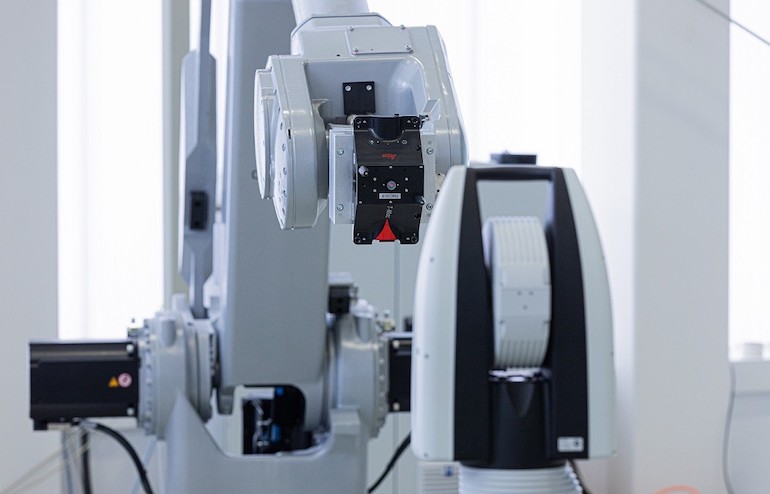
The measurements made by these units have an accuracy of +- 40 µm anyplace within the working house. Supply: Fraunhofer IPA
Complete evaluation with new benchmark
If firms that use robots, in addition to the robotic producers themselves, are dissatisfied with absolutely the accuracy of their methods, your entire utility must be examined and analyzed. As described above, a person investigation of the causes is important.
The automation group at Fraunhofer IPA is a impartial undertaking companion that may conduct this root-cause evaluation in a methodical method primarily based on in depth skilled data and expertise.
In a typical undertaking, the group first data the present scenario utilizing sensor expertise such because the Leica Absolute Tracker AT960 to create a strong database. The laser tracker data the positions of the robotic with submillimeter accuracy. Particular efficiency indicators are calculated from the recorded knowledge, which can be utilized to find out the efficiency of the robotic system.
As well as, the traits of the robotic’s actions are examined, which additionally present beneficial insights. In an additional step, the specialists examine the reason for the undesirable habits. To do that, they study each the {hardware} and software program of the robotic system.
As well as, the group has developed a closed-loop benchmark particularly for the closed-loop robotic methods talked about above. The benchmark is appropriate for robots from many producers. Within the benchmark, a reference-giving machine, a “metronome,” is used to impress the robotic into sure behaviors, which permits conclusions to be drawn about its efficiency.
Whereas ISO 9283 solely focuses on the robotic itself to measure absolute accuracy, the benchmark developed can study all the things that makes up a closed-loop managed course of or process. For example, this contains the efficiency of your entire robotic cell, together with the sensor expertise and the supposed course of.
The benchmark process was introduced on the 56th Worldwide Robotics Symposium (ISR 2023) and on the twenty first Worldwide Convention on Automation Know-how and Mechanical Engineering (CASE 2025).
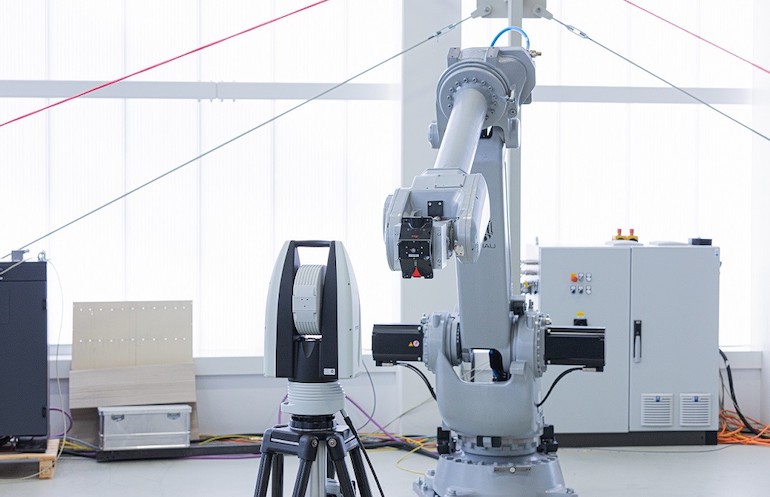
With an correct robotic, the deliberate path may be executed with out handbook interplay on the true robotic. Supply: Fraunhofer IPA
Added worth of excessive absolute accuracy
A robotic with adequate absolute accuracy can’t solely exchange dearer gear but additionally enhance flexibility and decrease rework. In lots of functions, it due to this fact is smart to analyze anomalies and enhance absolute accuracy.
A robotic that works exactly and reliably presents financial benefits, in addition to will increase an organization’s competitiveness. Investing on this space is due to this fact a strategic determination that pays off in the long run.
In regards to the writer
Martin Finkbeiner is a undertaking supervisor on the Fraunhofer Institute for Manufacturing Engineering and Automation IPA. He may be reached at [email protected] and +49 711 9701046.
