



Trending
- Revolutionary AI Breakthrough Promises to Change the Way We Live and Work
- Breakthrough AI Tech Set to Revolutionize Everyday Life: Discover What’s Coming Next
- Revolutionary AI Breakthrough Promises to Change Your Everyday Life Forever
- Revolutionary AI Breakthrough: How This New Technology is Changing the Future of Work
- Revolutionary Tech Breakthrough Promises to Change Our Lives Forever
- Apple’s Game-Changing iPhone Update Brings Groundbreaking Features You Won’t Want to Miss
- AI-Powered Innovations: The Game-Changing Technologies Set to Transform Our Future!
- Revolutionary New Technology Set to Transform Our Daily Lives: Here’s What You Need to Know!

Author: Carter

Carter
Hi, I'm Carter, a Wisconsin-based tech writer and creator. I launched this blog as a comprehensive resource to help people navigate the fast-moving tech landscape. Covering multiple facets of the industry—from software insights to digital tools—my goal is to break down complex concepts into actionable, easy-to-understand guides. When I'm not tracking the latest tech trends, I'm focused on developing my skills in business administration and digital management.
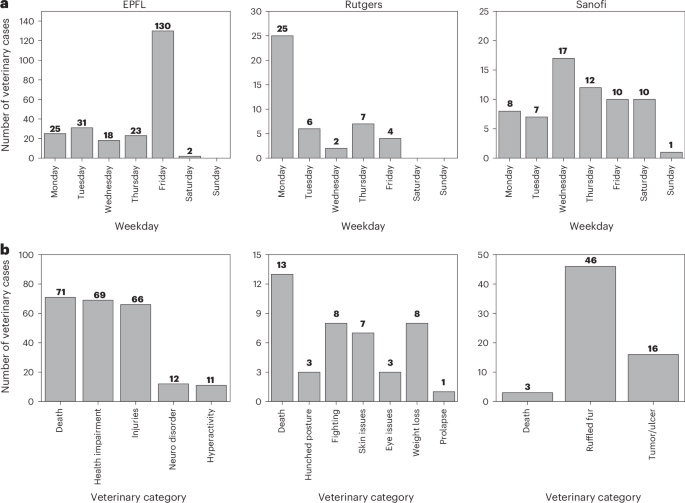
Figure 1 illustrates how daily health checks are carried out at the three facilities. At Rutgers University (fig. 1a), technicians use a flashlight (pen light) to look for signs of animal distress. However, visibility can be limited because animals are often resting inside their nests or enrichment devices (fig. 1b,c). Fully pulling cages out of the rack to inspect the animals is discouraged at both Rutgers and the École Polytechnique Fédérale de Lausanne (EPFL), as this practice can disturb the animals’ sleep and compromise the reliability of scientific results. Observations of technician workflow at Rutgers showed that each cage typically…

Federal agencies are experiencing a sharp rise in cyberattacks, driven in part by the expanding role of artificial intelligence. According to the Cybersecurity and Infrastructure Security Agency, in 2025, the agency managed over 30,000 cyber incidents across federal systems, prevented more than 2.6 billion malicious access attempts on civilian government networks, and blocked 371 million additional threats targeting essential infrastructure. In response to these escalating threats, the White House introduced its Cyber Strategy for America in March. This roadmap defines how the government plans to modernize defenses, enhance operational tools, strengthen protections for critical infrastructure, and prepare for emerging AI-fueled…

RAIN RFID technology is moving beyond conventional fixed and handheld readers, which tend to be bulky. It is now being built directly into a new wave of compact, embedded mobile devices—think wearables, scanners, rugged handhelds, vehicle-mounted terminals, robots, smart cabinets, connected weight scales, and other multi-purpose IoT gadgets. In these setups, the RFID reader must share tight space with the main processor and wireless radios. This shift is unlocking fresh possibilities for businesses by putting RFID scanning capabilities into the hands of frontline workers and autonomous systems, while instantly feeding item-level data back to enterprise platforms in real time.As RFID…

As of 2026, the global order is steadily shifting toward a multipolar structure, and this momentum is likely to persist over the next ten years, extending into 2036. In truth, the preceding era of unipolarity was the real historical exception. Following the conclusion of World War II in 1945—and particularly after the Soviet Union dissolved in 1991—the United States stood alone as the planet’s singular hyperpower. For the first time ever, advances in telecommunications and industrial capacity linked the entire globe, creating the possibility of truly worldwide influence. Before that shift, multipolar power dynamics were standard. Even at the peak…

Preventing credential theft and responding to stolen credentials isn’t impossible in theory, but in reality, it’s a growing challenge—with no signs of improvement on the horizon. Credentials The term “credentials” in cybersecurity traces back to the Latin word *creder*, meaning “to believe.” In ancient times, someone might say, “I am Socrates—trust that.” By the Middle Ages, this evolved into carrying a physical document—proof of that claim. These documents became known as *credentialis*: written proof verifying who you are. Today, credentials are digital, not physical, but their purpose remains the same: enabling trust in your identity. They confirm, “I am who…

In this step-by-step guide, we create a fully functional pgvector environment within Google Colab and demonstrate how PostgreSQL can serve as a robust vector database for cutting-edge AI use cases. We begin by setting up PostgreSQL, compiling the pgvector extension from source, establishing connections via Psycopg, and registering vector types to ensure seamless integration with Python. Next, we generate embeddings using SentenceTransformers, store them in PostgreSQL, construct HNSW indexes, and perform advanced operations such as semantic search, filtered queries, comparisons across distance metrics, half-precision storage, binary quantization, sparse vector lookups, hybrid retrieval, and vector aggregation. This hands-on workflow reveals how…
Scientists at Sakana AI and the University of Tokyo have introduced DiffusionBlocks, a new training framework that builds neural networks one piece at a time. Unlike conventional methods that process the entire model simultaneously, this approach cuts training memory usage by a factor of B — where B represents the total number of blocks — while delivering comparable results across a wide range of model designs. Why Memory Becomes a Bottleneck During Training Standard end-to-end backpropagation works by saving every intermediate activation across all layers during a forward pass. Because memory needs increase in direct proportion to the number of…

On Tuesday, May 26, Iran’s vice president confirmed that Internet access was being gradually restored nationwide after nearly three months offline, following the start of U.S. and Israeli military strikes on February 28. Cloudflare Radar data corroborates increased network activity, pointing to a gradual reinstatement of connectivity across Iran. In this article, we’ll walk through key data insights that shed light on this extended blackout — and the encouraging signs that Iranians are slowly regaining online access. As developments continue, Radar will provide up-to-date tracking of Iran’s Internet connectivity status. Iranians have endured two nationwide Internet blackouts this year so…

Don Osborne, CEO of EarthDaily, was traveling to a conference in Colorado when the company’s six newest satellites successfully reached low Earth orbit (LEO) onboard a SpaceX Falcon 9 rideshare mission earlier this month. “The launch itself didn’t worry me much,” he explains. “The real work starts the moment they’re released. You need to track each unit, establish communication, orient them properly, and activate them one at a time. That’s when the pressure really builds.” As more businesses deploy LEO satellite constellations, EarthDaily is among those taking advantage of the growing availability of rideshare launches, mainly from SpaceX and Blue…
# Introduction Data is rarely static. Decisions are rarely risk-free. As a data scientist, you are frequently asked to stress-test business assumptions, explore distributional uncertainty, or simulate alternative realities. “What if our daily active user acquisition costs double?” “What if our server traffic spikes by 300% during a promotional event?” “What is the probability that our operational losses exceed $50,000 this quarter?” Answering these what-if questions requires moving from simple point estimates (like the simple mean) to robust, probabilistic thinking. While many practitioners may immediately jump to heavy simulation engines, the standard Python scientific stack already contains an underutilized workhorse…