



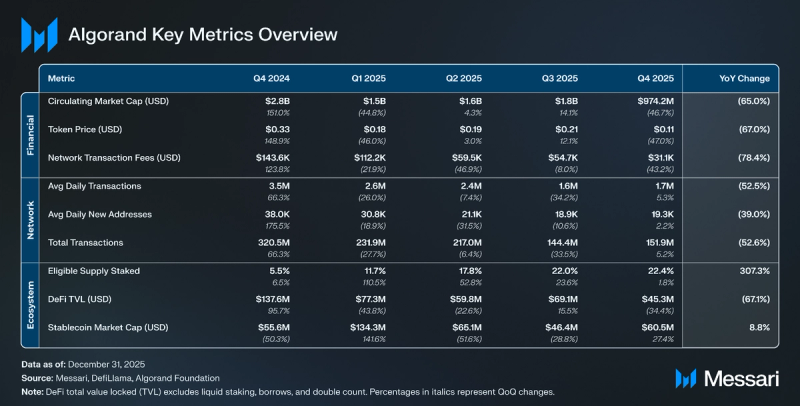
Key Insights
- Whole stablecoin market cap on Algorand grew 27.4% QoQ from $47.5 million to $60.5 million, pushed by a 28.9% ($13.1 million) QoQ improve in USDC after crypto funds supplier Coinify’s integration with Algorand.
- Algorand’s circulating market cap decreased 46.7% QoQ from $1.8 billion to $974.2 million.
- Whole staked ALGO grew 2.5% QoQ from 1.9 billion at Q3-end to 2.0 billion at This fall-end, whereas group staked ALGO grew 3.1% QoQ from 1.54 billion to 1.59 billion.
- Whole each day transactions grew 5.2% QoQ from 1.6 million in Q3 to 1.7 million in This fall, nonetheless whole charges declined 48.2% QoQ from $54,700 to $31,300.
- In This fall, 9 infrastructure initiatives obtained funding by means of the Algorand Basis’s xGov mainnet, a governance device for submitting and voting on grant proposals.
Primer
Algorand (ALGO) is a Layer 1 blockchain that makes use of the Pure Proof-of-Stake (PPoS) consensus mechanism, a course of wherein validators are randomly chosen utilizing a Verifiable Random Operate (VRF), with every validator’s likelihood of choice proportional to their staked ALGO steadiness.
In January 2025, Algorand upgraded to v4.0, which permits wallets staking a minimum of 30,000 ALGO to earn block rewards by operating a node or wallets staking a minimum of 10 ALGO to delegate their stake to a third-party node operator. Block rewards embody 50% of transaction charges and 10 ALGO per block, decaying at a charge of 1% each million blocks till an estimated date of January 2027. Algorand distributes rewards with out lockups, unbonding, or slashing. As an alternative, the protocol removes offline or malicious nodes from future validator choice.
Algorand’s good contracts run on the Algorand Digital Machine (AVM). Algorand Applied sciences develops the community, whereas the Algorand Basis manages governance, treasury administration, and ecosystem funding. Turing award winner Silvio Micali, who co-invented zero-knowledge proofs and VRFs, based Algorand in 2017.
Web site / X / Discord
Key Metrics
Efficiency Evaluation
Market Cap
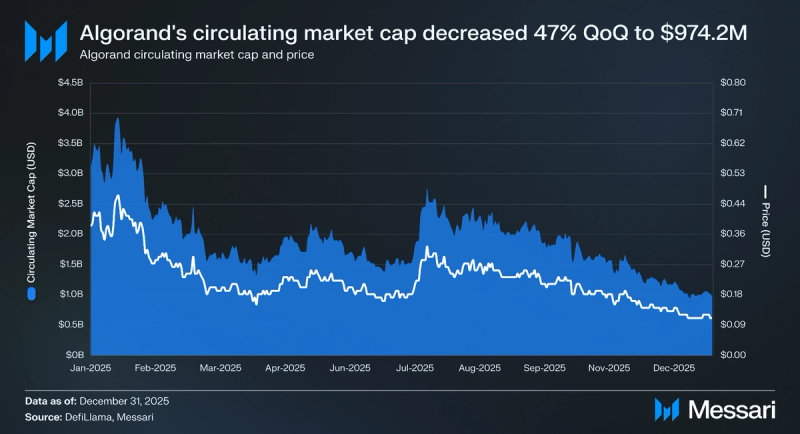
Algorand’s circulating market cap decreased 46.7% QoQ from $1.8 billion to $974.2 million, whereas ALGO’s value fell 47.0% QoQ from $0.21 to $0.11. Circulating provide elevated 0.6% QoQ from 8.81 billion to eight.84 billion ALGO, which drove the divergence between value and market cap. Crypto’s whole market cap fell 23.6% QoQ from $3.99 trillion to $3.05 trillion over the quarter.
On July 14, FedWire, the Federal Reserve’s settlement system for high-value transfers, started supporting ISO 20022, a world monetary messaging normal designed to streamline cross-border funds. On July 17, ALGO’s circulating market cap surged to a Q3 peak of $2.8 billion, probably fueled by the announcement, as articles usually cite Algorand as a possible candidate for future ISO 20022 compatibility.
In This fall, Algorand didn’t expertise a comparable occasion or announcement that drove demand for ALGO.
Community Transactions
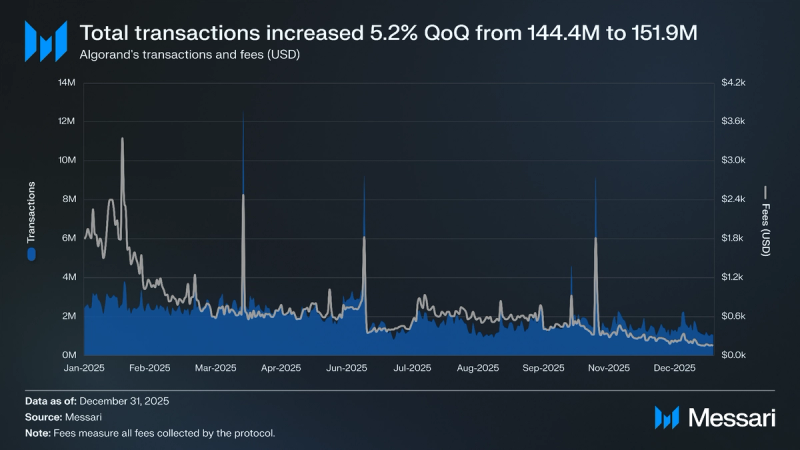
In This fall, common each day transactions elevated 5.2% QoQ from 1.6 million in Q3 to 1.7 million, whereas whole transactions grew 5.2% QoQ from 144.4 million in Q3 to 151.9 million. Over the identical timeframe, common each day charges declined 42.8% QoQ from $595 to $340, whereas whole charges fell 42.8% from $54,700 to $31,300.
In This fall, the each day transaction depend ranged from a excessive of 9.2 million to a low of 1.0 million, whereas each day charges ranged from a excessive of $1,809 to a low of $149. The each day charge excessive occurred on Oct. 24, pushed by a brand new characteristic on Lofty, which had points matching new restrict orders with market orders.
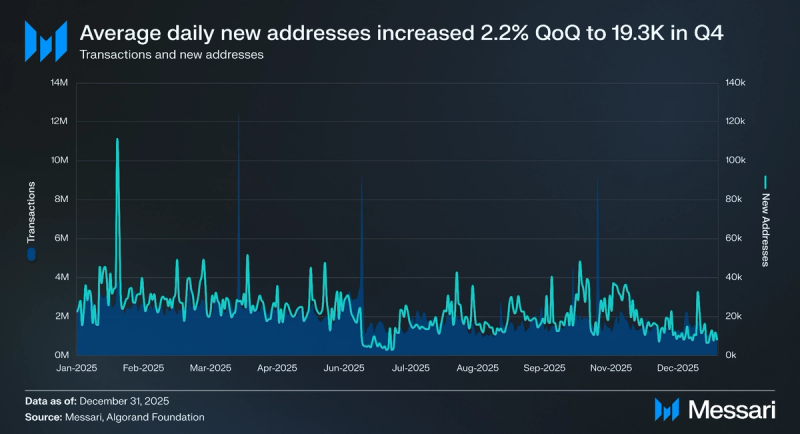
In This fall, common each day new addresses grew 2.2% QoQ from 18,900 to 19,300, and whole new addresses by the identical share QoQ from 1.7 million to 1.8 million. Day by day new deal with creation ranged from a excessive of 48,300 to a low of 6,500, reflecting greater person acquisition and deal with progress.
Staked ALGO
In January 2025, Algorand upgraded to v4.0, which enabled wallets staking a minimum of 30,000 ALGO to earn block rewards by operating a node or wallets staking a minimum of 10 ALGO to delegate their stake to a third-party node operator, similar to Valar. Block proposers earn 50% of transaction charges from the blocks they create, plus a bonus reward funded by the Algorand Basis. The bonus began at 10 ALGO per block and decays 1% each million blocks, with funding scheduled to say no towards fee-only issuance by January 2027. Algorand distributes rewards with out lockups, unbonding, or slashing. As an alternative, the protocol removes offline or malicious nodes from future validator choice and requires them to pay a small charge to rejoin.
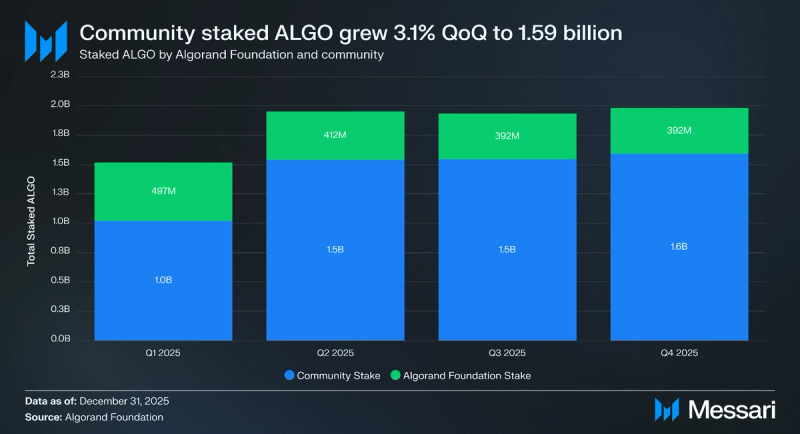
Whole staked ALGO grew 2.5% QoQ from 1.9 billion at Q3-end to 2.0 billion at This fall-end, whereas group staked ALGO grew 3.1% QoQ from 1.5 billion to 1.6 billion over the identical interval. Algorand Basis staked ALGO remained unchanged at 392.4 million.
As of Dec. 31, community-staked ALGO elevated 245.0% YoY to 1.6 billion from 460.7 million. The rise adopted the introduction of delegated staking and block proposer rewards, which lowered operational necessities for participation.
Stablecoins
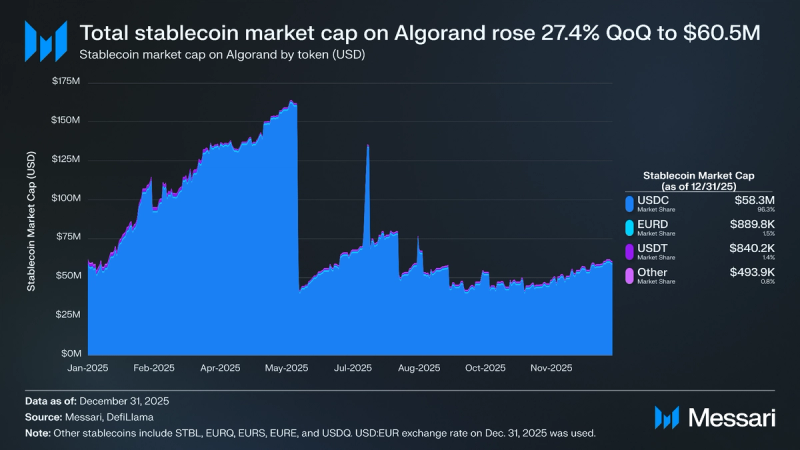
The entire stablecoin market cap on Algorand grew 27.4% QoQ from $47.5 million to $60.5 million. USDC accounted for almost the whole improve, rising 28.9% QoQ from $45.2 million to $58.3 million. Conversely, EURD decreased 6.6% from $952,400 to $889,200. USDT remained unchanged at $841,400, whereas different stablecoins, comprising STBL, EURQ, EURS, EURE, and USDQ, elevated barely from $488,500 to $493,900. On the finish of This fall, USDC made up 96.3% of Algorand’s stablecoin market cap, with others collectively accounting for 3.7%.
The vast majority of the USDC market cap improve occurred after Nov. 20, following crypto funds supplier Coinify’s integration with Algorand. Algorand built-in Coinify’s cost gateway to assist USDC funds and settlement. After the mixing went reside, prospects utilizing functions built-in with Coinify may choose “USDC on Algorand” as a cost methodology at checkout, whereas retailers may obtain settlement in USDC on Algorand when prospects paid with one in every of 30 Coinify-supported tokens.
On July 11, 2024, Tether introduced it might wind down assist for USDT on Algorand by ending redemptions and freezing tokens beginning Sept. 1. On Aug. 29, Tether reversed course on the freeze however confirmed that it might nonetheless cease issuing and redeeming USDT on Algorand from Sept. 1 onward. Sensible contracts utilizing USDT on Algorand stay energetic, and customers can proceed transferring tokens between wallets, although Tether not helps the asset.
DeFi
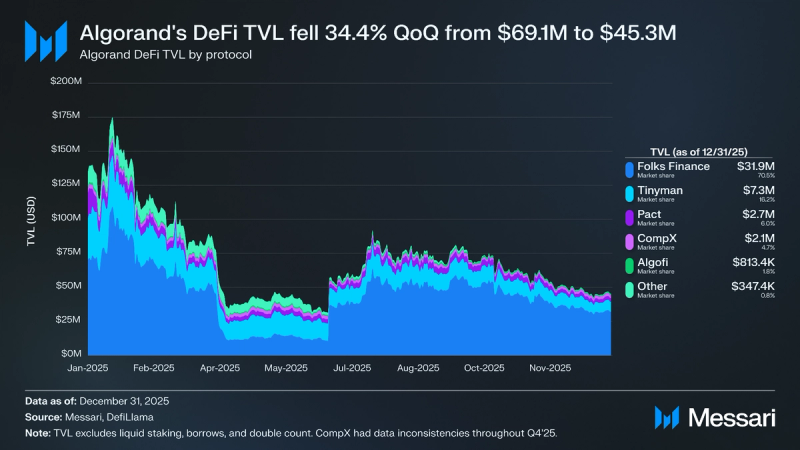
Algorand’s DeFi TVL fell 34.4% QoQ from $69.1 million to $45.3 million. Of us Finance, a lending protocol, decreased 36.6% QoQ from $50.2 million to $31.9 million and had a 70.5% market share of DeFi TVL at This fall-end. Tinyman, an AMM DEX, fell 38.2% QoQ from $11.9 million to $7.3 million but remained the most important DEX on Algorand by TVL. Pact was the second-largest DEX, and decreased 34.8% QoQ from $4.2 million to $2.7 million.
Qualitative Evaluation
xGov (Ecosystem Infrastructure Venture Funding)
On Dec. 16, the Basis launched xGov v2.0.0, which up to date proposal voting durations to 2 weeks and set minimal voter participation necessities between 40% and 70% of eligible voters primarily based on the requested grant quantity. As of Dec. 31, there have been 224 eligible xGov voters.
As of Dec. 31, 9 proposals had obtained retroactive funding, 4 had been in progress, and 6 had been rejected, whereas the xGov treasury held 2.6 million ALGO (0.026% of the full token provide). Funk’s Final Node Controller (FUNC), a node-runner platform, and Of us’ good contract library every obtained the most important permitted grant at 200,000 ALGO. Use-Pockets, an open-source pockets integration library, obtained the third-largest grant at 175,000 ALGO.
On July 29, the Algorand Basis launched the xGov mainnet, a governance device that enables group members to suggest and vote on funding for open-source infrastructure initiatives within the Algorand ecosystem. Proposers should full KYC, create a profile on xGov, and pay a one-time account creation charge of 100 ALGO to be eligible. Proposers can request grants starting from 5,000 to 400,000 ALGO for growing or sustaining SDKs, wallets, explorers, or telemetry instruments. Proposers additionally pay 3% of the requested grant quantity as ‘anti-spam’ collateral, which is refunded after voting until the proposal violates program phrases and situations, wherein case the xGov Council can slash it. Draft proposals are revealed to the Algorand Discussion board for dialogue earlier than being voted on by xGov voters.
Voters should pay a one-time enrollment charge of 100 ALGO, and are awarded voting energy proportionally primarily based on the quantity of blocks produced on the Algorand community in the newest 3 million-block commentary window, up to date at each millionth block. For instance, if a proposer submits their proposal between blocks 55 million and 56 million, the voters can be counted within the commentary window that features blocks 52 million by means of 55 million.
Venture King Security
On July 31, the Algorand Basis launched an up to date roadmap protecting the community’s financial sustainability, decentralization, and governance. The Basis launched Venture King Security to handle financial sustainability, a analysis initiative designed to switch Algorand’s present validator reward construction, which depends on declining Basis-subsidized rewards and transaction charge income. As of Dec. 31, validators earned 9.03 ALGO per block, of which transaction charges contributed 0.05 ALGO, and the rest got here from Basis-subsidized block rewards. The Basis-subsidized portion declines by 1% each million blocks. Beneath the present reward schedule, validator rewards will proceed converging towards fee-only issuance per block by January 2027, a stage that doesn’t present enough financial assist for long-term validator participation.
The Basis outlined three potential choices to regulate validator incentives, together with fee-based rewards, MEV-based extraction, and inflationary incentives. It plans to launch a place paper with additional particulars and goal implementation in 2026. The brand new reward construction would require approval from validators controlling 90% of on-line staked ALGO previous to implementation.
Peer-to-Peer Networking
On Dec. 9, Algorand launched peer-to-peer (P2P) networking on mainnet, introducing a brand new connection mannequin that enables validators to connect with permissionless repeater nodes. Beneath this mannequin, validators take part in consensus and produce blocks, and repeaters propagate blocks, transactions, and participation messages throughout the community.
The replace eliminated Algorand’s architectural dependence on permissioned repeaters, which beforehand served as the first information propagation layer, whereas permitting them to proceed working as non-compulsory infrastructure for efficiency.
At launch, P2P networking required nodes to decide in. By default, new nodes join solely to permissioned repeaters. On the identical time, operators can allow Hybrid mode to connect with each permissioned and permissionless repeaters, or P2P-only mode to attach completely to permissionless repeaters. Earlier than Q3 2026, Algorand plans to make Hybrid mode the default for brand new nodes, formalizing a community design wherein permissioned repeaters assist efficiency with out serving as the only information propagation layer.
Noah Partnership
On Nov. 18, the Algorand Basis partnered with Noah, a monetary providers supplier that operates cross-border cost infrastructure for changing fiat into stablecoins. The partnership gave Algorand builders entry to Noah’s regulated funds stack, together with digital EUR and USD financial institution accounts, to simply accept financial institution transfers and transfer real-world property onchain. Functions constructed on Algorand can route fiat funds from jurisdictions together with the U.S. and Europe into onchain RWA workflows.
Closing Abstract
In This fall, Algorand’s circulating market cap decreased 46.7% QoQ from $1.8 billion to $974.2 million, whereas ALGO’s value fell 47.0% from $0.21 to $0.11. Whole staked ALGO grew 2.5% QoQ from 1.9 billion at Q3-end to 2.0 billion at This fall-end, whereas group staked ALGO elevated 3.1% QoQ from 1.5 billion to 1.6 billion.
In This fall, common each day transactions grew 5.2% QoQ from 1.6 million in Q3 to 1.7 million in This fall, whereas whole charges declined 48.2% QoQ from $54,700 to $31,300. The entire stablecoin market cap on Algorand grew 27.4% QoQ from $47.5 million to $60.5 million. USDC accounted for many of the improve following Coinify’s integration of USDC funds and settlement on Algorand on Nov. 20.
In This fall, 9 infrastructure initiatives obtained funding by means of the Algorand Basis’s xGov mainnet, a governance device for submitting and voting on grant proposals. The allocation of treasury capital by means of xGov, alongside elevated validator participation and rising USDC circulation, factors to Algorand shifting towards better self-sustainment in 2026.
