



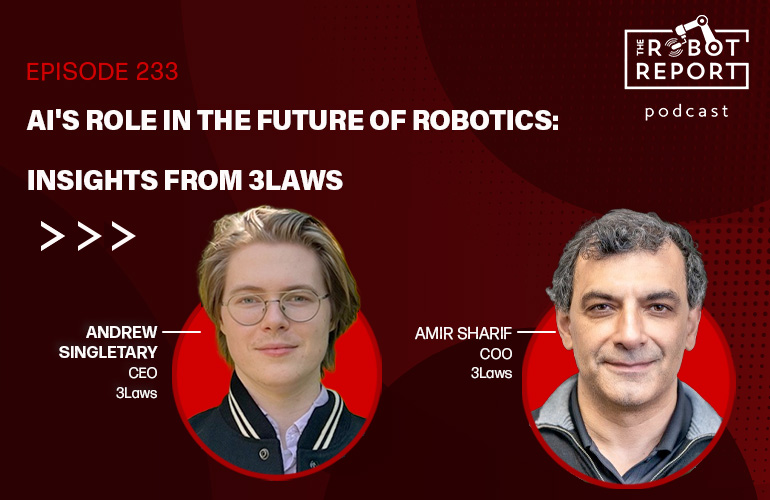
Episode 233 of The Robotic Report Podcast options Andrew Singletary, CEO, and Amir Sharif, chief working officer of 3Laws. They focus on the evolution of the corporate’s clever robotic supervisor know-how from educational analysis to sensible functions, the challenges of startup management, and the significance of integrating security into the design course of.
The dialog highlights the modern approaches 3Laws is taking to democratize autonomy and guarantee security in robotics, emphasizing the necessity for deterministic programs in an more and more AI-driven world. Any roboticist creating a brand new system ought to take into account whether or not the Pasadena, Calif.-based firm can assist tackle safety-critical operations.
Singletary additionally explores the variations between Supervisor Professional and Supervisor for ROS, and the way these merchandise cater to completely different market wants. He and Sharif clarify the importance of customization, certification, and making secure robotics extra accessible to smaller corporations.
Andrew Singletary, CEO (l), and Amir Sharif, COO (r) of 3Laws. | Credit score: 3Laws
The dialogue additionally talked about these prior podcast episodes:
Present timeline
- 8:07 – Information of the week
- 24:45 – Andrew Singletary and Amir Sharif, co-founders of 3Laws
Information of the week
Intrinsic is becoming a member of Google to advance bodily AI in robotics
Simply 5 years after spinning out from Alphabet Inc.’s “moonshot factory,” Intrinsic Innovation is becoming a member of Google. The bodily AI startup stated that being a part of Google will enable it to amplify its work throughout frontier AI, from R&D by deployment and day by day operations, enabling industrial use instances in manufacturing and logistics.
The businesses didn’t disclose monetary particulars of the transaction. As a definite group inside Google, the corporate will proceed evolving the Intrinsic platform, utilizing the capabilities of Google Gemini fashions and Google Cloud, in addition to working intently with Google DeepMind.
Wendy Tan White, the present CEO of Intrinsic, will stay in her place. The remainder of the unit’s reporting and management group stays the identical, an Intrinsic spokesperson advised The Robotic Report.
DoW shoots down Border Patrol drone working in navy area
The Division of Conflict (DoW) mistakenly shot down a U.S. Customs and Border Safety (CBP) drone within the Fort Hancock airspace about 50 miles southeast of El Paso, Texas. The engagement occurred inside navy airspace removed from populated areas. The FAA confirmed there was no impression on industrial flights or civilian security.
Some experiences characterised the incident as a major escalation of the coordination failures reported earlier this month. Whereas the earlier airspace shutdown was an administrative and public relations catastrophe, this newest occasion represents a direct “friendly fire” engagement between two federal companies.
The roles have shifted. On this case, the DoW acted because the aggressor, utilizing its counter-unmanned plane system (C-UAS) authorities to neutralize the CBP’s drone. This implies a “double-sided” coordination hole the place neither company appears to know what the opposite is flying or firing.
Learn extra: pic.twitter.com/RV6rumMFmt
— ABC Information (@ABC) February 27, 2026
Wayve raises $1.2B with plans to deliver robotaxis to London
Wayve Applied sciences closed a Collection D spherical of $1.2 billion, bringing its post-money valuation to $8.6 billion. The London-based firm stated it plans to make use of the funding to speed up commercialization of its “end-to-end AI platform” for autonomous driving.
Based in 2017, Wayve stated its AI Driver doesn’t depend on map-based programs and runs fully on onboard car compute. The corporate stated its unified AI platform spans SAE Stage 2 “hands-off” operations by Stage 4 “eyes-off” driving throughout autos, manufacturers, and markets.
Up to now 12 months, Wayve claimed that it was “the first and only AV developer to drive zero-shot in more than 500 cities across Europe, North America, and Japan, meaning without city-specific fine-tuning before deployment.”
VDMA warns Germany is dropping floor in international robotics race
Germany’s robotics and automation trade is making ready for an additional powerful 12 months. The VDMA Robotics + Automation Affiliation, a German commerce group, expects income to fall 5% in 2026 to about €14.1 billion ($16.6 billion U.S.). That follows a 7% decline in 2025, marking the second straight 12 months of contraction for one of many world’s main robotics clusters.
Business leaders stated the issues transcend a standard financial slowdown. Weak demand from key prospects has harm orders. On the similar time, geopolitical tensions and broader financial uncertainty have made corporations extra cautious about investing in new automation gear.
In line with the affiliation, Germany’s robotics trade can also be dropping floor internationally. Opponents, significantly in Asia, are increasing sooner and gaining market share. The VDMA has warned that top prices, regulatory burdens, and gradual decision-making in Europe are making it tougher for native corporations to compete.

