



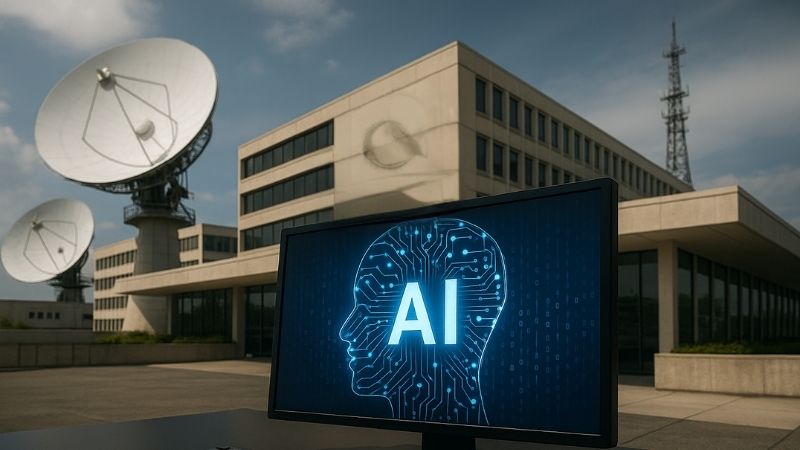
The usage and popularity of artificial intelligence (AI) has surged within the past couple of years, seamlessly integrating itself across numerous industries. The greatest feat that artificial intelligence provides to organizations is its seemingly limitless capability to process and analyze substantial amounts of information at an unprecedented amount of speed, efficiency, and accuracy. AI initiatives significantly reduce the time and cost of labor, while maintaining quality that surpasses previous industry standards. (Syracuse University, 2025) With AI becoming an integral part of society and business practices, its integration at the federal level and other intelligence fields was inevitable. Between 2023 and 2024, alone, the U.S. Government Accountability Office reported a “ninefold” increase in federal use of generative AI. This technology was used in various government sectors to support operations in international relations, all the way to law enforcement. (GAO, 2025) This swift integration shows that AI is not only here to stay, but it will be a key player in shaping our future within national intelligence. To provide a comprehensive understanding, this article will investigate traditional intelligence analysis methods and explore how integrating AI can streamline this process. It will also analyze how large organizations’ use of AI benefits the U.S. government, assess the potential risks and limitations of this technology, and consider how AI can innovate our future within national security.
Traditional methods of intelligence analysis without the implementation of machine learning and AI are heavily reliant on “all-source intelligence.” All-source intelligence is the combination of many disciplines within intelligence, such as Human Intelligence (HUMINT), Signals Intelligence (SIGINT), Imagery Intelligence (IMINT), Open-Source Intelligence (OSINT), and Measurement and Signature Intelligence (MASINT), to form a thorough perspective and increase the precision in decision-making. Analysts would need to link this data together and map possible correlations to construct a “picture” and experiment with multiple hypotheses. While this can be an effective means of analysis, human error could always play a role in affecting the accuracy of an investigation. Things to consider could be an information overload, where analysts spend a substantial amount on an assessment, which could alter its outcome in a fast-changing scenario. Our cognitive ability could also pose a possible hindrance, as many assessments factor in countless variables that only so many analysts can efficiently investigate. For example, an analyst reviewing large heaps of data in a case study could overlook subtle patterns or correlations that AI wouldn’t. AI-enabled software could efficiently perform every step of the intelligence cycle, even with large amounts of data. As reported by the National Security Commission on Artificial Intelligence, “AI algorithms can sift through vast amounts of data to find patterns, detect threats, identify correlations, and make predictions.” (NSCAI, 2021) Implementing AI within these assessments will allow analysts to investigate larger quantities of data and come to increasingly accurate solutions.
Aside from the prevalent technological advantages that come with AI, the use of the latest artificial intelligence models is particularly appealing to the United States. One of the most practical examples of this appeal involves a software company called Palantir Technologies. It was founded in 2003 and has multiple founders, with the most prominent members being Alex Karp, CEO and co-founder of Palantir, and Peter Thiel, co-founder of both PayPal and Palantir. Together, they operate a company valued at over $400 billion that recognizes and leverages the power of AI routinely, training models to analyze real-time data at a significant scale, and uses predictive analytics that’s capable of forecasting market demand all the way to anticipating terrorist threats. (Rumage, 2025) Most recently, Palantir landed a contract where the United States government purchased its ImmigrationOS platform that “will pull together vast amounts of data, detect patterns, and flag individuals who meet certain criteria, raising concerns about potential impacts on civil liberties in America,” in a $30 million deal. (Hubbard, 2025) This contract lasts until 2027 and is a prime example of our current presidential administration’s desire for AI technology to aid in operations at the federal level.
Although AI looks to have a promising future within the world of national intelligence, there are, of course, risks and limitations that are essential to address. One of the most important issues involves a question of ethics and civil liberties. There is an argument that AI, with its capabilities for facial recognition and surveilling billions of available data points on the internet, can pose a serious privacy breach. Although leveraging the use of AI in surveillance medians can provide accurate assessments in vital areas such as threat detection, this leaves open the possibility of individuals constantly being under watch in an unjustifiable fashion. (Sorkhou, 2025) Another concern involves the fact that a bias could be implemented while training an AI model, which will affect its function. For example, in 2016, an investigation was conducted on COMPAS, an AI risk-assessment tool that incorrectly ranked Black American defendants at a higher risk of being repeat offenders in disproportionate numbers compared to their White American counterparts. This investigation found that “they were design decisions,” meaning that these biases were absolutely intentional, and corrupted the accuracy of the risk-assessment tool. This shows that if AI sources data that is biased, a similarly biased result could be expected.
As artificial intelligence continues to improve, its role within national security and intelligence will become increasingly more significant. As advancements are made in data analysis and decision making, its interpretation of data will largely improve. This will inevitably capture the attention of prominent figures, from venture capitalists, all the way to ambitious politicians who want to share these innovations with the United States. Although the future largely looks bright with this technology, there are certainly risks that can be taken into account, which can be used as examples to maintain and uphold ethical transparency, as well as prevent misuse from hindering innovation. In ensuring this standard, AI will strengthen national defence, improve and deepen insight for the most accurate decision-making in intelligence analysis, and create systems that can positively impact and shape our world forever.
References
Hubbard, S. (2025, August 22). Ice to use Immigrationos by Palantir, a new AI system, to track immigrants’ movements. American Immigration Council. https://www.americanimmigrationcouncil.org/blog/ice-immigrationos-palantir-ai-track-i mmigrants/
NSCAI. (2021). Chapter 5 – NSCAI Final Report. https://reports.nscai.gov/final-report/chapter-5 Office, U. S. G. A. (2025, July 29). Artificial Intelligence: Generative AI use and management at federal agencies. Artificial Intelligence: Generative AI Use and Management at Federal Agencies | U.S. GAO. https://www.gao.gov/products/gao-25-107653
Rumage, J. (2025, August 7). What is Palantir? the company behind government AI Tools. Built In. https://builtin.com/articles/what-is-palantir
Syracuse University School of Information Studies. (2025, June 11). Key benefits of AI in 2025: How ai transforms industries. iSchool. https://ischool.syracuse.edu/benefits-of-ai/
Sorkhou M. (2025). Surveillance and Artificial Intelligence (AI). The Decision Lab., from https://thedecisionlab.com/reference-guide/computer-science/surveillance-and-artificial-i ntelligence-ai
