



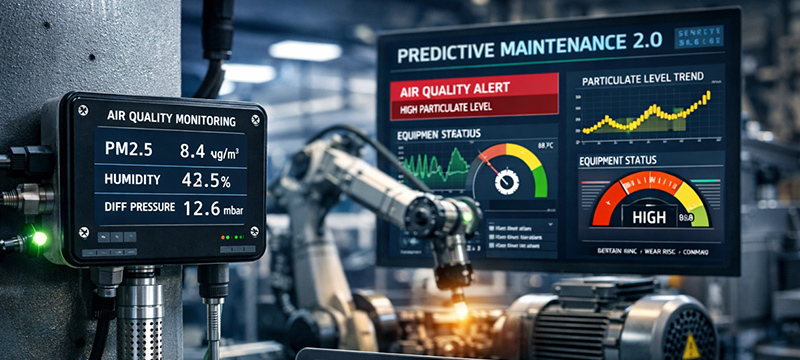
From Predictive Upkeep to Root Trigger Intelligence
For the final 5 years, the commercial sector has been obsessive about “listening” to machines. We’ve got plastered billions of {dollars} value of vibration sensors and thermal cameras onto motors, gearboxes and pumps. The promise of the Industrial Web of Issues (IIoT) was easy: If it vibrates, we will repair it earlier than it breaks. However in 2026, we’re realizing that this method has a elementary flaw. By the point a bearing begins to vibrate or a gearbox begins to overheat, the harm is already finished. You aren’t stopping gear failure; you’re merely managing the aftermath.
The subsequent era of predictive upkeep (PdM 2.0) isn’t about detecting the signs of damage. It’s about detecting the causes of damage. And most of the time, the foundation trigger is environmental. It’s the invisible grit, the microscopic mud and the consumption high quality that dictates the lifespan of an asset lengthy earlier than the primary vibration alarm triggers.
The Blind Spot within the Digital Twin
The present iteration of the “Digital Twin” is incomplete. We’ve got modeled the kinematics of the machine completely, however we now have largely ignored the air it intakes.
It is a essential oversight. Industrial equipment, from gasoline generators to precision CNC items, is extremely delicate to particulate contamination. A 5-micron particle coming into a high-speed bearing is the catalyst that finally causes the vibration three months later. In case your IoT ecosystem displays solely vibration, you miss the chance for early intervention throughout the interval earlier than signs seem.
To shut this hole, ahead considering facility managers are actually integrating sensible air administration techniques into their IIoT stacks. By monitoring the differential strain and particulate load on the consumption degree, they will correlate air high quality instantly with asset efficiency. This shift permits leaders to maximise machine availability not simply by fixing damaged elements, however by guaranteeing the working atmosphere by no means permits the degradation to start. This method shifts upkeep technique from predictive (anticipating imminent failures) to proactive (stopping deterioration earlier than it begins).
Information-Pushed “Hygiene”
The mixing of filtration information into the ERP (Enterprise Useful resource Planning) system allows more practical scheduling of downtime.
Traditionally, filter adjustments had been analog occasions, which means you modified them each three months or when a crimson mild flashed on the bodily unit. In observe, that is inefficient. In a digital manufacturing unit, the filtration system must be a networked node.
Think about this: your consumption sensors detect a spike in ambient particulate matter. Why? Maybe as a consequence of a building challenge subsequent door or a change within the manufacturing line combine. A wise system doesn’t simply “soak up” this. As an alternative, it communicates this data. It indicators the Constructing Administration System (BMS) to extend constructive strain within the clear room, or it alerts the upkeep scheduler that the filter life has dropped by 20% in a single shift.
That is the place return on funding (ROI) is realized. It eliminates the “calendar-based” upkeep that wastes cash on good filters, and eliminates the “failure-based” upkeep that prices cash in downtime. It successfully allows a just-in-time upkeep schedule for the gear’s air consumption techniques.
The Value of Micro-Downtime
We are likely to concentrate on catastrophic failures. The road stops that make the quarterly report. However a major, usually ignored think about productiveness loss is ‘micro-downtime’. These are the 2-minute stops, the sensor resets and the thermal throttles that occur when electronics get soiled or intakes get clogged.
Extra warmth impairs electronics, and dirt accumulation will increase thermal insulation, exacerbating overheating. In server rooms and management cupboards, a layer of mud on a warmth sink adjustments the thermal conductivity, inflicting processors to throttle down. An AI-driven robotic arm will not be malfunctioning, however it may function much less effectively as a consequence of controller overheating.
Connecting environmental controls to the IoT community makes this seen. You’ll be able to overlay “Cupboard Temperature” with “Consumption Particulate Load” in your dashboard. Instantly, the correlation turns into apparent. Productiveness losses will not be as a consequence of software program points, however moderately to insufficient {hardware} upkeep and environmental situations.
The ESG Connection: Vitality is Information
There’s a sustainability angle right here that usually will get ignored within the tech dialogue. A clogged machine operates much less effectively.
When an air consumption is restricted, the fan motor has to work more durable to drag the identical quantity of air. This will increase the amp draw. In a facility with a whole bunch of air handlers and motors, this extra vitality demand can contribute considerably to general vitality prices.
Good sensors flip this into actionable information. By monitoring the airflow resistance in real-time, the system can calculate the precise vitality value of a grimy filter vs. the price of a substitute. It could actually calculate the optimum time to switch consumables so as to reduce carbon footprint.
In accordance with a report by Deloitte on the way forward for sensible manufacturing, organizations that combine sustainability metrics instantly into their operational dashboards are seeing a marked enhance in operational effectivity. Sustainability efforts now focus not solely on environmental affect but additionally on decreasing mechanical inefficiency, which is mirrored in pointless vitality consumption.
The Self-Therapeutic Ecosystem of the Future
We’re shifting towards a future the place the manufacturing unit might be autonomous not simply in manufacturing, however in self-preservation.
Within the subsequent few years, we’ll see “Self-Therapeutic” environmental controls. If an IoT sensor on a laser cutter detects an increase in smoke or particulates, it gained’t simply log an error. It’ll talk with the HVAC system to isolate that zone and ramp up extraction, defending the neighboring machines.
Vibration sensors will proceed to play an necessary function as a last safeguard in opposition to gear failure. Nevertheless, the first focus of worth is shifting earlier within the course of – towards monitoring the standard of inputs similar to air, energy and coolant. By controlling these inputs by way of real-time information, services can considerably enhance gear reliability and uptime.
So, in case your dashboard solely reviews gear failures, it’s outdated. Dashboards that determine the foundation causes of contamination characterize the way forward for predictive upkeep.
