



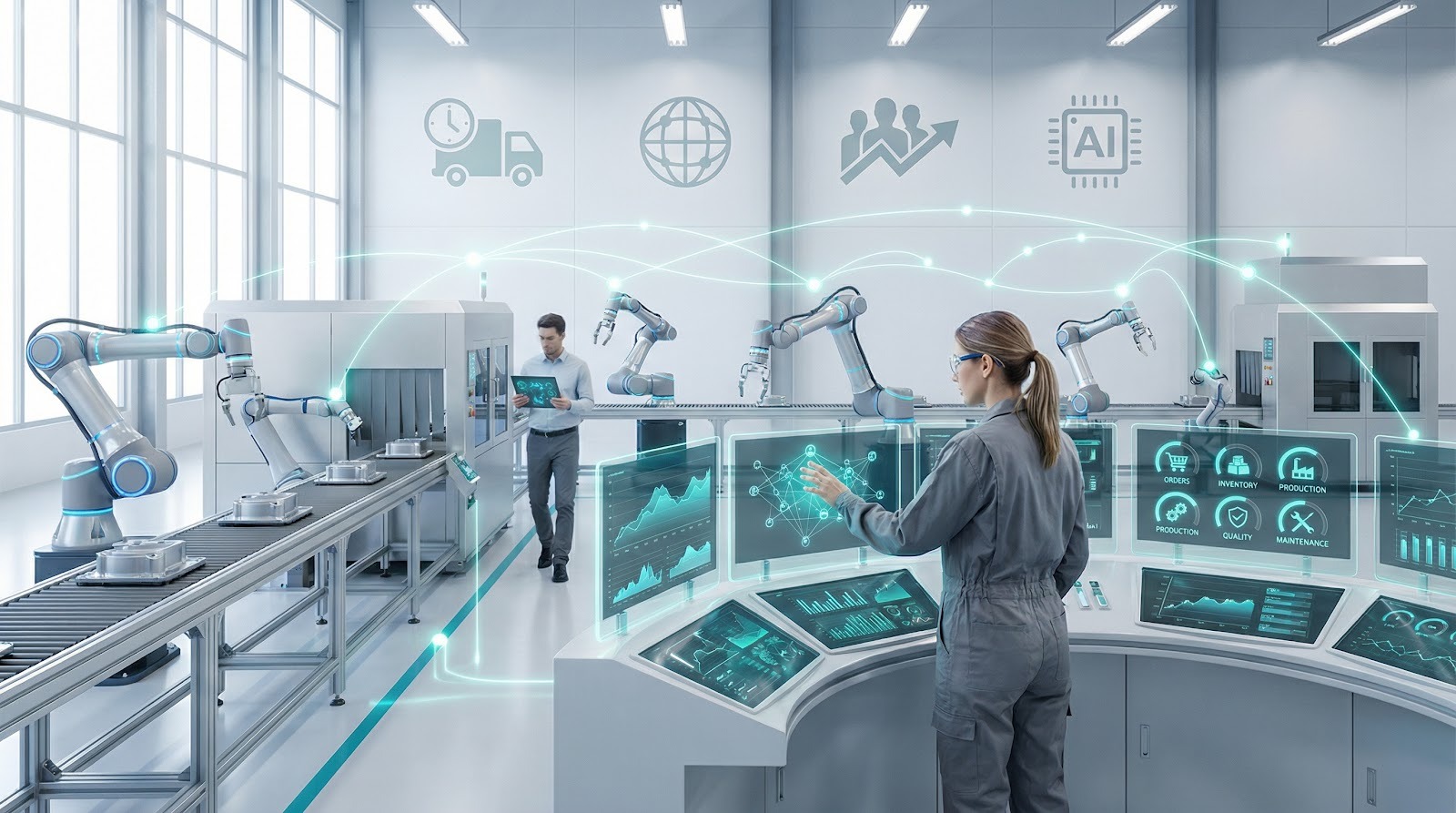
Transformation is more than another manufacturing buzzword. Today, 98 percent of manufacturers have a digital initiative in flight—up from 78 percent in 2019—and they’re channeling roughly 30 percent of their 2024 operating budgets into smart operations. If you run a plant, division, or enterprise network, you need to grasp what that shift really means—beyond installing new machines—so you can turn data, automation, and connected workflows into day-to-day results.
Key drivers behind the push to transform
A connected, data-driven factory floor is the foundation of modern manufacturing transformation.
According to AlixPartners, customers now expect delivery in roughly 3.5 days, a full two days faster than a decade ago. Gartner finds that supply-chain volatility is reshaping factory footprints: 73 percent of companies have added or removed production sites in the past two years to stay resilient. Deloitte estimates that the talent pool is shrinking, and the United States may face 1.9 million open manufacturing roles by 2033 unless plants invest in upskilling. Competitive intensity completes the picture: Rockwell Automation reports that 81 percent of manufacturers say rising pressures are accelerating digital programs, and 95 percent already fund AI-enabled smart-manufacturing technology.
Ignore any one of these forces and you’ll hand speed, flexibility, and profit to peers that turn insight into action first.
The core pillars of manufacturing transformation

The four core pillars—connected operations, analytics habits, flexible automation, and people-centered change—form a practical blueprint for manufacturing transformation.
Research shows four capabilities separate top-quartile plants from the rest: connected operations, data-driven decision-making, flexible automation, and people-centered change. In Deloitte’s 2025 Smart Manufacturing Survey, firms strong in all four were twice as likely to expand margins and 1.7 times more likely to cut lead time by at least 10 percent. Those same levers anchor MCA Connect’s Connected Blueprint™ manufacturing transformation program, which maps a phased 4–6-week roadmap that links supply-chain data, low-code automation, and frontline upskilling to deliver measurable P&L gains.
1. Connected operations
Connected operations combine orders, inventory, production, quality, and maintenance data in a single time-stamped view, so every layer of the plant sees the same facts. After an automotive-parts maker streamed these data sets in real time, Automation.com reported a 30 percent drop in unplanned downtime and a 15 percent boost in asset life within one year. With that shared lens, teams surface bottlenecks, weigh trade-offs, and coordinate fixes in minutes.
2. Data and analytics as a habit
Collecting data is easy; turning it into daily decisions is rare. McKinsey found that 86 percent of executives call their analytics programs only “somewhat effective,” yet plants that embed analytics on the line capture a 4–10 percent EBITDA lift within 12 months.
- Publish a short list of standard KPIs everyone reviews during the morning huddle.
- Show dashboards on operator stations and supervisor phones, so deviations trigger action right away.
- Pair sensor data with AI models, then feed outcomes back into the model to sharpen the next shift.
Once teams experience that closed loop, they start asking sharper questions and demanding richer data, turning analytics from an IT project into a muscle.
3. Flexible, automated processes
Smart factories use automation to multiply, not replace, human ingenuity. McKinsey benchmarks show that well-designed flexible automation can raise throughput by 20–30 percent and cut unit cost by about 20 percent within 18 months. Adaptability is the common thread:
- Process robots and cobots pick, place, and inspect parts while operators handle problem-solving and changeovers.
- Low-code workflow engines connect engineering, quality, and maintenance steps, so a change in one stage updates the rest of the line automatically.
Because these tools reconfigure quickly for new SKUs or volumes, teams spend less time on manual tweaks and more time on improvement, which keeps the system sturdy when demand or supply swings.
4. People-centered change
Talent, not technology, is now the biggest swing factor. Deloitte reports that 65 percent of U.S. manufacturers rank hiring and retention as their top challenge, and up to 1.9 million roles could sit unfilled by 2033 if nothing changes. A World Economic Forum study echoes the gap: more than half of industry leaders cite skills shortages as the main barrier to transformation.
- Explain the “why” early and often. Tie every new dashboard, robot, or workflow to a clear benefit for the team’s safety, pay, or growth.
- Invest in frontline capability. Ten-minute micro-lessons before each shift can double skill retention compared with yearly workshops.
When people see how new tools make their shifts safer and their decisions smarter, resistance fades and improvement accelerates.
Common missteps to avoid
McKinsey reports that about 70 percent of large-scale transformations miss their targets, and four mistakes show up again and again.
- Framing it as an IT rollout, not a business shift. Technology alone rarely moves the profit needle. Value appears only when process owners and P&L leaders steer the roadmap.
- Trying to “boil the ocean.” Firms that launch more than five major initiatives at once succeed only 25 percent of the time, compared with 45 percent when they tackle work in waves.
- Skipping change management. Prosci’s 2024 benchmark shows projects with structured change programs are six times more likely to meet or beat objectives.
- Flying blind on impact. Without baseline-to-benefit tracking, seven in ten initiatives stall after pilot because no one can prove the payoff.
Spotting these pitfalls early lets you set guardrails such as executive sponsorship, phased funding gates, and disciplined benefit tracking, which push the odds in your favor.
A practical way to begin
Many manufacturers stall in “pilot purgatory.” McKinsey says 70 percent never scale beyond a handful of trials, and only 11 percent reach network-wide adoption of Industry 4.0 use cases. If that sounds familiar, try this five-step loop:

A simple five-step loop helps plants escape pilot purgatory and scale data-driven improvements across sites.
- Pick one painful metric. On-time delivery, scrap rate, or first-pass yield works well. Choose something your plant already tracks in dollars.
- Trace the flow end to end. Follow that metric across planning, production, and shipping to uncover the real constraint.
- Wire up the data. Pull the minimum signals you need—even if a spreadsheet bridges gaps—to create a live baseline.
- Run a two-week experiment. Change one variable (for example, the reorder point or an inspection trigger) and watch the metric respond.
- Lock in the win, then repeat elsewhere. Document the result, automate the data pull, and move to the next line or plant.
Teams that cycle through this loop every month are twice as likely to scale successful use cases across ten or more sites and capture 10–30 percent productivity gains compared with firms still iterating ad hoc.
Conclusion
Manufacturing transformation succeeds when leaders link connected operations, data-driven decisions, flexible automation, and people-centered change. By focusing on measurable value, avoiding common pitfalls, and scaling wins methodically, plants can turn today’s digital investments into sustained competitive advantage.
