



# How Decision AI Is Changing the Way Security Teams Sort Alerts
Artificial intelligence has entered a new chapter — and it’s showing up in the places where security teams feel the weight of every notification. Instead of generating long explanations or paragraphs, a fresh wave of AI tools now answer simple, structured questions: Is this alert dangerous? What’s the likelihood? Should we act on it now?
This shift matters enormously for security operations centers, where analysts face tens or hundreds of thousands of alerts and need fast, reliable answers about what deserves attention.
## What These New AI Models Actually Do
Rather than producing freeform text, these models accept a set of facts about an alert and return a direct judgment. Think of it less like asking a chatbot for advice and more like filling out a form where the AI fills in the verdict. You get a clean output — a score, a probability, or a yes/no classification — backed by a confidence level that’s consistent and repeatable.
For security teams, this is a game changer. Instead of reading through paragraphs of generated reasoning, analysts receive a structured answer they can immediately act on or automate.
## Why Security Teams Are Taking Notice
Three things make this category of AI especially useful for daily alert handling.
**They produce numbers you can trust with thresholds.** If an AI rates an alert as 97% likely to be harmless, you can set an automated rule to close it. Anything below a certain threshold gets escalated to a human. This means routine, clear-cut alerts get handled instantly while genuine threats still reach the right people.
**They’re remarkably affordable.** Running these models against every single alert costs a fraction of what it used to take to triage even the high-priority ones. This removes the old habit of only investigating the most severe alerts out of budget necessity — meaning lower-severity signals that could still be real threats finally get a proper look.
**Every answer creates a traceable record.** Because the output format is fixed and includes a confidence score, every decision can be logged, reviewed later, and compared against what actually happened. This kind of audit trail is far easier to work with than trying to reconstruct logic from a block of natural language.
One important note: these models don’t “hallucinate” in the traditional sense — they always stay within the answer format you defined. But a well-structured answer can still be incorrect if the input facts it received are incomplete or misleading.
## The Input Still Matters More Than the Model
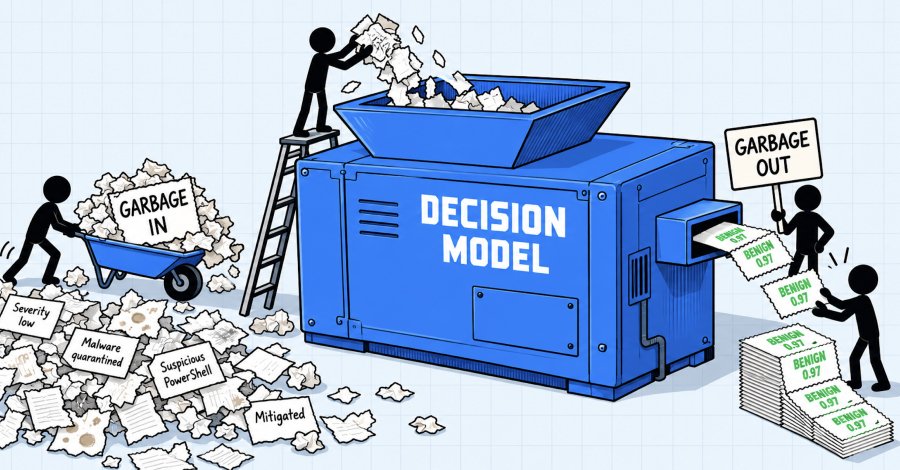
A calibrated AI is only as good as the information it receives. Calibration means that when the system says it’s 90% confident, it’s right about 90% of the time — but only for cases that look similar to what it was trained on. If the input is just an alert title and a severity tag, the AI knows nothing about what was actually happening on the machine or network.
This gap shows up in real data. Many alerts that look safe on the surface turn out to involve compromised devices that had already been marked as handled by endpoint tools. The alert metadata said one thing, but the actual state of the machine told a different story. Similarly, some genuinely dangerous incidents come from alerts tagged at the lowest severity levels, simply because the attack flew under the radar of typical classification systems.
## What Real Evidence Looks Like in Practice
Think of it like solving a crime. A general description of a scene might lead to a plausible theory. But DNA, fingerprints, and verified witness statements lead to the right conclusion.
In cybersecurity, the equivalent of forensic evidence includes details like the full process tree of what was running, the exact command lines used, whether suspicious code still lives in memory, and what network connections the suspicious file actually made. None of this is exotic — it’s the kind of detail a skilled investigator gathers by hand. The challenge is collecting it automatically and quickly enough to keep pace with the volume of alerts.
Some of the most dangerous threats, like tools designed to operate entirely in memory, leave almost no trace on disk. A file that looks “handled” might still have active malicious code running underneath. This is exactly why surface-level alert data often fails to tell the full story.
## The Hardest Part: Understanding What’s Normal
Even perfect forensic evidence can’t answer one critical question: Is this behavior normal for this particular organization?
A model might see a VPN login from a foreign country and flag it as suspicious. But for a finance team that regularly works across borders, that’s routine. A security tool might mark a routine software deployment as an anomaly. Without understanding the organization’s unique patterns, even the best AI will raise false alarms or miss real ones.
This organizational knowledge is difficult to capture because it changes constantly — new devices, new users, new workflows. It’s also the kind of knowledge that lives in senior analysts’ experience and walks out the door when they leave. The solution is to build a living system that learns from past investigations, pulls in fresh context during each case, and continuously updates its understanding of what “normal” looks like.
## Putting It All Together
The most effective approach to modern alert triage follows a clear sequence: collect detailed evidence first, then apply structured reasoning — whether that reasoning comes from a human analyst or an AI model. Build forensic capabilities into your detection pipeline automatically. Store and refresh organizational context continuously. And always measure your results against reality so you can spot when your system’s confidence levels start drifting.
Decision AI models make the final judgment step faster, cheaper, and more auditable than ever before. But that final step is only as strong as the evidence and context feeding into it.
—
## Frequently Asked Questions
**What exactly is a “decision AI model” in this context?**
A decision AI model is a type of artificial intelligence that takes structured input — such as alert details, severity tags, and evidence — and returns a direct, bounded answer like a classification, score, or probability. Instead of generating free-form text, it stays within a predefined output format.
**Why are these models particularly useful for security operations?**
Security teams deal with enormous alert volumes and need fast, consistent triage decisions. Decision models provide scores and probabilities that can be automated, logged, and audited — turning what was previously a manual, time-intensive process into something scalable.
**Can these AI models make mistakes?**
Yes. While they don’t produce the kind of free-form hallucinations associated with text-generating models, they can still output incorrect answers if the input data is incomplete, misleading, or doesn’t reflect the actual state of the system. The quality of the input directly determines the quality of the output.
**How does organizational context improve AI-driven triage?**
Organizational context answers the question of what’s normal for a specific company. Without it, an AI model might flag routine behavior as suspicious or miss genuine threats that don’t match generic patterns. Building a system that learns and updates this context over time dramatically improves accuracy.
**Is forensic evidence collection expensive to automate?**
Many forensic techniques — like capturing process trees or checking memory — are deterministic and relatively inexpensive compared to running large AI models on every alert. Investing in automated evidence collection can pay for itself quickly, even before adding decision AI to the pipeline.
**What should a security team prioritize if they want to start using decision models today?**
Focus first on gathering rich, automated evidence for each alert. Then continuously refine your understanding of normal behavior for your environment. Finally, measure every automated decision against its real-world outcome to keep your system calibrated and trustworthy.
—
## Conclusion
The arrival of structured decision AI gives security teams a powerful new way to handle the crushing volume of daily alerts. These tools are fast, affordable, and auditable — and they remove the old excuse for ignoring low-severity signals. But the technology is only as effective as the foundation it sits on. Rich evidence, up-to-date organizational context, and a discipline of measuring outcomes against predictions are what turn a useful tool into a reliable system. The teams that invest in these foundations now will be the ones who get the most value from decision AI as it continues to evolve.
Thank you for reading
