



# Barcodes vs. RFID: Picking the Right Identification Tool for Your Warehouse
## Introduction
Every warehouse manager faces the same challenge: how to keep track of inventory, assets, and shipments efficiently without slowing down operations. For decades, barcodes have been the go-to solution. Now, radio-frequency identification (RFID) has emerged as a powerful alternative. But the real question isn’t which technology is better overall—it’s which identification method fits each specific process best.
When barcode scanning and RFID are treated as complementary tools rather than rivals, warehouses can build smarter, more practical paths toward automation. The goal isn’t to replace one technology with another but to use the right tool for the right job.
—
## Why Barcodes Still Work
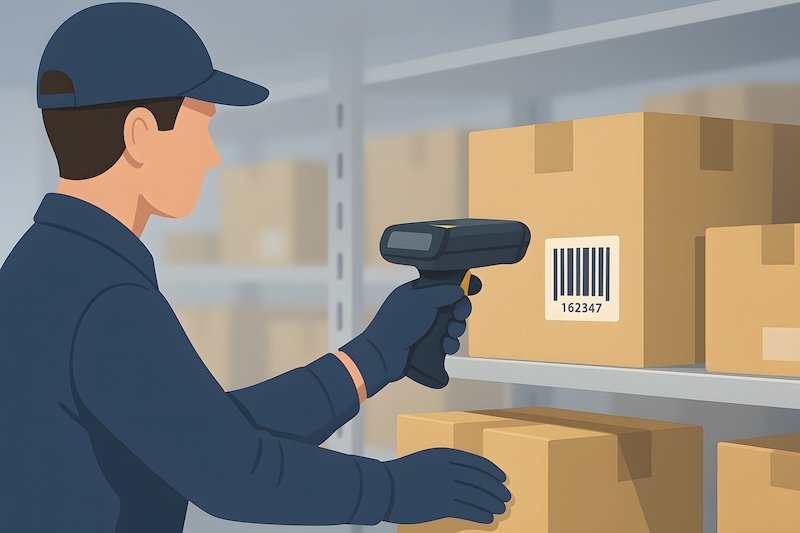
Barcodes remain a reliable backbone in modern logistics. They are affordable, universally standardized, and supported by millions of scanners, printers, and warehouse software systems already in use today. In many situations, the simple act of deliberately scanning a barcode at exactly the right moment provides the confirmation a worker needs—whether that’s confirming a pick, verifying a location, checking a pallet, or handling an exception.
Barcodes also shine in situations where items arrive without any pre-existing identification tags, where tagging every individual item would cost more than it saves, or where the volume of process activity doesn’t justify investing in fixed reading infrastructure. The growing popularity of 2D barcodes adds even more value, since they can hold richer data like lot numbers, serial numbers, expiration dates, and other details—all within the same familiar scanning workflow.
In short, barcodes are an excellent choice when the process calls for one-at-a-time, intentional confirmation with minimal setup.
—
## Where RFID Changes the Game
RFID becomes especially valuable when proving that objects are present starts to slow things down. Consider these common warehouse scenarios:
### Inventory Counting
With barcodes, every single label typically needs to be pointed at and scanned individually. RFID changes this completely. Tagged items can be identified in large groups as they pass through a configured reading zone. This shifts inventory counting from a slow, methodical scan-by-scan task toward a much faster, exception-driven approach—where workers focus on resolving discrepancies rather than scanning every item.
### Receiving and Shipping
RFID portals or controlled read points can automatically verify tagged goods as they move through specific locations. Instead of a worker scanning each unit one by one, the system captures identifiers automatically and checks them against what was expected for that shipment. This dramatically speeds up dock operations and reduces the chance of human error.
### Reusable Assets
Items like totes, containers, hand tools, cages, and returnable transport units gain their value from repeated movement. Keeping track of them with manual scanning at every handoff is tedious and often incomplete. RFID makes these movements far more visible without requiring someone to scan each item every time it changes hands.
—
## Five Questions to Ask Before Investing in RFID
Before committing to readers, antennas, tags, or integration software, warehouse teams should work through these five practical questions:
1. **How many items need identification in this process?** High volumes may justify RFID; low volumes may not.
2. **How much labor is currently spent positioning items and scanning them one by one?** If this takes significant time, RFID could offer real savings.
3. **Does the process need deliberate, one-at-a-time confirmation, or can bulk identification work?** RFID excels at bulk; barcodes excel at precision confirmation.
4. **Is the physical environment suitable for reliable RFID performance?** Materials like liquids and metals, as well as tag placement and reader geometry, all affect how well RFID works.
5. **What measurable outcome would justify the investment?** Think faster inventory counts, fewer shipping errors, better asset visibility, less manual handling, or higher overall throughput.
If these questions don’t reveal a meaningful bottleneck, RFID may sound impressive in theory but might not make strong business sense in practice.
—
## Making the Case for RFID in Real-World Warehouses
In many warehouses across Central and Eastern Europe, the core challenge isn’t whether RFID technology works—it’s whether it can be introduced without disrupting an otherwise well-functioning operation. Existing warehouse management systems, multiple generations of mobile handheld devices, established label formats, supplier practices, and tight budget cycles all play a role in shaping the decision.
That’s why a phased, selective approach tends to work best rather than attempting a complete technology overhaul all at once. A warehouse can start by applying RFID to the process where the financial return is easiest to measure—such as cycle counting, tracking returnable containers, or verifying outbound shipments—while continuing to use barcodes in other areas.
The ultimate goal shouldn’t be maximum RFID coverage everywhere. It should be maximum operational improvement for every unit of complexity added.
—
## Building a Technology-Neutral Data Foundation
Hybrid identification works most smoothly when the underlying business system focuses on the identifier itself, not on how that identifier was captured.
Industry-standard identification frameworks allow the same business identifiers to work across both barcode and RFID systems. At the application level, a warehouse management system should receive the product identity, asset identity, location identity, or serial number it needs—without requiring separate business logic depending on whether that information came from a handheld scan or an RFID read event.
This approach reduces dependency on any single technology and makes gradual modernization far easier. A company can introduce RFID at one loading dock or in one inventory process without having to rewrite all of its existing barcode-driven workflows.
—
## Start With One Clear Bottleneck
The most successful RFID projects typically begin with a narrow, measurable question. For example:
– How long does a complete inventory count currently take?
– How many labor hours go toward scanning returnable assets?
– How often does an outbound pallet end up in the wrong lane?
– How much time is lost searching for tools or containers?
Measure the current process carefully first. Then test whether RFID changes that specific metric enough to justify the cost of tags, readers, system integration, training, and new process controls. A controlled pilot also surfaces real-world technical challenges early—such as how tag placement, product materials, and the physical environment affect reading reliability—so they can be addressed before scaling up.
—
## The Hybrid Warehouse: Where Things Are Headed
The warehouse of the future is unlikely to rely on just one identification technology. It will almost certainly use multiple methods, each chosen to match the demands of a specific process.
Barcodes will continue to be excellent for situations where low cost, visual confirmation, broad interoperability, and deliberate one-at-a-time scanning matter most. RFID will continue to add value where bulk reading, non-line-of-sight capture, automated transitions, and higher process speed change the cost-benefit calculation.
The winning warehouse architecture is never the one with the flashiest technology. It is the one that gives every single process the simplest, most cost-effective identification method capable of meeting its requirements for accuracy, speed, visibility, and cost.
For leaders evaluating RFID, a better starting point is this: don’t ask which technology should replace barcodes. Ask which manual identification step is expensive enough to deserve automation.
—
## Frequently Asked Questions
**Q: Is RFID always more expensive than barcodes?**
A: The initial investment is generally higher for RFID—tags cost more than printed labels, and readers and antennas add infrastructure costs. However, the long-term return can be significant when RFID reduces labor hours, speeds up counting, and cuts error rates in high-volume processes.
**Q: Can barcode and RFID systems run side by side?**
A: Absolutely. Many modern warehouses operate hybrid environments where barcodes handle precise, one-at-a-time confirmation tasks and RFID handles bulk identification and automated capture. With a well-designed data layer, both systems feed into the same warehouse management platform seamlessly.
**Q: Does RFID work on all types of products?**
A: RFID performance can be affected by the physical properties of products. Liquids and metals, in particular, can interfere with radio signals. Tag placement, product packaging, and the warehouse environment all need to be tested during a pilot phase to ensure reliable read rates.
**Q: How long does a typical RFID pilot take?**
A: A focused pilot can often be set up within a few weeks to a couple of months, depending on the complexity of the process being tested and the size of the area involved. The key is to measure results against a clear, pre-defined metric.
**Q: What if my warehouse already uses barcodes effectively?**
A: That’s perfectly fine. Barcodes are not going away. The question is whether any specific process in your warehouse would benefit from the bulk-reading and automation capabilities that RFID offers. Start by identifying one bottleneck and test RFID there.
**Q: Do I need to replace my warehouse management system to use RFID?**
A: Not necessarily. A well-architected system can accept RFID data alongside barcode data without requiring a full system replacement. The goal is for the system to care about the identifier, not the technology used to capture it.
—
## Conclusion
Choosing between barcode scanning and RFID doesn’t have to be an either-or decision. Both technologies have distinct strengths, and the smartest warehouses use each where it fits best. By asking the right questions, starting with a single measurable bottleneck, and building a flexible data foundation, warehouse teams can introduce RFID gradually and justify every step with real operational results.
The practical end state is a hybrid environment where no single technology dominates—just the right tool for each process, delivering the simplest path to accuracy, speed, and visibility.
Thank you for reading
