



# Reimagining Linux for the AI Era: What openKylin Is Building
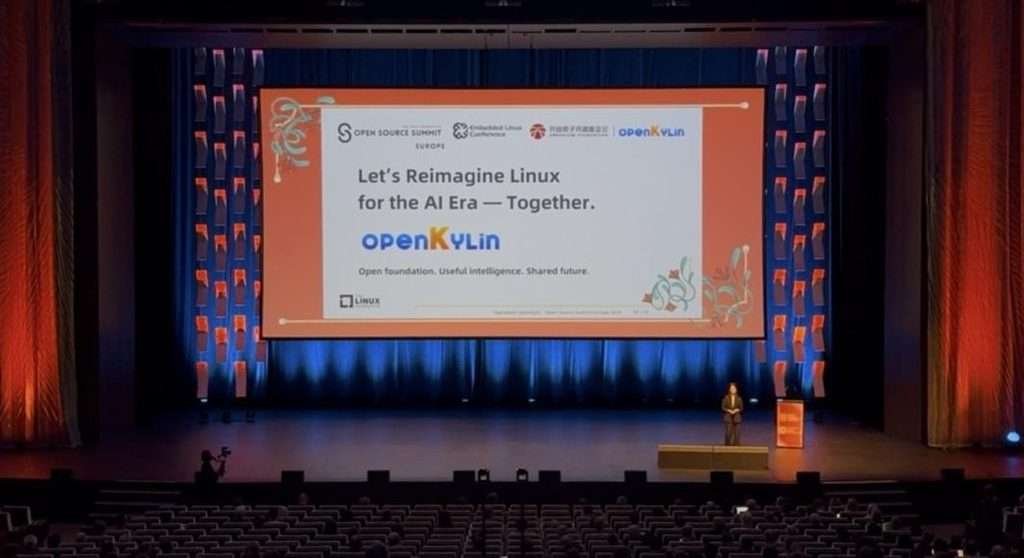
Linux is at a crossroads. As artificial intelligence reshapes how we interact with computers, traditional operating systems face a critical question: How do they keep up? At a major European open-source summit in Prague last October, a growing community called openKylin laid out a bold answer.
## The Problem: AI Is Stuck Outside the Desktop
AI has made incredible leaps recently. Frameworks like PyTorch and vLLM have made it easier than ever to build and run AI models. Open-weight models from companies like DeepSeek have lowered the barrier to entry dramatically. Yet most of this innovation still lives outside the everyday computing experience.
The real issue, as openKylin sees it, is not about making better AI models. It is about building the system infrastructure that connects AI to the desktop. Today, AI capabilities are disconnected from routine tasks. AI toolchains remain fragmented. And getting hardware to work smoothly with AI software is still painfully complicated. This is not a problem unique to one company or one community — it is a challenge facing the entire operating system world.
## A New Way of Thinking: From Managing Resources to Understanding Intent
At the heart of openKylin’s vision is a fundamental shift. Traditional operating systems manage things like CPU time, memory, and files. They are great at handling resources but not great at understanding what a user actually wants to accomplish.
openKylin proposes flipping the model. Instead of resource management, the goal becomes **intent management**. The system would understand a user’s goal, break it down into actionable steps, carry them out, and then observe the results to learn and adjust. Think of it as a loop of understanding, planning, doing, and reflecting.
To make this work, openKylin describes a three-layer architecture:
– **Runtime Layer:** A unified AI runtime called KART, paired with a local inference engine named kytensor, provides shared services for running AI models efficiently.
– **Agent Execution Layer:** This layer hosts an environment where intelligent agents can operate. It supports an assistant called KylinBot, a tool named Kylin-CUA, and agents built by third-party developers.
– **Capability Layer:** This is where the system connects AI to the real world. It exposes APIs, desktop tools, and graphical interface skills to agents, all governed by permission controls and execution monitoring to keep things safe.
## openKylin 3.0: AI Features You Can Actually Use
All of this is not theoretical. openKylin 3.0, the community’s latest release, ships with three AI-powered desktop features already built in:
– **AI Assistant:** Instead of hunting through menus to find a feature, users can simply tell the system what they want to do.
– **Global Intelligent Search:** Searching no longer means knowing a file name or location. The system understands what you are looking for in a broader, more natural way.
– **Intelligent Space:** Documents and information are organized around the task at hand, rather than buried in nested folders.
## Making AI Work on New Hardware: The RISC-V Push
Beyond the desktop, openKylin is also expanding its AI stack to RISC-V, an emerging open hardware architecture. This matters because RISC-V promises more open, customizable chips — and openKylin wants to make sure AI software is ready for them.
Some highlights from this work include:
– **Faster inference:** By optimizing for the RISC-V Vector extension, openKylin achieved a 2 to 5 times speedup in standard floating-point AI inference using ONNX Runtime.
– **Big-model support:** The AI stack can run larger models on RISC-V hardware, with vLLM supported on SpacemiT’s K3 processor.
– **Flexible delivery:** AI software can be distributed through .deb packages, Python wheels, Conda, or Docker containers — making it accessible across different setups.
openKylin has also stated its intention to submit both the RISC-V kernel optimizations and the inference framework improvements back to upstream open-source projects, reinforcing its commitment to community-driven development.
## A Community with Real Scale
The community behind this work is no small side project. openKylin has contributed over one million lines of core code to Linux and RISC-V ecosystems. Its UKUI desktop environment is now part of the official repositories of major distributions including Debian, Ubuntu, and Fedora. As of October 2026, the project reports roughly 27 million deployments, 2.9 million active users, and over 29,000 contributors spread across the globe, with user groups established in more than 30 countries.
At the summit itself, attendees had hands-on access to AI PCs running openKylin 3.0. Demonstrations included interactive VR experiences from Haihe Laboratory, a K3 laptop from chipmaker SpacemiT, and AI edge computing products from Singapore-based Nanyang Singtech.
## Looking Ahead
openKylin has identified three priorities going forward. First, it will continue strengthening the runtime foundation to make it easier for developers to build AI-powered applications. Second, it will focus on security and control, ensuring that AI-driven actions remain transparent and manageable. Third, it aims to cultivate a thriving open ecosystem where hardware makers, AI model developers, and application creators can collaborate more efficiently.
The message is clear: the future of operating systems is not just about managing files and processes. It is about building systems that can genuinely understand what people want and act on their behalf — all while keeping everything open and accessible.
—
## Frequently Asked Questions
**What is openKylin?**
openKylin is an open-source operating system community that focuses on building an AI-integrated OS for global users. It contributes heavily to both the Linux and RISC-V ecosystems.
**What is KART?**
KART is a unified AI runtime developed by openKylin. It provides shared inference services that make it easier to run AI models on Linux-based systems.
**What is intent management?**
Intent management is a new approach to operating system design where the system focuses on understanding a user’s goals, planning actions to achieve them, executing those actions, and then observing the results — creating a continuous feedback loop.
**What are the three desktop features in openKylin 3.0?**
They are the AI Assistant (which lets users express intent instead of searching for features), Global Intelligent Search (which enables semantic, meaning-based searching), and Intelligent Space (which organizes information around tasks rather than folders).
**Why does RISC-V matter for openKylin’s plans?**
RISC-V is an open-source hardware architecture. By optimizing its AI stack for RISC-V, openKylin aims to ensure that AI software can run efficiently on a wider variety of hardware, especially chips designed with openness and customization in mind.
**Is openKylin only for users in China?**
No. While the community is based in China, openKylin is designed for global users and has international user groups in over 30 countries. Its software is available through major Linux distribution channels.
—
## Conclusion
The push to integrate AI directly into operating systems is no longer a distant vision — it is happening now. openKylin’s work at the Prague summit demonstrated that a community-driven approach can deliver practical tools, from a unified AI runtime to an intent-driven desktop experience. By tackling the infrastructure gap head-on and investing in open hardware ecosystems like RISC-V, the project is helping ensure that the AI era belongs to everyone, not just a few large companies. Whether you are a developer, a hardware enthusiast, or simply a curious user, the changes openKylin is championing are worth watching closely.
Thank you for reading
