



# Azure Maia 300: A New Generation of AI Infrastructure Built for Smarter Inference
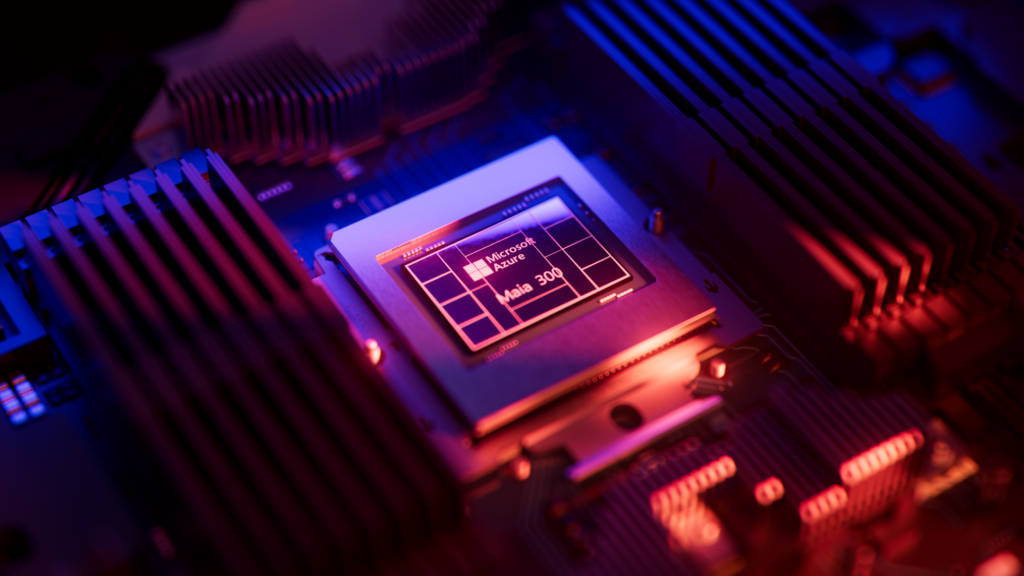
Microsoft has introduced Maia 300, the third generation of its custom-designed AI accelerator platform. Unlike conventional approaches that focus narrowly on chip performance, Maia 300 is engineered as a complete system — from silicon to software to rack to datacenter — all working together to maximize how much useful AI output is delivered for every unit of energy and every dollar spent.
This matters because modern AI workloads have changed dramatically. Applications like intelligent agents, long-context reasoning, and multi-step tool use demand very different computing patterns than earlier models. They require systems that can move data efficiently, keep large models in memory, and scale across thousands of processors without wasting energy. Maia 300 was designed from the ground up to meet these exact challenges.
—
## A Smarter Way to Move Data
At the heart of Maia 300 is a software-defined dataflow architecture that gives programmers direct control over where data lives and how it moves within the chip. Instead of treating all memory the same, the system organizes data in a way that keeps it physically close to the processors that need it.
The chip itself uses a multi-chiplet design built on TSMC’s cutting-edge N2P process. Compute-heavy parts of the chip get the most advanced process technology, while other functions like memory control and input/output are handled by separate, optimized dies. This means more silicon area goes toward actual computation, delivering a 36% increase in compute performance and 2.5 times the memory bandwidth compared to its predecessor.
Maia 300 also introduces enhanced low-precision data formats, including improved MXFP4 and storage formats below 3 bits. These narrower representations mean less data needs to be moved for every AI token processed, enabling larger models, longer conversations, and more simultaneous users — all within the same power budget.
—
## Memory That Keeps Pace with Compute
AI inference is increasingly memory-bound, meaning the speed of a system is often limited by how quickly it can feed data to the processors. Maia 300 addresses this with an upgraded memory hierarchy. Each accelerator now includes eight HBM4 memory stacks, providing 288 GB of capacity and 18 terabytes per second of bandwidth. This translates to roughly double the memory bandwidth per watt compared to the previous generation, while also increasing total capacity by 33%.
By restructuring memory access to be non-uniform — placing memory closer to the compute regions that use it — Maia 300 dramatically reduces the energy cost of moving data around the chip. The result is that more of the system’s AI model state and key-value cache stays near the processors, reducing latency and improving throughput.
—
## A Unified Network From Rack to Datacenter
One of Maia 300’s most ambitious innovations is its networking approach. Rather than using separate networks for communication within a rack and across a datacenter, Maia 300 uses a single, unified fabric that spans from individual accelerators all the way up to massive superpods containing over 12,000 accelerators.
Within each rack, all 96 accelerators connect through a half-switched topology using energy-efficient electrical links. Between racks, optical connections link up to 128 racks into a single superpod. Software sees one consistent communication model regardless of where processors are located, and accelerators can talk directly to each other without routing through a separate network card.
This design supports three latency tiers: the fastest is a direct connection between two processors, followed by processors within the same rack, and finally processors across different racks — reachable in just three network hops. This makes it easy for AI software to keep communication-local traffic fast while still scaling to enormous cluster sizes when needed.
The network also supports flexible workload placement. Training or inference jobs can span multiple racks, and if a processor fails, backup capacity from another rack can be used seamlessly — improving both reliability and utilization.
—
## Datacenter-Friendly Design
At full scale, a Maia 300 rack houses 96 accelerators across 24 trays in a compact 167-kilowatt enclosure — double the accelerator density of the previous generation. By eliminating separate host server trays and consolidating components, the rack makes better use of space and power.
Cooling is handled through a hybrid approach: liquid cooling removes more than 80% of the heat generated by processors, switches, and power components, while traditional air cooling handles memory and storage. This hybrid setup allows Maia 300 to be deployed in a wide variety of datacenter environments, whether they have direct water access or rely on air-cooled heat exchangers.
Six specialized switch chips are integrated into liquid-cooled trays within the rack itself, minimizing the footprint and power overhead of networking equipment. The rack also features redundant power feeds, real-time telemetry at every level, and automated failover — all designed to keep large-scale AI operations running reliably.
—
## Performance at a Glance
Compared to its predecessor, Maia 300 delivers up to seven times greater token throughput at the rack level in its full 96-processor configuration and more than 2.5 times the performance per watt. It packs twice as many accelerators into each rack, doubles memory bandwidth, and does all of this while supporting the demanding workloads of modern AI agents and large-scale inference.
—
## FAQ
**What is Azure Maia 300?**
Azure Maia 300 is Microsoft’s third-generation custom AI accelerator, designed specifically to make large-scale AI inference more efficient. It is part of a broader system-level approach that co-designs silicon, software, networking, racks, and datacenter infrastructure.
**How is Maia 300 different from typical AI chips?**
Most AI chips are optimized in isolation. Maia 300 is designed as part of a complete platform, where the chip, software architecture, memory subsystem, network, and cooling infrastructure all work together. This system-level co-design is what allows it to achieve significantly higher performance per watt.
**What does “software-defined dataflow” mean?**
It means that software, rather than fixed hardware circuits, controls how data moves around the chip. This gives Microsoft the flexibility to optimize for different AI workloads — such as reasoning, long-context processing, or agentic tasks — by reconfiguring data paths as needed.
**How much power does a Maia 300 rack use?**
A fully configured Maia 300 rack with 96 accelerators operates at 167 kilowatts, which is remarkably dense given the computational power it provides.
**What kind of AI workloads benefit most from Maia 300?**
Large language model inference, agentic AI systems, multi-step reasoning, long-context processing, and any workload where moving data efficiently is a bottleneck will see significant improvements.
**How does the networking work at scale?**
Maia 300 uses a two-tier network: electrical connections within a rack for speed and efficiency, and optical connections between racks to form superpods of up to 12,288 accelerators. Everything appears as a single unified network to the software layer.
**Is Maia 300 available now?**
Microsoft has announced Maia 300 as its latest platform advancement. Availability and deployment timelines are typically shared through Microsoft’s official channels and events such as Microsoft Ignite.
—
## Conclusion
Azure Maia 300 represents a significant leap in how AI infrastructure is designed. By treating the entire system — from individual transistors to rack-level cooling to cross-datacenter networking — as a single optimization problem, Microsoft has created a platform that delivers dramatically more AI capability per watt and per dollar. As AI agents and large-scale inference become central to enterprise and consumer applications, systems like Maia 300 will play a critical role in making advanced AI practical, sustainable, and accessible at scale.
Thank you for reading
