



# Building Production-Ready Python AI Libraries: Five Essential Practices
—
## Why AI Libraries Break in Ways Normal Libraries Don’t
Imagine a colleague adopts your open-source AI wrapper and, within a week, everything falls apart. A missing API key surfaces as a bare `KeyError` deep in a traceback no one can act on. A simple text-classification feature silently drags in a four-gigabyte deep learning framework nobody requested. Your test suite only passes when the model provider is feeling generous, because your assertions verify the model’s exact wording rather than your library’s actual logic.
This isn’t a matter of poorly written code. It’s a fundamental category mismatch. Most Python packaging guidance was written for libraries that interact with databases or parse files — scenarios with predictable failure modes. AI libraries face a fundamentally different challenge: outputs that will never conform to a guaranteed schema, dependencies measured in gigabytes rather than megabytes, and third-party APIs that fail in ways a standard REST client was never designed to handle.
The goal of this guide is to walk through five concrete practices that transform a fragile AI prototype into a library you can confidently ship to production. Each practice is illustrated with real, runnable code that builds toward one small, coherent example library.
—
## What Makes an AI Library Production-Ready
Before diving into specifics, let’s define the target. A genuinely production-ready Python AI library exhibits several concrete characteristics:
– **Complete type coverage** with a `py.typed` marker so downstream type checkers can actually see your annotations.
– **A `pyproject.toml`-first structure** conforming to **PEP 621**, avoiding scattered legacy configuration files.
– **Input and output validation** at every public boundary, since no model response can be guaranteed to match expectations.
– **Dependency isolation** so that installing the package doesn’t force every user into a massive, unnecessary install.
– **Resilience built from day one** around every external call, not bolted on after the first outage.
– **A continuous integration pipeline** that enforces all of the above automatically.
These traits aren’t aspirational — they are the baseline for any AI library meant to survive outside a demo notebook.
—
## Libraries Worth Studying
Several well-known projects embody these principles in different ways and are worth reading through directly:
– **OpenAI’s official Python SDK** demonstrates clean module design, exposing exactly the client, types, and exceptions users need, plus dual type-checker CI using both `pyright` and `mypy`.
– **Instructor** provides schema-validated structured output layered directly on Pydantic — a pattern worth replicating.
– **PydanticAI** treats type safety as the core design philosophy from the ground up, not as an afterthought.
– **LiteLLM** offers a unified interface across dozens of providers while keeping each provider’s quirks hidden from the public API.
– **Hugging Face Transformers** is the reference case for making heavy dependencies genuinely optional at real scale.
—
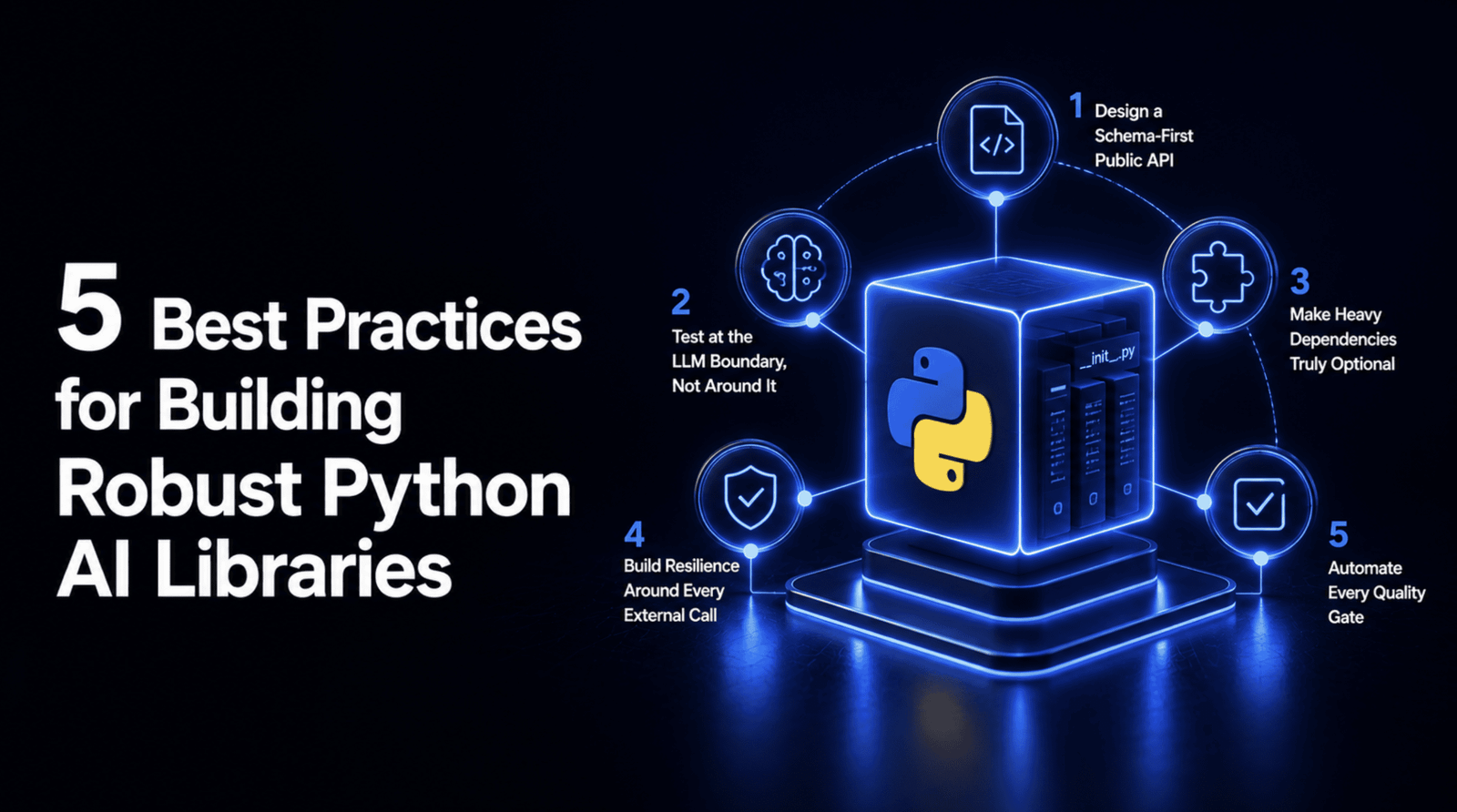
## The Five Practices
Each of the following practices addresses a specific problem unique to AI libraries:
| Practice | Problem It Solves |
|—|—|
| Validate all I/O with structured schemas | Model outputs are unpredictable and unstructured |
| Mock at the provider boundary | Model responses are nondeterministic, causing flaky tests |
| Declare heavy dependencies as optional | AI frameworks can weigh gigabytes, not megabytes |
| Add fault tolerance to every external call | Provider APIs fail in ways ordinary REST endpoints rarely do |
| Automate every quality gate | None of the above survives without enforcement |
—
## Practice 1: Validate Everything at the Boundary
The single most important design principle for an AI library: never let a raw string or untyped dictionary pulled straight from a model response cross your library’s public API. A model can return malformed JSON, a missing field, or a value of the wrong type. If that raw output reaches your caller unchecked, the failure shows up far from its actual cause — usually as a confusing crash deep inside downstream code that has no idea the real problem originated in the model response.
### A Working Example
Consider a function that extracts structured fields from an invoice using a language model. The function validates the model’s response against a Pydantic schema before returning anything:
“`python
from pydantic import BaseModel, ValidationError
from openai import OpenAI
client = OpenAI()
class InvoiceData(BaseModel):
vendor: str
total: float
due_date: str
class SchemaValidationError(Exception):
“””Raised when the model’s response doesn’t match the expected schema.”””
def extract_invoice(raw_text: str) -> InvoiceData:
“””Extract structured invoice fields. Returns a validated InvoiceData
object, never a raw dict or unstructured string.”””
response = client.chat.completions.create(
model=”gpt-4o”,
messages=[
{“role”: “system”, “content”: “Extract invoice fields as JSON: vendor, total, due_date.”},
{“role”: “user”, “content”: raw_text},
],
response_format={“type”: “json_object”},
)
raw_json = response.choices[0].message.content
try:
return InvoiceData.model_validate_json(raw_json)
except ValidationError as e:
raise SchemaValidationError(
f”Model returned data incompatible with InvoiceData: {e}”
) from e
“`
Two details deserve emphasis. First, `response_format={“type”: “json_object”}` constrains the provider to return valid JSON rather than prose with JSON buried somewhere inside, eliminating an entire class of parsing failures before validation even begins. Second, the `except ValidationError as e: raise SchemaValidationError(…) from e` pattern deliberately catches Pydantic’s internal exception type — something callers of your library should never need to know — and re-raises it as a clear, domain-specific exception. The `from e` clause preserves the original error in the traceback for anyone who needs to debug further.
The function signature itself — returning `InvoiceData` and nothing else — is a contract: anyone calling this function never writes a single line of code checking whether the result looks correct. It already does.
—
## Practice 2: Test at the Boundary, Not the Provider
Generic Python testing guides rarely address the specific challenge of AI libraries: the model itself is a black box. Its reasoning varies from run to run, and any test asserting on the literal wording of a model response will flake regardless of whether your library logic is correct.
The solution is to identify the testable layers and mock precisely at the boundary between your code and the provider:
1. **Prompt construction** — is the right instruction being sent?
2. **Call mechanics** — are timeouts, headers, and parameters correct?
3. **Output parsing** — does your library correctly handle the parsed result?
The model’s actual reasoning is not a testable layer. It should never appear in your test suite.
### A Runnable Test Suite
“`python
from unittest.mock import patch, MagicMock
import pytest
from mylib.invoices import extract_invoice, SchemaValidationError
def _build_mock_response(content: str) -> MagicMock:
“””Constructs a fake OpenAI response object shaped just enough
for extract_invoice to parse it.”””
mock = MagicMock()
mock.choices = [MagicMock(message=MagicMock(content=content))]
return mock
@patch(“mylib.invoices.client”)
def test_extract_invoice_parses_valid_response(mock_client):
mock_client.chat.completions.create.return_value = _build_mock_response(
‘{“vendor”: “Acme Corp”, “total”: 452.10, “due_date”: “2026-09-01”}’
)
result = extract_invoice(“some raw invoice text”)
assert result.vendor == “Acme Corp”
assert result.total == 452.10
# Verify the prompt itself was constructed correctly
sent_messages = mock_client.chat.completions.create.call_args.kwargs[“messages”]
assert “Extract invoice fields as JSON” in sent_messages[0][“content”]
@patch(“mylib.invoices.client”)
def test_extract_invoice_raises_on_malformed_output(mock_client):
mock_client.chat.completions.create.return_value = _build_mock_response(
‘{“vendor”: “Acme Corp”}’ # missing total and due_date
)
with pytest.raises(SchemaValidationError):
extract_invoice(“some raw invoice text”)
“`
The `@patch(“mylib.invoices.client”)` line is the most critical part of both tests. It patches the `client` object exactly where `extract_invoice` looks for it — inside your own module — rather than where it was originally defined in the `openai` package. Patching at the wrong location is one of the most common and confusing mistakes with `unittest.mock.patch`.
The first test verifies two genuinely independent things: that the function correctly parses a well-formed response, and separately, by inspecting `call_args.kwargs[“messages”]`, that the prompt sent to the model actually contains the right instruction. Catching a real class of bug where the logic is correct but the wrong prompt gets sent.
The second test never touches a real model and still verifies something valuable: that malformed output produces a clear, catchable `SchemaValidationError` rather than propagating a confusing crash. Neither test depends on what a real model would say, which is exactly why they’re fast, free, and immune to flakiness in CI.
—
## Practice 3: Keep Heavy Dependencies Optional
AI libraries carry a dependency-weight problem that ordinary libraries rarely face. A library offering both a hosted API path and a local model path should not force every user to install `torch` or `transformers` just to use the hosted path. The fix combines `pyproject.toml`’s optional-dependencies extras mechanism with lazy imports that fail loudly and helpfully instead of with a bare `ModuleNotFoundError`.
### pyproject.toml Configuration
“`toml
[project]
name = “mylib”
dependencies = [
“pydantic>=2.0”,
“httpx>=0.27”,
]
[project.optional-dependencies]
openai = [“openai>=1.0”]
local = [“torch>=2.0”, “transformers>=4.40”]
all = [“mylib[openai,local]”]
“`
The core dependency list stays deliberately minimal — just `pydantic` and `httpx`, both lightweight. Optional extras let users install only what they need: `pip install mylib[openai]` for the hosted API path, `pip install mylib[local]` for local inference, and `pip install mylib[all]` for everything.
### The Lazy Import Helper
“`python
def _require(module_name: str, extra_name: str):
“””Import an optional dependency, raising a clear, actionable
error naming the exact extra to install if it’s missing.”””
try:
return __import__(module_name)
except ImportError as e:
raise ImportError(
f”‘{module_name}’ is required for this feature. ”
f”Install it with: pip install ‘mylib[{extra_name}]'”
) from e
def load_local_model(model_name: str):
torch = _require(“torch”, “local”)
transformers = _require(“transformers”, “local”)
return transformers.AutoModel.from_pretrained(model_name)
“`
Without the `_require` helper, a user who skips the `local` extra and calls `load_local_model` receives a bare `ModuleNotFoundError: No module named ‘torch’` with no indication of what to do about it. With it, they receive an error that names the exact `pip install` command to fix the problem — the difference between a five-second fix and a confused GitHub issue.
—
## Practice 4: Add Fault Tolerance to Every External Call
AI libraries live or die on the reliability of third parties they don’t control. Providers rate-limit, time out, and occasionally return 503 errors that resolve after a few seconds. Code that doesn’t account for any of that turns a routine, transient hiccup into a hard failure for every user of the library.
The answer is retry-with-backoff scoped specifically to the errors worth retrying, with an explicit cap to prevent a struggling provider from turning into an infinite loop.
“`python
import logging
import httpx
from tenacity import (
retry,
stop_after_attempt,
wait_exponential,
retry_if_exception_type,
before_sleep_log,
reraise,
)
logger = logging.getLogger(“mylib”)
class ProviderUnavailableError(Exception):
“””Raised when a provider call fails after all retries are exhausted.”””
@retry(
stop=stop_after_attempt(3),
wait=wait_exponential(multiplier=1, min=1, max=10),
retry=retry_if_exception_type((httpx.TimeoutException, httpx.HTTPStatusError)),
before_sleep=before_sleep_log(logger, logging.WARNING),
reraise=True,
)
def _call_provider(client, **kwargs):
return client.chat.completions.create(timeout=15.0, **kwargs)
“`
Every parameter in this decorator does deliberate, specific work:
– **`stop_after_attempt(3)`** — a hard ceiling that prevents an unbounded retry loop. A struggling provider could quietly turn into a runaway bill or a hung process without it.
– **`wait_exponential`** — spaces retries with increasing delay rather than hammering an already-struggling provider three times in rapid succession.
– **`retry_if_exception_type`** — only retries genuinely transient failures (timeouts and HTTP errors) and deliberately does not retry authentication errors, since retrying a bad API key three times wastes time without ever fixing the problem.
– **`before_sleep_log`** — provides visibility into every retry as it happens, rather than silently failing with no trace.
– **`reraise=True`** — ensures that when all attempts genuinely fail, the caller sees the real underlying exception, not a generic “retry library gave up” message that hides what actually went wrong.
– **`timeout=15.0`** — set explicitly on the call itself. A library that never sets its own timeout is entirely at the mercy of whatever default — or lack of one — the underlying HTTP client ships with.
—
## Practice 5: Automate Quality Enforcement in CI
The first four practices only remain true over time if something enforces them automatically, rather than relying on every contributor to remember to run the linter before pushing.
### The 2026 Default Tool Stack
The practical modern stack for a Python AI library includes:
– **uv** for environment and dependency management
– **ruff** for both linting and formatting
– **mypy** for type checking
– **pytest** with coverage for the test suite
All wired together in a CI workflow that runs on every push and pull request.
### pyproject.toml (Dev Dependencies)
“`toml
[dependency-groups]
dev = [
“ruff>=0.6”,
“mypy>=1.11”,
“pytest>=8.0”,
“pytest-cov>=5.0”,
“tenacity>=9.0”,
]
“`
### CI Workflow
“`yaml
name: CI
on:
push:
branches: [main]
pull_request:
jobs:
quality:
runs-on: ubuntu-latest
steps:
– uses: actions/checkout@v4
– uses: astral-sh/setup-uv@v3
– run: uv sync –all-extras –dev
– run: uv run ruff check .
– run: uv run ruff format –check .
– run: uv run mypy src/
– run: uv run pytest –cov=mylib –cov-report=term-missing tests/
“`
Each step catches a specific way a contribution could quietly erode reliability:
– **`ruff check`** and **`ruff format –check`** catch style drift and a real class of bugs that ruff’s linter rules flag directly. Running `format –check` rather than `format` fails the build on unformatted code instead of silently reformatting it in CI.
– **`mypy src/`** verifies that the type annotations are actually correct throughout the entire codebase, not just in the one function someone happened to test by hand.
– **`pytest –cov=mylib –cov-report=term-missing`** runs the boundary-mocked test suite and reports which lines still aren’t covered, so a testing gap shows up as a number in the CI log.
– **`uv sync –all-extras –dev`** pulls in every optional dependency so CI tests the full surface of the library, not just whatever subset happens to be installed on one contributor’s machine.
None of these steps are exotic. What makes them a practice rather than a suggestion is that they run on every single push, automatically, whether or not anyone remembers to ask for them.
—
## Common Mistakes
Several recurring mistakes are worth naming directly, since they represent the exact failure modes the practices above exist to prevent:
– **Hardcoding API keys or model names** in library code instead of accepting them as configuration. This breaks the moment someone needs a different key or wants to use a newer model.
– **Testing against a live provider in CI** — slow, costly, and structurally flaky by design. This is exactly what boundary mocking (Practice 2) eliminates.
– **Trusting model output without schema validation** — the precise gap that Practice 1 closes with Pydantic models.
– **Making heavy frameworks like `torch` hard, non-optional dependencies** for features most users will never touch. Practice 3 solves this with extras and lazy imports.
– **Retrying failed calls silently and without a cap** — quietly turning a temporary provider outage into a runaway bill or a hung process instead of a clear, bounded, loggable failure. Practice 4’s `stop_after_attempt` is the guard against this.
– **Skipping the `py.typed` marker file** — a one-line omission that quietly breaks type checking for every downstream user of an otherwise fully typed library. Without it, type checkers treat the package as untyped regardless of how carefully its own code is annotated.
—
## FAQ
### Q: Why can’t I just test my AI functions with a real model in CI?
A: Testing against a live provider introduces three problems simultaneously: slowness (each test requires a network round-trip), cost (every call consumes API quota), and flakiness (model providers return different outputs on different runs, sometimes due to infrastructure issues entirely outside your control). Boundary mocking eliminates all three by replacing the provider with a deterministic fake that returns exactly what you tell it to return. The real model is never consulted during CI.
### Q: Is Pydantic the only option for schema validation?
A: No. Pydantic is the most common choice in the Python AI ecosystem due to its tight integration with language model providers and its `model_validate_json` method. Alternatives like `dataclasses` with manual validation, `attrs`, or even custom validators can work. However, Pydantic’s ability to produce clear, actionable validation error messages and its native JSON schema generation make it particularly well-suited for the input-output boundary that AI libraries must guard.
### Q: What if my optional dependency has its own heavy transitive dependencies?
A: This is common — for example, `transformers` pulls in `torch`, which is itself gigabytes. The key is to keep those transitive dependencies inside the optional extra, never in the core `dependencies` list. Users who only need the hosted API path should never see them. If you need to further reduce footprint, consider splitting into multiple packages (e.g., a lightweight core package and a separate “local-inference” package) rather than a single monolithic package.
### Q: How do I decide what to retry and what not to retry?
A: The general principle is: retry only errors that are likely to be transient. Timeouts and 5xx HTTP status codes are good candidates. 4xx errors — especially 401 Unauthorized and 403 Forbidden — indicate configuration or permission problems that retrying will never fix. Authentication errors should fail immediately so the user knows to update their credentials. Rate-limit errors (429) are borderline: they can be retried after a delay, but you should respect any `Retry-After` header the provider sends.
### Q: Does `ruff format –check` in CI mean I can’t auto-format?
A: Not at all. `–check` mode verifies that the code is already formatted correctly and fails the build if it isn’t. For development, running `ruff format .` locally or configuring your editor to auto-format on save keeps the code compliant. The CI check simply ensures that no unformatted code makes it into the repository.
### Q: How often should I update my CI quality tools?
A: Keep them current, especially `ruff`, `mypy`, and `pytest`. New versions frequently add rules that catch additional categories of bugs. Pinning to minimum versions (e.g., `ruff>=0.6`) allows security and bug-fix patches to flow through automatically, while using a lockfile or uv’s resolution system ensures reproducible builds.
—
## Conclusion
The five practices in this guide — schema validation, boundary mocking, optional dependencies, fault-tolerant external calls, and automated CI enforcement — all answer the same fundamental question that every library user eventually asks under real pressure: when something goes wrong, can I trust this thing?
A model returns something unexpected. A provider has a bad night. Someone installs the package on a machine that can’t spare four gigabytes for a dependency they don’t need. A library that has already answered these questions before it ships is the one people keep using. A library that answers them after its first production incident is the one people abandon.
Robustness isn’t a feature you add at the end. It’s the architecture you build from the start.
—
Thank you for reading
