



# Federal Health Benefits 2027: What Employees and Annuitants Need to Know About Upcoming Premium Changes
The federal benefits landscape is shifting once again, with health insurance costs projected to climb significantly in the coming year. After two consecutive years of double-digit premium growth, federal employees and retirees enrolled in the Federal Employees Health Benefits (FEHB) program will face yet another substantial increase when coverage renews for 2027. Understanding these changes now can help you make informed decisions before the Open Season window opens.
## The Big Picture: Why Costs Are Climbing
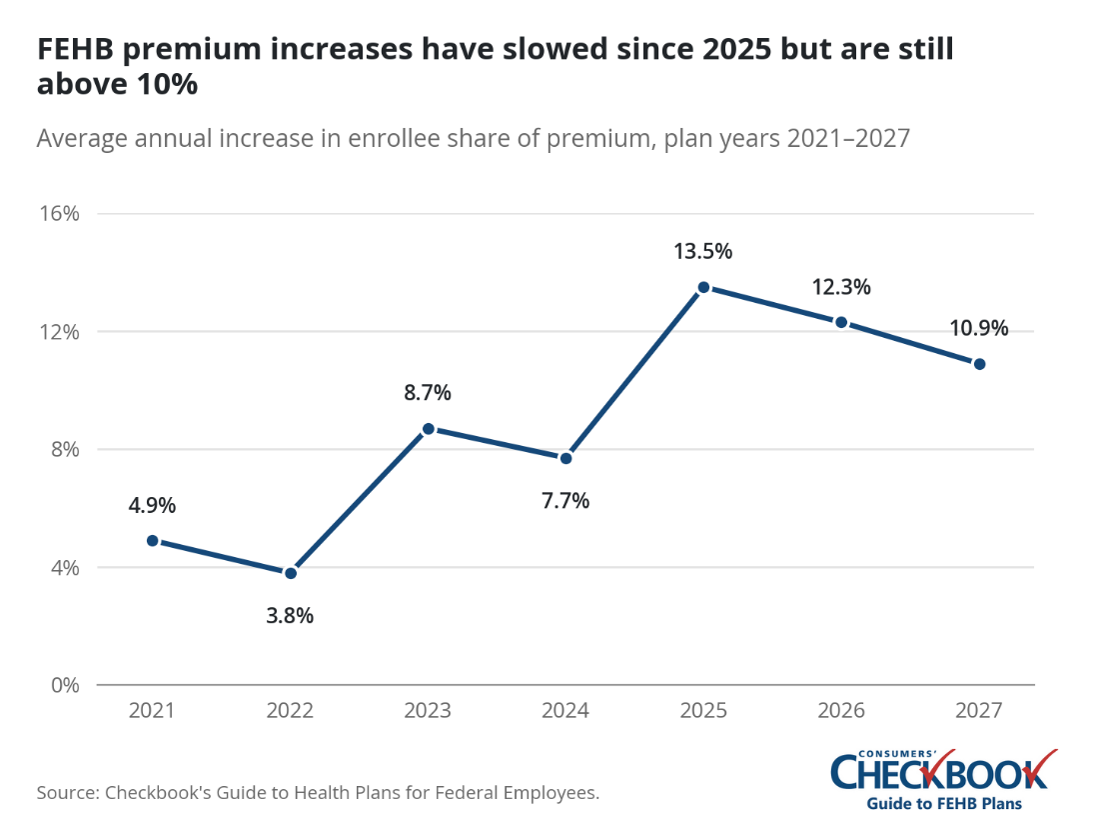
The Office of Personnel Management has confirmed that the average enrollee share of FEHB premiums will rise by 10.9% in 2027. While this figure represents a slight improvement over the steep hikes seen in recent years, it still marks a third consecutive year of double-digit growth — a trend that far outpaces general inflation.
Several factors are driving these increases. OPM highlights a notable surge in behavioral and mental health service utilization, alongside a sharp uptick in prescription drug spending. Among the most significant contributors is the growing use of GLP-1 medications for weight management, which has placed additional financial pressure on the entire benefits system.
It is worth noting that these price pressures are not isolated to the federal workforce. Marketplace plans under the Affordable Care Act are also bracing for a median premium increase of 15% in 2027, and large-group employer plans are anticipating an average rise of approximately 9.5%. The broader healthcare inflation environment continues to push costs upward across the board.
## How the Numbers Break Down Across Plans
Not every FEHB plan is experiencing the same level of premium growth. Among the 117 plans that are available in both the current and upcoming year, the picture is varied:
– **20 plans** will actually see a decrease in self-only premiums.
– **5 plans** will remain flat, with no change.
– **53 plans** will increase, but at a rate below the 10.9% average.
– **39 plans** will increase above the average rate.
The range of change is striking. On the favorable end, M.D. IPA (JP1), offered in the Washington, D.C. area, is slashing its premium by 46%, which would save self-only enrollees roughly $2,626 annually. On the other extreme, MHBP Standard (Plan 454) is raising its premium by 63%, adding $1,540 per year to the cost for self-only coverage.
This wide disparity underscores the importance of reviewing your current plan carefully. Even if you are satisfied with the coverage itself, the price tag may be pushing you toward a more cost-effective alternative — and you may not even realize it unless you look.
## Blue Cross Blue Shield Dominance and the Case for Review
Approximately two-thirds of all federal employees are enrolled in one of the three Blue Cross Blue Shield (BCBS) plans: Standard, Basic, or FEP Blue Focus. These three options together form the backbone of federal health coverage, yet many enrollees have not revisited their choice in years.
All three BCBS plans are seeing premium increases, but not equally. Standard and Basic are rising below the all-plan average, while FEP Blue Focus is climbing slightly faster than the others.
What often goes unnoticed is that the three plans differ in meaningful ways beyond just price. The Standard plan offers several benefits that Basic and FEP Blue Focus do not:
– **Out-of-network provider access** — giving you more flexibility in choosing a doctor.
– **Mail-order prescription drug coverage** for all enrollees (Basic only extends this to annuitants with Part B).
– **Skilled nursing care benefits** for those needing extended recovery support.
– **In vitro fertilization coverage** of up to $25,000 per year.
If you currently have Standard coverage but do not use any of these additional benefits, switching to Basic or FEP Blue Focus could result in significant savings while keeping you within the same BCBS in-network system. Two-person families switching from Standard to Basic could save $2,843 next year, and those moving to FEP Blue Focus could save $8,360.
## Enrollment Strategy for Couples: Self-Plus-One vs. Self & Family
Married federal employees and couples with dependents have two enrollment options: Self-Plus-One or Self & Family. The less expensive choice for most households is Self-Plus-One, but in 38 FEHB plans, Self & Family enrollment actually costs less.
The financial impact can be substantial. Consider a two-person family enrolled in Kaiser High (Plan E3) in the Washington, D.C. area, Kaiser High (Plan NZ) in Fresno, California, or Kaiser High (Plan 59) in northern California. By choosing Self & Family instead of Self-Plus-One, they would save $76.29 per biweekly payroll deduction, totaling $1,984 in annual savings.
The key takeaway: check the premium tables in the FEHB brochure. The last page of each plan’s official document shows the enrollee share of premium for both enrollment types, and the coverage and benefits remain identical regardless of which option you select.
## Special Considerations for Postal Service Employees
Postal Service employees and annuitants have a separate benefits program to consider: Postal Service Health Benefits (PSHB). The good news is that PSHB premium increases are expected to be more moderate, with an average rise of 8.2% for 2027. This represents a meaningful improvement over the 11.3% increase experienced in 2026, offering some relative relief for postal workers navigating the same broader healthcare inflation trends.
## Dental and Vision: A More Stable Picture
The Federal Employees Dental and Vision Insurance Program (FEDVIP) has historically been less affected by the steep healthcare inflation seen in medical plans, and that trend continues into 2027. Dental plan premiums are projected to rise by an average of just 1%, and vision plan premiums are expected to increase by 1.6%. These modest adjustments make dental and vision coverage among the more predictable components of the federal benefits package.
## What You Should Do Now
With the 2027 Open Season running from November 9 through December 14, there is a full six-week window to compare options, evaluate costs, and make any necessary changes to your coverage. Premiums are only one piece of the puzzle — out-of-pocket costs, in-network provider availability, prescription drug formularies, and unique benefits like fertility coverage or mental health services all play a role in determining the true annual cost of a health plan.
A comprehensive guide ranking all FEHB plans by estimated yearly total cost — combining premiums and likely out-of-pocket expenses tailored to your specific profile — can be an invaluable resource during this process. Review your current plan details carefully, check the premium and cost-sharing changes, and consider whether a different plan might better serve both your health needs and your budget.
## Frequently Asked Questions About FEHB 2027 Changes
**Q: Why are FEHB premiums increasing for the third consecutive year?**
A: The increases are driven by broader healthcare inflation, a rise in behavioral and mental health service utilization, and higher spending on prescription medications — particularly GLP-1 drugs used for weight management. These cost pressures affect the entire healthcare system, not just the federal workforce.
**Q: Is the 10.9% average increase the same for every plan?**
A: No. The 10.9% figure is an average across all FEHB plans. Some plans will see premiums decrease, while others could increase by more than 60%. The specific change depends on the plan you are enrolled in.
**Q: Can I change my plan during Open Season?**
A: Yes. Open Season, which runs from November 9 to December 14, is the annual window when federal employees and annuitants can switch between FEHB plans, change enrollment types, or drop coverage entirely. Changes made during this period take effect on January 1, 2027.
**Q: Does switching from Blue Cross Blue Shield Standard to Basic or FEP Blue Focus mean I lose my doctor?**
A: No. All three BCBS plans operate within the same BCBS in-network system, so you can keep seeing the same providers if they are in-network under the plan you switch to.
**Q: Are PSHB and FEHB premiums going up at the same rate?**
A: No. PSHB premiums are expected to rise by 8.2% for 2027, which is notably lower than the 10.9% average increase for FEHB. PSHB is a separate program for Postal Service employees and annuitants.
**Q: Should I also look at FEDVIP options during Open Season?**
A: Absolutely. While FEDVIP premiums are expected to see only modest increases of 1% for dental and 1.6% for vision, it is still worth reviewing whether your current dental or vision plan continues to meet your needs and whether switching might save you money or offer better coverage.
**Q: What is the difference between Self-Plus-One and Self & Family enrollment?**
A: Self-Plus-One covers you and one other person (typically a spouse), while Self & Family covers you and all eligible dependents. Despite the name, Self & Family can sometimes be cheaper than Self-Plus-One for certain plans, so it is worth comparing both options for each plan you are considering.
## Conclusion
The 2027 FEHB premium environment demands attention and proactive planning. With double-digit increases continuing for a third straight year, taking the time to understand how your specific plan is changing and whether better-value alternatives exist can translate into meaningful savings — and more comprehensive coverage — for you and your family. Open Season is your opportunity to act, and the decisions you make now will shape your healthcare costs for the entire coming year. Start reviewing your options early, gather the information you need, and do not hesitate to explore plans you may not have considered before.
Thank you for reading.
