



# Why Every Organization Must Map Its Full Credential Landscape Before It’s Too Late
## The Invisible Infrastructure Powering Modern Software
Every application, automated pipeline, and artificial intelligence system running in today’s enterprises relies on a hidden foundation: credentials. These are the API keys, tokens, passwords, and certificates that allow machines and humans to authenticate, authorize, and interact with one another. Without them, no code could be deployed, no cloud resource could be provisioned, and no AI agent could take action on behalf of a developer.
The problem is that this credential foundation has grown far beyond what most security teams can see, let alone control. As software development enters an era of agentic coding and accelerated production pipelines, the number of credentials in play is expanding at a pace that outstrips traditional security tooling and processes.
## The Scale of the Crisis
To understand how bad the situation has become, consider the sheer volume of modern software production. GitHub’s engineering leadership has indicated that the platform is preparing infrastructure for a workload 30 times larger than what it handles today — a reflection of how agentic development has compressed timelines and amplified output. Where the platform once logged roughly one billion commits across an entire calendar year, it recently reached 2.9 billion commits in a single month. Annualized, that represents over 14 billion commits in a single year.
More commits means more code. More code means more configuration files, more deployment scripts, more environment variables, and more places where a credential can accidentally end up exposed.
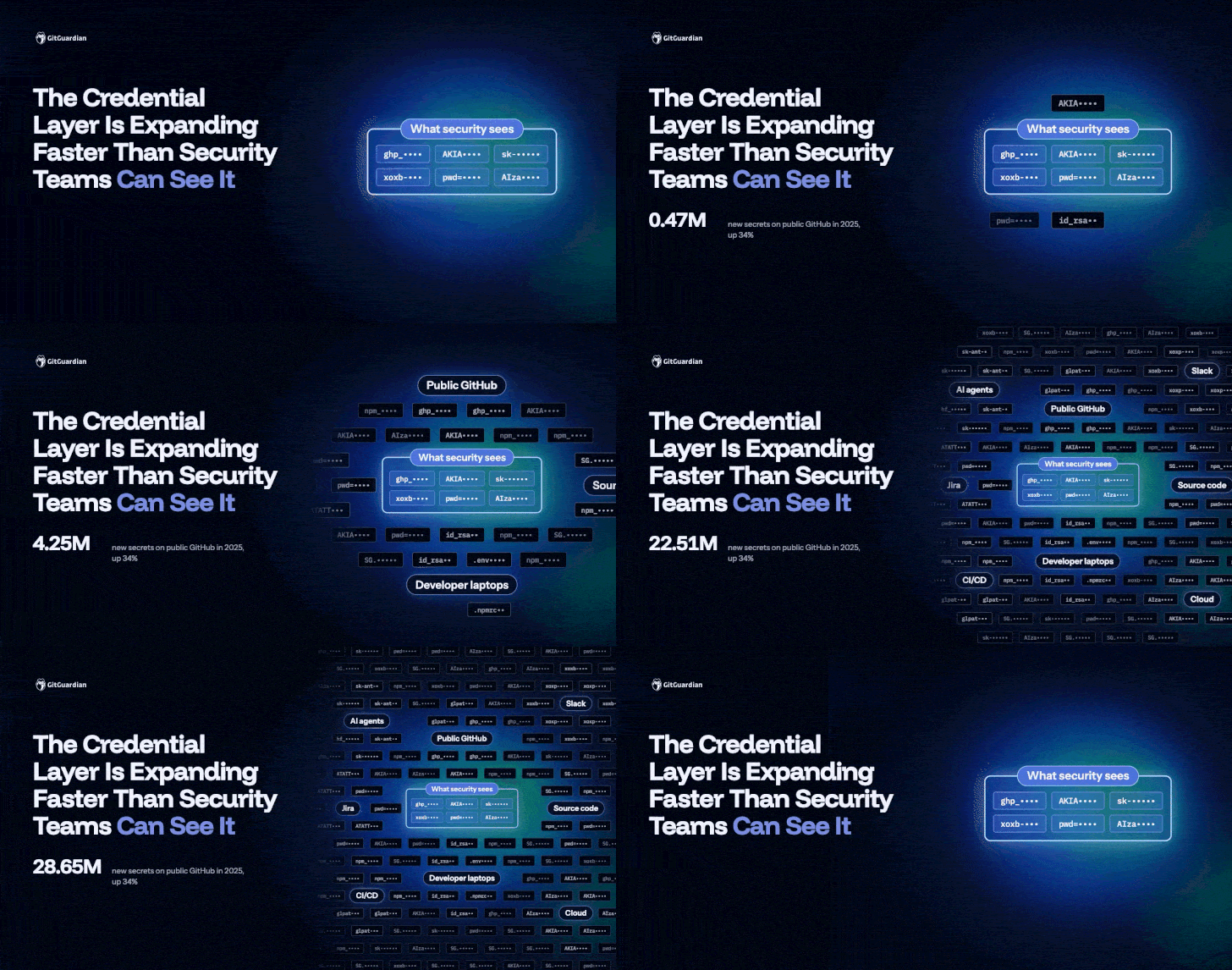
The numbers tell a stark story. GitGuardian’s research found 28.65 million new hardcoded secrets sitting in public GitHub repositories during 2025 alone — a 34% increase over the year before. Even more alarming, credentials tied to AI services surged by 81% during the same period. As organizations rush to integrate AI capabilities into their workflows, they are generating and exposing authentication material at an unprecedented rate.
## There Is No Perimeter Around Credentials
Traditional security models rely on perimeters. Firewalls protect network boundaries. Access controls gate entry to approved systems. But credentials do not respect these boundaries. A single key created within a sanctioned cloud account can, through a series of mundane actions, end up in a public repository, a developer’s personal laptop, a shared Slack channel, or a collaboration tool where it remains searchable indefinitely.
This phenomenon — known as credential sprawl — means the attack surface of any organization is defined not by the tools security has approved, but by everywhere a credential has actually been copied, pasted, or stored in plaintext. The perimeter follows the credentials themselves, which means it is fluid, fragmented, and nearly impossible to track without dedicated discovery mechanisms.
Research from GitGuardian’s State of Secrets Sprawl report illustrates the breadth of the problem. Internal repositories were approximately six times more likely than public ones to contain at least one secret. Around 28% of all credential exposure incidents originated entirely outside source-code repositories — buried in ticketing systems, chat logs, documentation wikis, and other collaboration platforms where security scanning often does not reach.
## Developer Laptops Have Become Prime Targets
For years, the industry accepted a risky norm: storing secrets in local environment files, caching authentication tokens in command-line histories, and relying on developers to manually scrub sensitive values before sharing code. The perceived risk of an exposed shell history or a local config file was considered low enough to tolerate.
That calculus has changed dramatically. The latter half of 2025 saw the emergence of devastating infostealer campaigns — Shai-Hulud and S1ingularity chief among them — that specifically targeted developer workstations to harvest credentials and inject malicious packages into software supply chains. These attacks transformed the developer laptop from a trusted production tool into a high-value entry point for adversaries.
The evidence is sobering. Analysis of systems compromised during the Shai-Hulud 2 supply-chain campaign revealed that across 6,943 infected machines, security researchers identified 33,185 unique credentials. Forty-four percent of compromised devices held more than 10 secrets, and 5% contained over 100. A single laptop can serve as a gateway to source control systems, cloud infrastructure, internal applications, and development environments — all through credentials that may have never been intended to leave the machine.
## AI Agents Are Expanding the Surface Further
The newest variable in this equation is the rise of AI coding agents. These agents read source files, execute commands, interact with external services through Model Context Protocol (MCP) connections, and perform tasks that previously required direct human intervention. Each connection the agent makes requires its own authentication and authorization, which means each agent introduces new credentials into the environment.
GitGuardian’s analysis found 24,008 unique credentials exposed in publicly accessible MCP configuration files during 2025. Of those, 2,117 were confirmed as still valid and usable — meaning an attacker could potentially take control of connected services without needing to compromise a single password directly.
The danger is twofold. Adversaries can abuse AI agent credentials to gain unauthorized access, but the risk is not limited to malicious exploitation. An AI agent making unexpected decisions — such as deleting a production database or rotating a critical encryption key — can cause severe operational damage using the same permissions it was given in good faith. Security teams cannot assess the risk of these agents without knowing exactly what credentials they hold and what those credentials are permitted to do.
## Why Detection Is the Non-Negotiable First Step
GitGuardian’s security framework organizes credential protection into three stages: Detect, Remediate, and Prevent. Detection is foundational because every subsequent action depends on knowing what credentials exist, where they reside, and what they can access.
Effective detection requires a multi-source approach. Repository scanning captures credentials that have made it into source code and version control history. Public monitoring reveals exposures outside the organization’s own infrastructure. Endpoint discovery identifies credentials living on developer machines that may never have entered a centrally managed system. Collaboration platform scanning finds secrets pasted into tickets, messages, and documents.
None of these sources alone provides a complete picture. Only by connecting them can an organization build a unified inventory of its credential layer.
## Context Is What Turns a List Into a Risk Map
Finding a credential is only the beginning. Security teams need surrounding context to determine which exposures matter most and in what order to address them. Key contextual signals include:
– **Validity** — A credential that has already been rotated or revoked poses far less risk than one that remains active. GitGuardian retested credentials confirmed as valid in 2022 and found that 64% were still active nearly four years later. Long-lived credentials give attackers an extended window of opportunity.
– **Location and exposure history** — A credential that has appeared across multiple environments (developer laptop, internal repository, public GitHub) has a much wider blast radius than one confined to a single source. Credential fingerprinting techniques can link multiple detections back to a single underlying secret, providing a more accurate picture of its spread.
– **Ownership** — Knowing which user, service account, or application depends on a credential allows security teams to route remediation to the right team. It also clarifies which governance policies apply to that credential.
– **Permission scope** — A credential scoped to a development sandbox carries different risk than one with administrative access to production infrastructure. The sensitivity of permissions determines the urgency of response.
– **Dependencies** — A highly exposed credential that supports critical business workflows cannot simply be revoked without planning. Understanding the dependency chain is essential to executing safe rotation or replacement.
Together, these signals transform a raw list of discovered secrets into an actionable risk map — one that tells security teams not just what exists, but what to fix first.
## The Coverage Gap Most Teams Do Not Realize They Have
Many organizations have invested heavily in secrets management. They store credentials in approved vaults, enforce access policies, and rotate keys on defined schedules. These programs generate valuable reporting and provide strong protection for managed credentials.
But they also create a false sense of completeness. A company might have 50,000 credentials properly stored in a vault while thousands more sit in plaintext across repositories, developer endpoints, and collaboration tools — invisible to vault-based reporting. Some of those hidden credentials may correspond to values already held in the vault, creating duplication. Others may exist entirely outside any sanctioned management system, representing true blind spots.
Without a full discovery process, security teams cannot measure their actual coverage. They cannot know how many credentials have an identified owner, how many are actively tied to running workloads, or how many have already leaked into public environments. These are the metrics that define the real state of an organization’s credential security, and they can only be derived from comprehensive detection.
## Attackers Are Already Moving at Machine Speed
The urgency of building this visibility is underscored by how quickly adversaries operate. CrowdStrike reported that the average time for an external cybercriminal to break out of an initial compromised endpoint and begin lateral movement was just 29 minutes in 2025. The fastest recorded case reached lateral movement in 27 seconds.
Meanwhile, the growth rate of secret exposure has been tracking at 1.6 times the growth rate of active developers — meaning credentials are leaking faster than the workforce producing them. Defenders can no longer afford to rely on periodic scans and manual response cycles. The window for detection and intervention is shrinking from days to minutes, and the tools that measure and map credentials must keep pace.
The path forward is not merely faster detection — it is a fundamental shift toward prevention. And prevention is impossible without first knowing exactly what credentials exist, where they are, and what access they grant.
—
## Frequently Asked Questions
### Why can’t traditional vaults solve the credential visibility problem?
Vaults are excellent for managing credentials that are intentionally stored within them. However, they only cover credentials that have been deliberately placed inside their ecosystem. Credentials that developers have copied to local machines, pasted into collaboration tools, committed to repositories, or used in personal projects remain invisible to vault-based reporting. The credential layer extends far beyond any single management tool.
### How do credentials end up in public repositories?
Credentials can enter public repositories through several common scenarios: developers pasting configuration examples without sanitizing them, committing local environment files by mistake, including test credentials that were never rotated after being made public, or simply not realizing that a key or token had been embedded in code before pushing to a remote. Once public, these credentials are accessible to anyone who searches for them — including automated scanning tools used by attackers.
### What makes AI agent credentials different from traditional credentials?
AI agent credentials are distinct because agents operate autonomously and can perform actions at machine speed across multiple systems. A single compromised AI agent credential could allow an attacker to execute a cascade of operations — reading source code, triggering deployments, accessing cloud resources, or interacting with external APIs — without any human intervention. Additionally, the permissions granted to AI agents are often broad to enable productivity, which amplifies the potential damage of a breach.
### How can organizations start mapping their credential layer?
Mapping begins with comprehensive, multi-source discovery. This includes scanning all repositories (internal and external), monitoring public exposure, performing endpoint scans on developer machines, and inspecting collaboration platforms for pasted credentials. The resulting data should be enriched with context — validity status, ownership, permission scope, and dependency mapping — to produce an actionable inventory rather than a raw list of findings.
### Is rotating all discovered credentials the right response?
Not necessarily. Blind rotation of every discovered credential is neither practical nor always safe. Some credentials may already be expired or unused. Others may support critical production workloads where an unscheduled rotation could cause outages. The goal is to prioritize rotation based on risk signals — particularly validity, exposure breadth, and permission scope — while planning safe replacement for high-impact credentials.
### What role do infostealer attacks play in credential exposure?
Infostealer malware, such as Shai-Hulud and S1ingularity, specifically targets developer workstations to harvest stored credentials, browser sessions, SSH keys, and environment variables. These attacks can extract authentication material that has never entered any centrally monitored system, making endpoint discovery an essential complement to repository and public monitoring.
### How fast is the credential exposure problem growing?
GitGuardian’s research indicates that secret exposure has grown approximately 1.6 times faster than the number of active developers over the period studied. This means the problem is not just keeping pace with the growth of engineering teams — it is outrunning it.
—
## Conclusion
The credential layer is the backbone of modern enterprise software, yet it remains one of the least understood and most rapidly expanding attack surfaces organizations face. As development accelerates, as AI agents multiply, and as infostealer campaigns grow more sophisticated, the gap between what security teams know about their credentials and what actually exists will only widen.
Mapping that full credential landscape is no longer optional. It is the essential prerequisite for remediation and prevention. Organizations that invest in comprehensive, contextualized detection today are not just identifying secrets — they are building the visibility they need to stay ahead of an adversary landscape that is moving faster every year.
The time to act is now, because every day without full visibility is a day attackers can exploit without resistance.
Thank you for reading
